The VMO Secret: How to Strengthen Inner Quad for Knee Stability
You have likely stared at your legs in the mirror and noticed something missing. Or perhaps you feel that nagging, dull ache under your kneecap every time you walk down a flight of stairs. That missing link is the Vastus Medialis Oblique (VMO), the teardrop-shaped muscle just above your knee. Learning exactly how to strengthen inner quad muscles isn't just about aesthetics; it is the single most important factor in preventing patellar tracking issues and bulletproofing your knees against injury.
Most general leg days miss this muscle entirely. We are going to fix that today with precision, not just heavy lifting.
Key Takeaways: The VMO Protocol
- Focus on the Last 15 Degrees: The inner quad is most active during the final phase of knee extension (locking out).
- Heel Elevation is Mandatory: Raising the heels shifts the center of mass, forcing the quads—specifically the VMO—to work harder than the glutes.
- Tempo Matters: Bouncing out of movements destroys VMO engagement. You must control the eccentric (lowering) phase.
- Unilateral Work: You must train one leg at a time to correct imbalances effectively.
Why Your Current Squat Routine Isn't Enough
You might be squatting heavy, but that doesn't mean you are hitting the inner quad. The VMO is a stubborn stabilizer. Its primary job is to keep your kneecap (patella) tracking in its groove. When the outer quad (Vastus Lateralis) overpowers a weak inner quad, the kneecap gets pulled sideways, causing grinding and pain.
To truly strengthen inner quad muscles, you have to stop relying on your hips and glutes to move the weight. We need to isolate knee extension mechanics.
Top Inner Quad Strengthening Exercises
Forget standard leg extensions. To target the VMO, we need to manipulate leverage and foot positioning.
1. The Poliquin Step-Up
This is arguably the king of inner quad strengthening exercises. Unlike a standard step-up, you start with the working leg on a small elevation (like a slant board or a weight plate) with the heel elevated.
The Execution: Touch the heel of your non-working leg to the floor in front of you, then drive back up. The key here is that your working knee travels forward over the toe. This forward knee travel places maximum load on the VMO.
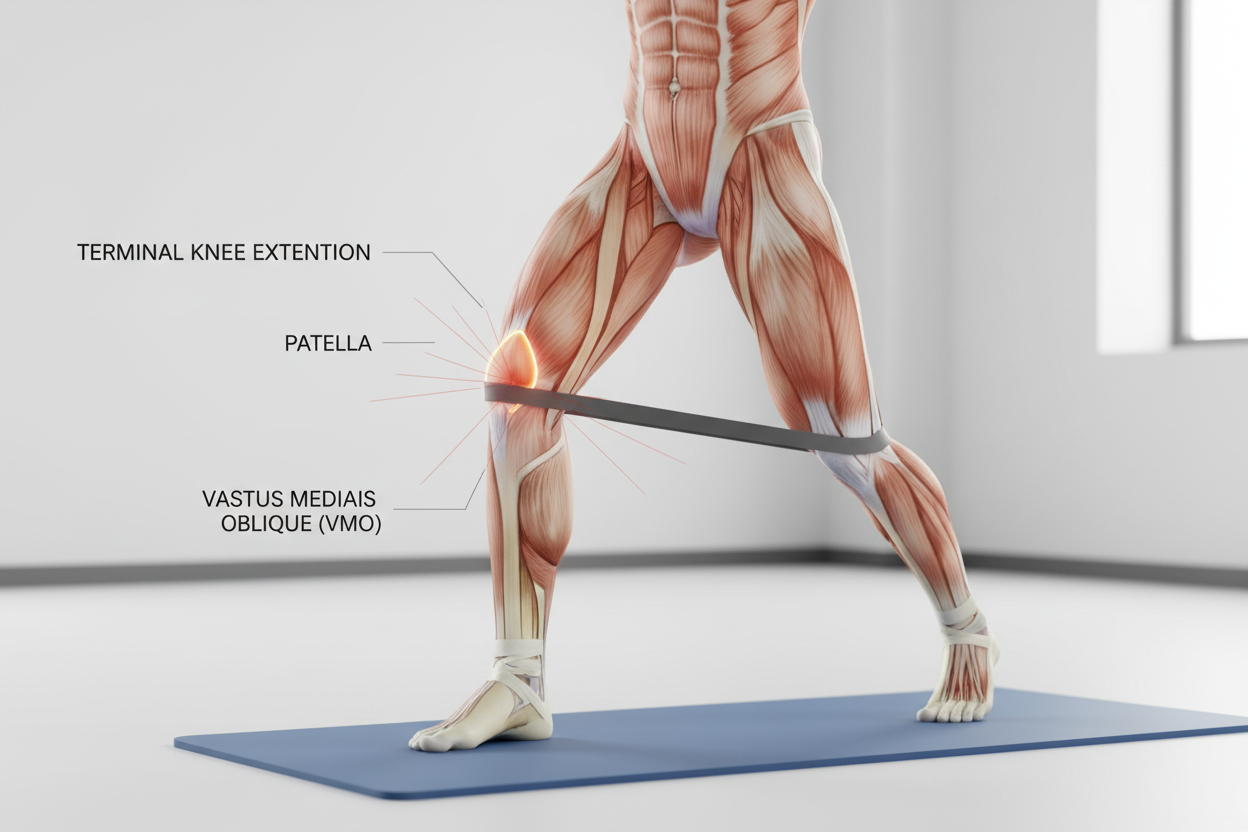
2. Terminal Knee Extensions (TKEs)
This looks simple, but when done with high volume, it is humbling. It isolates that critical last 30 degrees of extension.
The Execution: Loop a thick resistance band around a rack and the back of your knee. Step back to create tension. Let the knee bend slightly, then drive the heel into the ground to lock the leg straight. Squeeze that teardrop muscle hard at the top. Do not rush this.
3. Cyclist Squats
By elevating your heels significantly (on a wedge or block) and keeping your feet close together (hip-width or narrower), you almost entirely remove the hamstrings and glutes from the equation.
The Execution: Keep your torso completely upright. Lower yourself slowly. You should feel the tension directly above your kneecaps. If you lean forward, you are cheating.
My Training Log: Real Talk
I want to be honest about what this actually feels like because the textbook descriptions often miss the reality of VMO training. When I first started rehabbing a minor meniscus tear, I incorporated Poliquin Step-ups. I thought, "I squat 315 lbs, this bodyweight movement will be a joke."
I was wrong. The first thing I noticed wasn't muscle fatigue—it was a violent shaking in my knee when I tried to lower myself slowly. It wasn't a strength issue; it was a stability issue. My VMO had essentially "turned off."
But the specific detail that sticks with me is the sensation during high-rep TKEs. It’s not the deep, burning ache of a heavy squat. It feels like a hot needle right on the medial side of the knee cap. And the pump? It’s weird. Your knee feels "tight" inside the skin, almost like it's wrapped in a pressurized sleeve. If you don't feel that specific, localized pressure right on the teardrop, you are likely using too much hip or moving too fast.
Conclusion
Building the teardrop muscle requires patience and ego-free lifting. You cannot load these movements heavy until your stability is perfect. Implement these adjustments, focus on that final range of motion, and you will learn how to strengthen inner quad muscles effectively for long-term knee health.
Frequently Asked Questions
Can walking help strengthen the inner quad?
Walking generally does not provide enough stimulus to significantly strengthen the VMO, especially if you have an existing imbalance. While walking backward (retro-walking) can engage the quads more than forward walking, targeted resistance exercises like step-ups are required for real strength gains.
How often should I do inner quad exercises?
Since the VMO is a postural and endurance-oriented muscle, it responds well to high frequency. You can perform movements like TKEs or Peterson step-ups 3 to 4 times a week as part of a warm-up or a finisher without overtraining the central nervous system.
Why do I feel pain when trying to strengthen my VMO?
If you feel sharp pain inside the joint, stop immediately. However, VMO exercises often expose weakness, causing the knee to wobble or shake. This shaking is your nervous system learning to stabilize. Reduce the range of motion or use assistance (hold a rack) until the shaking subsides.