Gym Type Flooring Explained: What to Know Before You Buy
Building a home gym is an exciting investment, but too many lifters overlook the foundation. You spend thousands on a shiny new power rack and Olympic bumper plates, only to drop a heavy deadlift and crack your garage's concrete foundation. That is where proper gym type flooring comes in.
Whether you are outfitting a damp basement, a two-car garage, or a spare bedroom apartment setup, your flooring dictates what kind of training you can safely perform. In this guide, we will walk you through the exact materials, thicknesses, and layouts you need to protect your subfloor, your equipment, and your joints.
Key Takeaways
- Thickness matters most: Heavy weightlifting requires at least 3/8-inch (8mm) to 3/4-inch rubber flooring to adequately absorb shock.
- Material dictates durability: Vulcanized rubber is the gold standard for home gyms, far outlasting cheap EVA foam alternatives.
- Moisture control is critical: Garage and basement setups often require a vapor barrier beneath the flooring to prevent mold and mildew.
- Installation style impacts cost: Interlocking tiles offer easy DIY installation, while rolled rubber provides a seamless, commercial-grade look.
Choosing the Right Gym Flooring Material
Not all surfaces are created equal. When evaluating your gym flooring material, you have to balance impact absorption, budget, and long-term durability.
Rubber: The Undisputed King
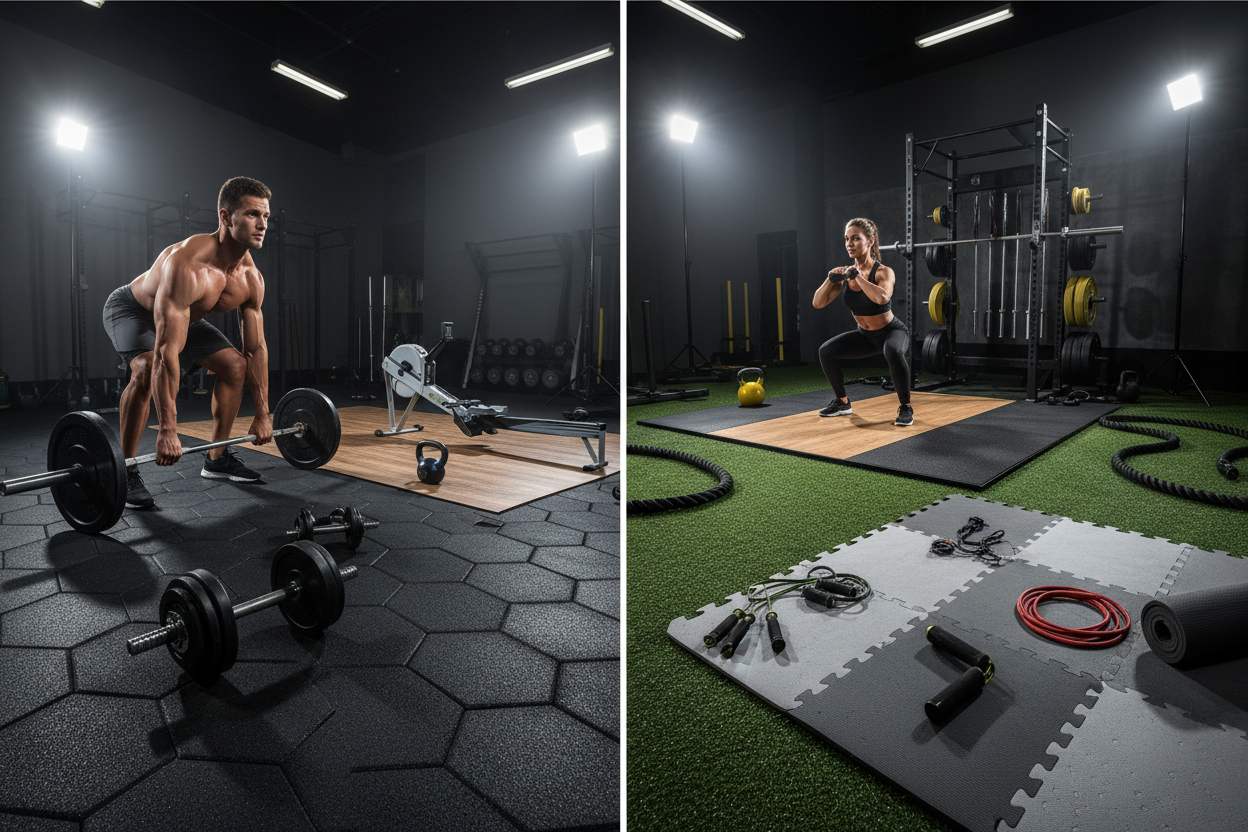
For 90% of home gyms, rubber is the definitive answer. It is ultra-durable, slip-resistant, and absorbs the intense shock of dropped heavy weights. You will typically find it in two formats: interlocking tiles (great for awkward room shapes and easy transport) and large rolled sheets (ideal for seamless, wall-to-wall garage setups).
EVA Foam and Vinyl Options
If your training consists entirely of yoga, light dumbbell circuits, or bodyweight exercises, high-density EVA foam might suffice. However, foam compresses under heavy equipment like treadmills or squat racks, leaving permanent indentations. Vinyl is excellent for multi-purpose rooms and cardio spaces but lacks the shock absorption needed for barbell drops.
The Ultimate Gym Flooring Guide to Thickness
Buying the right material is only half the battle; thickness dictates performance. A comprehensive gym flooring guide always comes down to matching the millimeter count to your specific training style.
Matching Thickness to Your Training Style
If you are mostly doing cardio, yoga, and using light machines, a 1/4-inch (8mm) floor is plenty. For general strength training and dumbbell work, 3/8-inch (10mm) is the sweet spot for budget and protection. But if you are dropping Olympic lifts or heavy deadlifts, you need 1/2-inch to 3/4-inch flooring, often paired with a dedicated wooden lifting platform to fully protect the concrete beneath.
Space Planning for Your Layout
North American home gyms usually fall into two categories: the garage and the basement. Each presents unique flooring challenges.
Garage Gyms vs. Basement Setups
Garages often have sloped floors for drainage and experience massive temperature swings. Heavy rolled rubber is ideal here because it expands and contracts less than interlocking tiles. Basements, on the other hand, fight moisture. Always check your concrete for dampness; you may need to lay down a dimpled plastic underlayment before dropping your rubber mats to allow airflow and prevent mildew.
From Our Gym: Honest Take
Over the years, I have built out three different personal home gyms. For my first garage setup, I tried to save money by using cheap, 1/2-inch EVA foam puzzle mats. It was a complete disaster. Within two months, my power rack had punched permanent divots into the foam, and the mats constantly pulled apart during kettlebell swings.
I eventually upgraded to 3/4-inch vulcanized rubber horse stall mats. The grip is phenomenal, and my chalked deadlift stance feels incredibly locked in. I can drop a 315-pound barbell without waking up the whole house. The only caveat? They smell strongly of sulfur for the first few weeks. If you go this route, you absolutely need to leave them outside in the sun to off-gas before bringing them into a poorly ventilated basement.
Frequently Asked Questions
What are the best types of gym flooring for heavy lifting?
The best types of gym flooring for powerlifting and Olympic weightlifting are high-density vulcanized rubber mats or rolls, specifically in 1/2-inch to 3/4-inch thicknesses. Pair these with a plywood lifting platform for maximum subfloor protection.
Do I need plywood under my gym flooring?
If you are dropping heavy barbells directly onto a concrete foundation, yes. Even 3/4-inch rubber cannot disperse all the kinetic energy of a 400-pound drop. A layer of 3/4-inch OSB or plywood under your rubber acts as a crucial force disperser.
How do I clean and maintain rubber gym floors?
Keep it simple. Vacuum up chalk dust and debris regularly. For mopping, use a pH-neutral cleaner mixed with warm water. Avoid harsh chemicals like bleach or ammonia, which will break down the rubber binders over time and cause the flooring to crumble.