Machines Gym Names: The Definitive Equipment Guide
Walking into a fitness center for the first time feels a lot like entering a cockpit without flight school training. You see cables, stacks of iron, and seats at strange angles, but you aren't sure what any of it actually does. This confusion is normal, but it shouldn't keep you from a great workout.
Knowing the correct terminology isn't just about sounding smart; it is about safety and efficiency. When you understand the specific machines gym names, you can follow workout programs accurately and ask staff for help without feeling awkward. Let’s decode the gym floor so you can train with intent.
Key Takeaways: Gym Equipment Terminology
If you are in a rush, here is the quick breakdown of the primary categories you will encounter on the floor. This list covers the essentials of what are the machines at the gym called:
- Selectorized Machines: Equipment with a weight stack and a pin (e.g., Chest Press, Leg Extension). Great for beginners.
- Plate-Loaded Machines: Machines where you manually add round iron plates (e.g., Hack Squat, Hammer Strength rows).
- Cable Stations: Versatile pulley systems (e.g., Cable Crossover, Lat Pulldown) providing constant tension.
- Smith Machine: A barbell fixed within steel rails for vertical movement only.
- Cardio Equipment: Endurance tools like Treadmills, Ellipticals, and Stair Climbers.
Decoding Upper Body Weight Machine Names
Upper body equipment is usually split into "push" (chest, shoulders, triceps) and "pull" (back, biceps) movements. Understanding these gym equipment terms helps you structure a balanced routine.
The Chest Press and Pec Deck
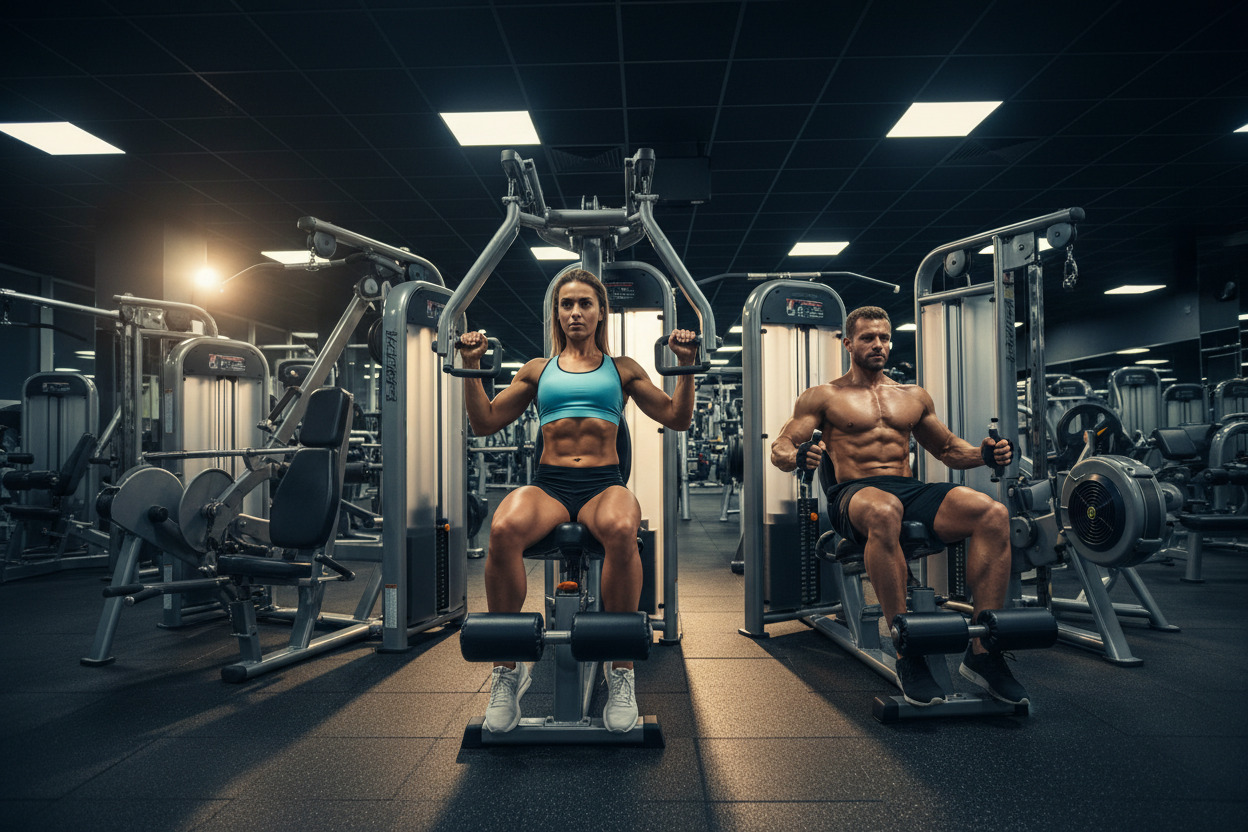
The Chest Press is the machine equivalent of a push-up or bench press. You sit upright and push handles away from your chest. It creates a fixed path of motion, which removes the need to balance the weight. This is often the first stop for beginners learning weight lifting equipment names.
The Pec Deck (or Machine Fly) looks different. You sit with your arms out to the sides, bringing them together in front of your face. It isolates the pectoral muscles without involving the triceps much.
The Lat Pulldown and Seated Row
If you see a machine with a long bar hanging from a cable above a seat, that is the Lat Pulldown. It mimics a pull-up. The key here is to pull the bar down to your upper chest, not behind your neck.
The Seated Row (often a cable machine) involves sitting on a bench and pulling a handle toward your stomach. This targets the thickness of your back. In terms of gym stuff names, you might hear this referred to simply as the "Cable Row."
Lower Body Weight Gym Equipment Names
Leg machines are massive and can look intimidating, but they are generally safer than heavy free-weight squats when you are learning the ropes.
The Leg Press
This is the large sled-like machine where you sit reclined and push a platform away with your feet. It allows you to move heavy loads safely because your back is supported against a pad. It is a staple in almost every facility.
Leg Extension and Leg Curl
These are isolation machines. The Leg Extension involves sitting and kicking your legs upward against a padded roller; this targets the quadriceps (front of the thigh). Conversely, the Leg Curl involves bending your knees to bring your heels toward your glutes, targeting the hamstrings. You will find both seated and lying variations of the Leg Curl.
The "Swiss Army Knife" of Gym Weights Name: The Cable Tower
Often called the Cable Crossover or Functional Trainer, this isn't just one machine. It consists of adjustable pulleys on either side. You can attach handles, ropes, or bars to it.
Because the cables allow freedom of movement, this equipment bridges the gap between fixed machines and free weights. It provides constant tension on the muscle throughout the rep, something standard gravity-based weights don't always do.
My Training Log: Real Talk
I want to pause the technical definitions and share a bit of reality regarding my personal experience with machines gym names and actually using them. It’s easy to read a manual; it’s another thing to feel the gear.
Take the Hack Squat machine, for example. On paper, it's just a leg press alternative. But the first time I loaded it up heavy, I realized something the diagrams don't tell you: the shoulder pads can be brutal. I remember wearing a thin tank top and feeling the textured vinyl dig into my traps so hard it left red welts that looked like a sunburn.
There is also the "Smith Machine friction." I used to train at a gritty basement gym where the guide rails were rarely oiled. I remember the specific, stuttering vibration in my palms as I lowered the bar—it wasn't a smooth glide; it was a gritty slide that actually made the eccentric part of the lift harder than the concentric. You learn quickly that knowing the name of the machine is step one, but knowing the quirks of the specific unit in your gym is where the real training happens.
Conclusion
The gym floor doesn't have to be a labyrinth. Once you can identify the weight machine names and understand their primary functions, the anxiety disappears. You stop worrying about looking foolish and start focusing on your progressive overload. Start with the selectorized machines, get comfortable with the movement patterns, and then explore the cable stations. You belong there just as much as anyone else.
Frequently Asked Questions
What are the machines at the gym called for cardio?
The most common cardio machines are the Treadmill (running), Elliptical (low-impact gliding), Stationary Bike (cycling), and the Stair Climber (often called the StepMill). You might also see Rowing Machines (ergs) which provide a full-body cardio workout.
Is there a difference between "machines" and "free weights"?
Yes. Machines (like the Chest Press) lock you into a fixed path of motion, stabilizing the weight for you. Free weights (dumbbells, barbells) require you to stabilize the load yourself, which engages more stabilizer muscles but requires more skill to perform safely.
What is the best machine for a beginner to start with?
The Leg Press and the Chest Press are excellent starting points. They target major muscle groups, are easy to adjust, and have a low risk of injury compared to free-weight squats or bench presses.