The Vertical Leg Press Smith Machine Technique You Need
You walk into the gym on leg day, and the standard 45-degree leg press is taken. Or worse, your gym doesn't even have one. Do you skip your heavy accessory work? Absolutely not. You head straight for the open rack to execute the **leg press smith machine** variation.
This exercise, often called the vertical leg press, turns the Smith machine into a mass-building powerhouse. However, it requires a level of precision and safety awareness that standard machines do not. If you set this up wrong, it’s not just ineffective; it’s dangerous. But get it right, and you unlock a degree of quad isolation that is hard to replicate with free weights alone.
Key Takeaways: Quick Summary
- Vertical Gravity: Unlike the 45-degree press, the vertical leg press on smith machine provides direct vertical load, increasing tension on the quads.
- Safety Stops are Non-Negotiable: Never attempt this movement without setting the safety catches to prevent the bar from crushing you if you fail a rep.
- Footwear Matters: Flat-soled shoes with good grip are essential to prevent the bar from slipping off your feet.
- Back Position: Keep your lower back glued to the floor (or mat) to protect your lumbar spine during the smith leg press.
Why the Vertical Leg Press on Smith Machine Works
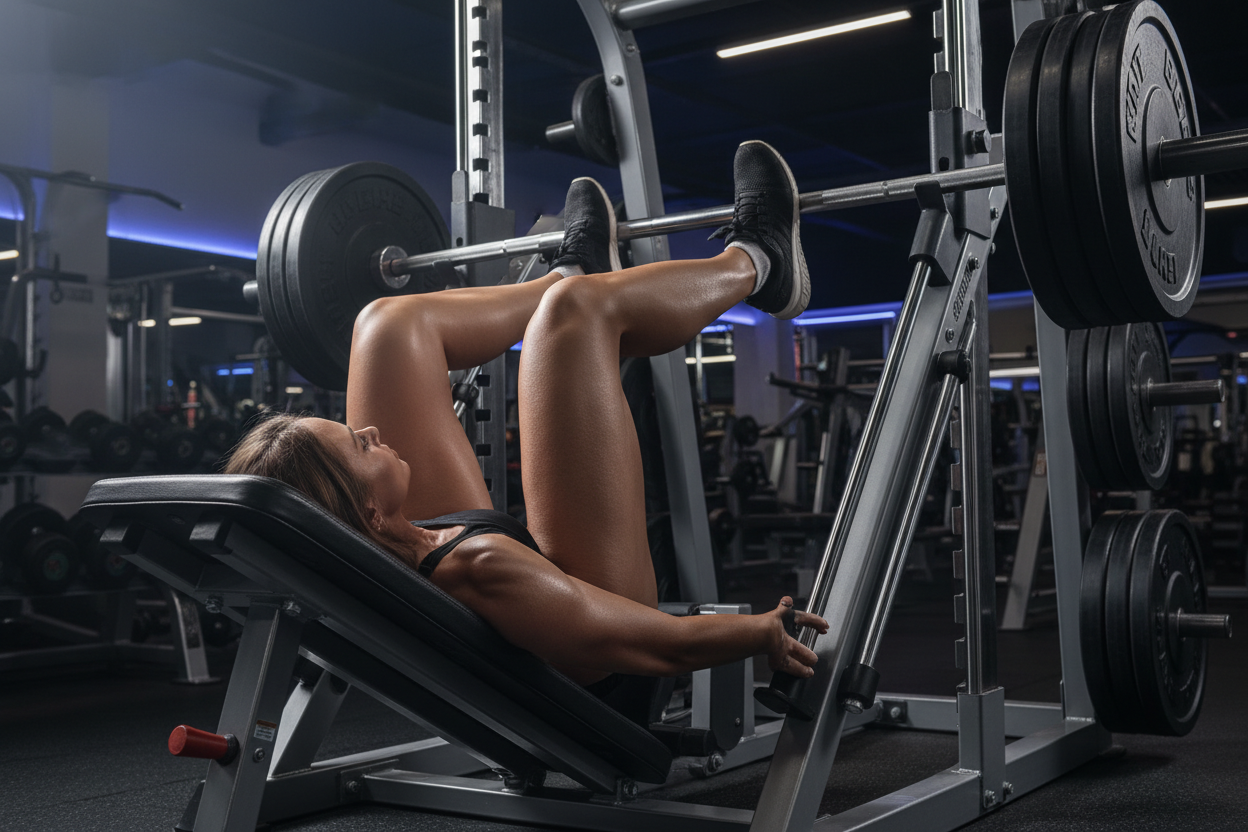
The physics here are different from a standard squat or angled press. When you perform a smith machine vertical leg press, you are lying flat on your back with your legs extending straight up. This removes the mechanical advantage usually provided by a 45-degree angle.
Because the weight moves vertically against gravity, 200 pounds here feels significantly heavier than 200 pounds on a standard sled. This position also removes axial loading (spinal compression), allowing you to blast your legs without straining your lower back—provided your form is locked in.
How to Set Up the Leg Press on Smith Machine
1. The Safety Setup
Before you even think about loading plates, set the safety stoppers. This is the most critical step for a leg press for smith machine setup. Adjust the stops so they are slightly below your active range of motion. If your foot slips or your legs give out, the bar must hit the stops, not your chest.
2. Positioning Your Body
Lie on the floor (use a yoga mat for comfort) directly under the bar. Your hips should be positioned so that the bar lines up with your mid-foot. If your hips are too far forward or back, you create shear force on your knees or lower back. You want a straight line of force.
3. The Unrack and Descent
Place the arches of your feet against the bar. Extend your legs to press the bar up, then rotate your feet slightly to disengage the hooks. Grip the uprights of the machine with your hands for stability. Lower the bar slowly—aim for a 3-second eccentric phase—until your thighs are near your chest. Do not let your butt lift off the floor (the "butt wink"), as this compromises your lumbar spine.
Common Mistakes with the Smith Leg Press
The most frequent error I see is wearing the wrong shoes. Running shoes with curved, squishy soles are a recipe for disaster. The bar needs a flat, stable surface to bite into. If the bar rolls, it rolls toward your face.
Another issue is ego lifting. Because this is a smith machine leg press, people assume they can load it up like a standard machine. Start with just the bar or very light weight to get used to the balance. The vertical path creates instability in your hips that you aren't used to.
My Personal Experience with Leg Press Smith Machine
I want to be real about the first time I added this to my rotation. I had read about the "vertical leg press" in old-school bodybuilding magazines and thought it looked easy. It wasn't.
The first thing I noticed wasn't the muscle pump—it was the fear factor. Lying on the floor with a knurled metal bar balancing on the soles of my Converse is a mental hurdle. I specifically remember the feeling of the bar's center knurling digging into the rubber of my shoe. It felt secure, but only because I was using flat soles. I tried it once in cross-trainers, and the wobble was terrifying; I racked it immediately.
Also, nobody warns you about the blood rush. After a heavy set of 12 reps, standing up too quickly gave me a massive head rush because my legs had been elevated for 45 seconds. Now, I take a solid 30 seconds to sit up before standing. It’s a brutal exercise for quad separation, but you have to respect the setup.
Conclusion
The leg press smith machine isn't just a backup exercise; it's a legitimate mass builder that spares your spine. By mastering the vertical leg press on smith machine, you can target your quads with surgical precision. Just remember: flat shoes, safety stops engaged, and leave your ego at the door.
Frequently Asked Questions
Is the Smith machine leg press safe?
Yes, but only if you use the safety stoppers. The smith leg press carries a risk of the bar slipping off your feet. By setting the safety catches high enough to stop the bar before it hits your body, you mitigate the danger. Proper footwear is also essential for safety.
How much weight should I use compared to a regular leg press?
You will need significantly less weight. A standard leg press moves on a 45-degree angle, which distributes the load differently. The smith machine vertical leg press moves directly against gravity. Start with 50% of your usual working weight and adjust from there.
Can I do single-leg presses on the Smith machine?
Absolutely. The leg press for smith machine is excellent for unilateral work. Doing one leg at a time helps fix muscular imbalances. Just ensure your foot is centered on the bar to prevent the barbell from tilting, even though the Smith machine rails provide guidance.