The Underrated Core Builder: Mastering Leg Lifts Without a Gym Membership
Most people chasing a stronger core default immediately to crunches. While there is nothing inherently wrong with a standard crunch, it often neglects the lower section of the abdominal wall and fails to address hip stability. If you want a functional, bulletproof midsection, you need to incorporate movements that challenge your stability and target the lower abs. This is where the leg lift shines. It is a deceptive exercise—looking simple to the observer but feeling incredibly intense for the person performing it. The best part is that you can effectively perform leg lifts at home with zero equipment, making them a staple for anyone looking to upgrade their living room fitness routine.
The Mechanics: How to Do Leg Lifts at Home Correctly
Let’s get straight to the technique. Executing this move with poor form won't just waste your time; it can strain your lower back. The goal isn't just to move your legs up and down, but to use your core to control the weight of your legs against gravity.
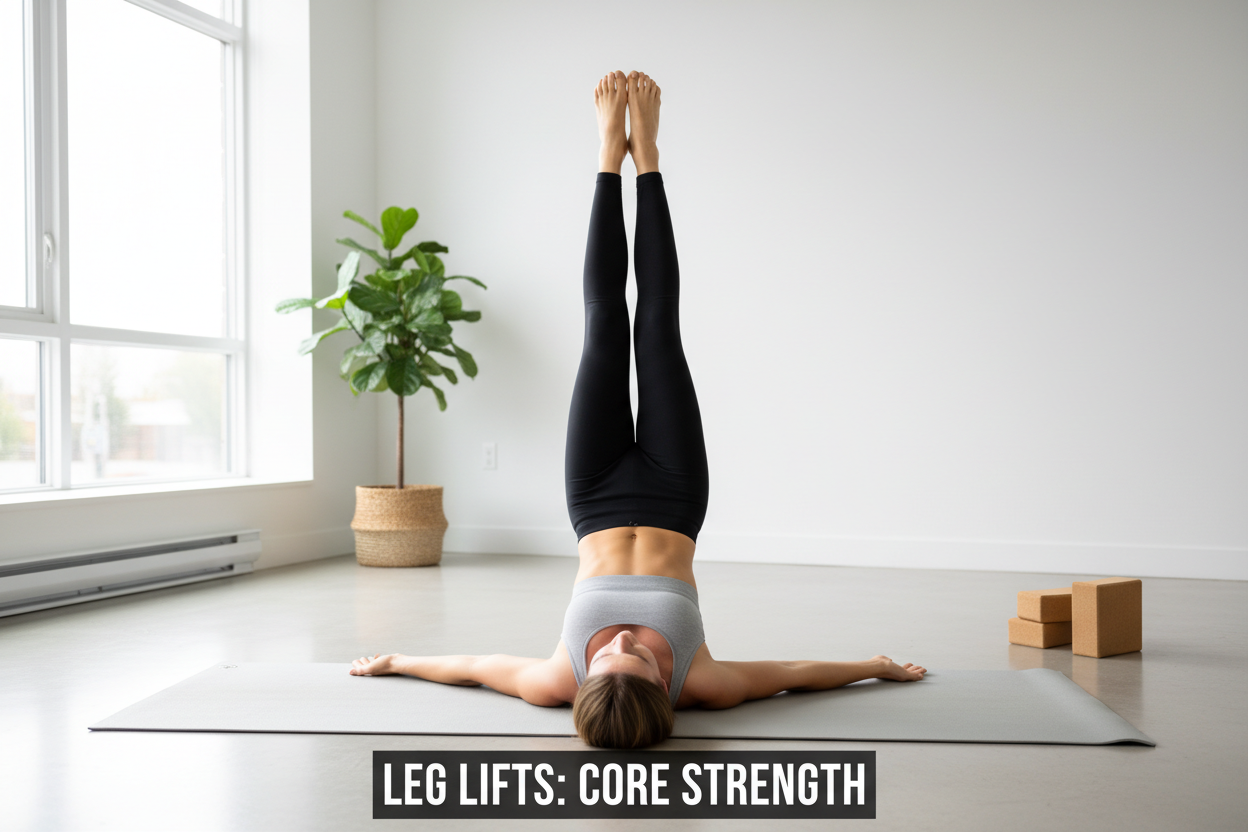
Start by lying flat on your back. You can use a yoga mat for comfort, but a carpeted floor works just as well. Your legs should be extended straight out in front of you, and your toes can be slightly pointed or neutral. Place your hands strictly by your sides, palms facing down. If you are new to this movement or suffer from lower back sensitivity, wedging your hands slightly under your glutes can provide necessary pelvic support.
Engage your core by imagining you are trying to pull your belly button through to the floor. This eliminates the gap between your lower back and the mat. Keeping your legs pressed together, inhale and lift them toward the ceiling until your hips form a 90-degree angle. Your body should look like an 'L' shape. Exhale as you slowly lower your legs back down. Stop just a few inches above the floor—do not let your heels touch the ground if you want to maintain tension—and immediately begin the next rep.
Why This Move Humbles Even Fit Athletes
I remember the first time I took leg lifts seriously. I was a runner who thought I had a decent level of fitness because I could hold a plank for two minutes. During a session with a physical therapist to address some nagging hip pain, she asked me to do ten slow leg lifts. By repetition four, my abdominal muscles were shaking violently, and I was fighting the urge to arch my back. It was a wake-up call. I realized my "strength" was mostly compensation from other muscle groups. Once I isolated the core with leg lifts, I discovered a massive weak link in my chain. Integrating them into my weekly routine didn't just give me better aesthetic definition; it completely resolved my lower back fatigue during long runs.
Common Mistakes That Kill Your Progress
The most pervasive error during leg lifts at home is the "anterior pelvic tilt," or the arching of the lower back. As your legs lower toward the ground, the weight becomes heavier due to leverage. If your abs aren't strong enough to stabilize the pelvis, your lower back takes over and arches up off the floor. This puts immense pressure on the lumbar spine. If you feel pain in your back, you aren't training your abs anymore; you are straining your spine.
Another issue is rushing the eccentric phase (the lowering part). Gravity wants to pull your legs down quickly. Fighting that urge is where the real muscle-building magic happens. A fast leg lift uses momentum; a slow leg lift uses muscle. Aim for a count of one second up, and three seconds down.
Modifications for Every Fitness Level
You don't need to be an elite gymnast to start. If the standard version causes your back to peel off the floor, shorten the lever arm. Instead of keeping your legs straight, bend your knees at a 90-degree angle. Perform the lifting and lowering motion with bent knees. This reduces the load on the core while still training the correct movement pattern.
Alternatively, try single-leg lifts. Keep one leg bent with the foot flat on the floor for stability, and lift the other leg. This allows you to focus entirely on engaging the core without the overwhelming weight of both legs. As you get stronger, you can extend the resting leg straight on the floor, and eventually graduate to lifting both legs simultaneously.
For those looking to increase the intensity, add a "pulse" at the top of the movement. When your legs reach the 90-degree angle, use your lower abs to lift your hips an inch or two off the floor, pushing your feet toward the ceiling. This small addition significantly increases activation in the deepest abdominal layers.
Anatomy of the Movement: Abs vs. Hip Flexors
There is often confusion about what muscles are actually working here. Leg lifts are a compound movement that primarily targets the rectus abdominis (specifically the lower region) and the hip flexors (iliopsoas). Because the hip flexors attach to the spine, tight or overactive hip flexors can pull on the lower back, causing that dreaded arch.
The key to making this an ab exercise rather than just a hip workout is the posterior pelvic tilt—that action of pressing the lower back down. By actively fighting against the pull of the hip flexors with your abdominal wall, you create a high-tension environment that strengthens the core and improves the flexibility and health of the hips simultaneously.
Integrating Leg Lifts into Your Routine
You don't need to dedicate an entire hour to abs. Leg lifts fit perfectly at the end of a workout as a "finisher" or as part of a morning mobility routine. Since you are learning how to do leg lifts at home, you have the flexibility to do them whenever you have five minutes. Try three sets of 10 to 15 repetitions. Focus on quality over quantity. Ten reps done with agonizingly slow control are worth more than 50 reps where you are swinging your legs wildly.
Consistency is the secret ingredient. The lower abs are notoriously stubborn because they are often underused in daily life compared to the upper abs, which help us sit up or bend over. By dedicating a few minutes every other day to this movement, you build a foundation of strength that translates to better posture, improved athletic performance, and a healthier back.
Frequently Asked Questions
Why do my hips click when I do leg lifts?
A clicking sound usually comes from a tight tendon snapping over the hip bone, often the hip flexor or IT band. It is generally harmless if painless, but you can minimize it by reducing your range of motion (don't lower your legs as far) or stretching your hip flexors before the workout.
Can leg lifts burn belly fat?
No exercise can spot-reduce fat from a specific area. Leg lifts will strengthen and build the muscle underneath the fat, which can improve the appearance of the midsection, but fat loss occurs through a combination of nutrition and overall calorie expenditure.
How often should I do leg lifts?
Treat your abs like any other muscle group; they need recovery to grow. Aim for 3 to 4 times per week rather than every single day. This allows the muscle fibers to repair and strengthen between sessions.