The Truth About Squats: Are They Really Necessary for Big Legs?
If you have ever walked into a gym and felt overwhelmed by the sheer number of machines dedicated to the lower body, you aren't alone. Between the leg press, the leg extension, and various curl machines, it is easy to wonder if you actually need to get under a barbell. But if you are asking yourself, does squats build leg muscle, the short answer is a resounding yes. In fact, they are arguably the single most effective movement for developing lower body mass and strength.
Squats are often called the king of exercises for a reason. They don't just target one specific area; they trigger a systemic growth response that isolation exercises struggle to replicate. While machines have their place for fine-tuning, the squat remains the foundation of almost every successful leg development program.
My Love-Hate Relationship with the Squat Rack
I distinctly remember my first year of serious training. I wanted impressive legs, but I was terrified of the squat rack. It felt dangerous, and frankly, it was embarrassing to struggle with weights that looked light compared to what the regulars were lifting. So, I stuck to the leg press. I could load up plate after plate and feel strong, yet my legs barely changed size.
It wasn't until a mentor figure in the gym pulled me aside and corrected my program that things shifted. He stripped the weight off, forced me to focus on depth and technique with just the bar, and made me squat twice a week. It was humbling. Walking down stairs the next day was agony. However, within three months, my pants started fitting tighter around the thighs. That experience taught me that avoiding the hard work of stabilization and balance was exactly what was holding my progress back.
The Mechanics: How Do Squats Work Legs?
To understand the effectiveness of this movement, we need to look at anatomy. When people ask, do squats work legs, they often underestimate just how much of the lower body is involved. It is a compound movement, meaning it requires movement across multiple joints—specifically the hips, knees, and ankles—simultaneously.
The primary movers are the quadriceps (front of the thigh) and the gluteus maximus (buttocks). As you descend, your hamstrings act as stabilizers for the knee joint, and your adductors (inner thigh muscles) work hard to keep your legs in position. Even your calves get involved to stabilize the ankle. Because you are balancing a load against gravity, your core and lower back are also forced to engage isometrically to protect your spine. This level of muscle recruitment creates a high metabolic demand, which is a fancy way of saying it shocks your body into growing.
Hypertrophy and Intensity
Simply performing the motion isn't enough. To answer the nuance of do squats build leg muscle effectively, we have to look at intensity and progressive overload. Your legs are accustomed to carrying your body weight around all day. To force them to grow, you need to present them with a challenge they aren't used to.
This usually means adding weight over time. Hypertrophy, or muscle growth, occurs when muscle fibers sustain microscopic damage during exercise and then repair themselves thicker and stronger during rest. Squats allow for almost infinite progressive overload. You can add five pounds to the bar every week for a long time before hitting a ceiling. This continuous increase in mechanical tension is the primary driver of growth.
Form Checks and Common Pitfalls
The biggest reason people claim squats don't work for them is usually poor technique. If you aren't hitting the right depth, you are shortchanging your gains. Partial reps—often called "ego lifting"—might allow you to put more weight on the bar, but they reduce the activation of the glutes and hamstrings significantly.
Aim for your hip crease to drop below the top of your knee (breaking parallel). This ensures the muscles are stretched under load, which is critical for growth. Another common issue is letting the knees cave inward. This puts stress on the joints rather than the muscles. Pushing your knees outward as you stand up engages the hips properly and keeps the tension where it belongs.
Variations for Different Goals
Not all squats are created equal, and depending on your body mechanics, one variation might suit you better than another.
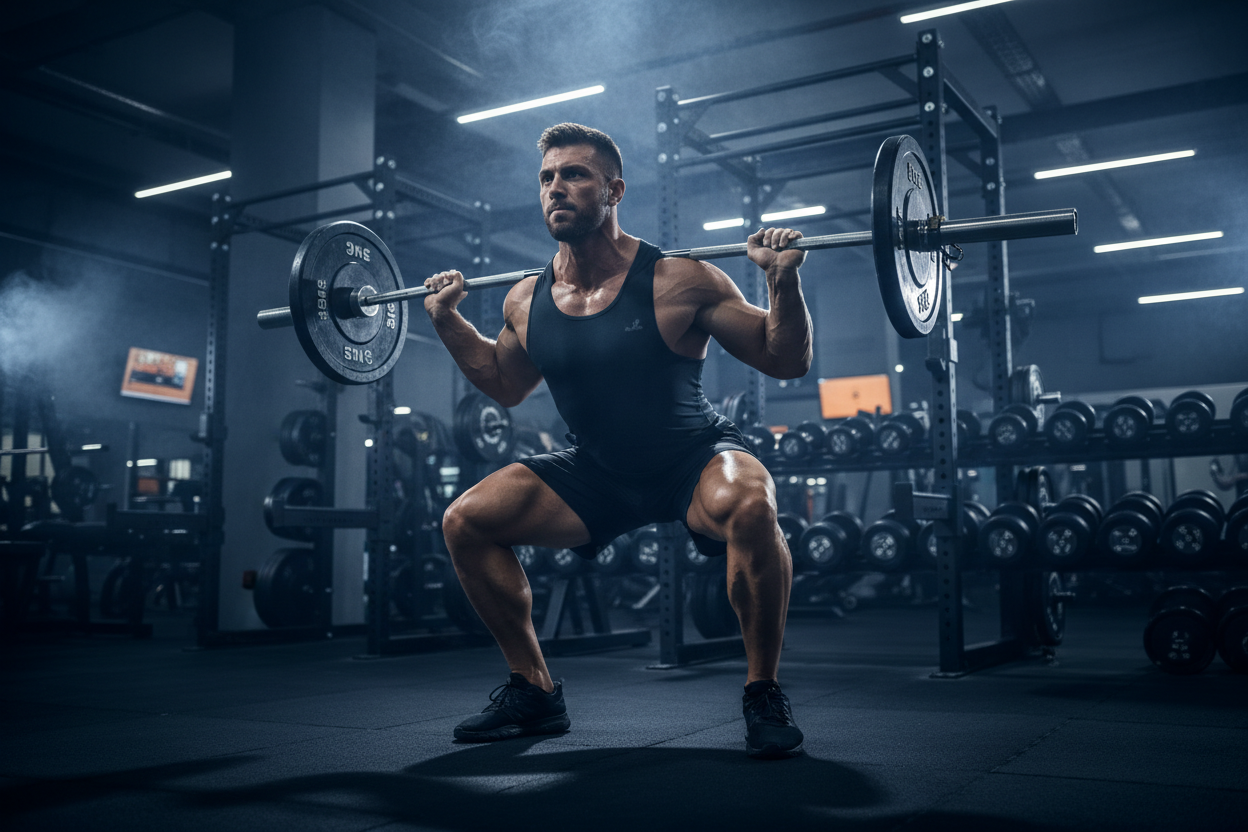
- High-Bar Back Squat: The most common variation for bodybuilders. The bar rests on your traps, keeping your torso relatively upright. This places the majority of the emphasis on the quadriceps.
- Low-Bar Back Squat: The bar sits lower on the rear delts. This forces you to lean forward more, shifting more load onto the posterior chain (glutes and hamstrings). This is generally the preferred style for powerlifters moving maximum weight.
- Front Squat: The bar is held across the front of the shoulders. This forces an upright posture and is brutal on the quads and upper back. If you want to isolate the front of the legs without as much lower back strain, this is a great option.
Do You Have to Squat Heavy?
There is a misconception that you must lift car-sized weights to see results. While heavy loads (1-5 reps) are great for strength, muscle building often happens in the 8-12 rep range, or even higher. High-repetition squats are mentally and physically draining, often leaving you breathless, but they are incredible for driving blood into the muscle and creating metabolic stress.
If you have back issues or lack the equipment for heavy loading, you can still build muscle by slowing down the tempo. Taking three seconds to lower yourself and pausing at the bottom removes momentum and forces the muscles to do all the work. This increases "time under tension," a key factor in muscle development.
The Verdict
If your goal is a balanced, powerful physique, skipping this movement is a mistake. While you can build legs with a combination of other exercises, nothing is quite as efficient. Squats teach your body to move as a unit, improve your balance, increase your bone density, and pack on mass. So, the next time you wonder, do squats build leg muscle, just look at the legs of any competitive powerlifter or bodybuilder. The proof is in the results.
Frequently Asked Questions
Do squats ruin your knees?
Generally, no. When performed with proper form, squats actually strengthen the tendons and ligaments surrounding the knee, making them more resilient. Knee pain usually stems from poor mobility, caving knees, or pre-existing injuries, not the exercise itself.
Can I build big legs with just bodyweight squats?
Bodyweight squats are excellent for beginners, but you will eventually hit a plateau where the resistance isn't enough to stimulate growth. To continue building muscle mass, you will eventually need to add external weight or switch to difficult variations like pistol squats.
How often should I squat?
For most people, squatting 2 times per week is the sweet spot. This frequency allows you to stimulate the muscles enough to grow while providing adequate recovery time (48-72 hours) between sessions to prevent overtraining.