The Power Rack Sizing Guide Every Home Gym Owner Needs to Read
When I first decided to set up a proper home gym, I spent weeks researching equipment, watching videos, and honestly, overthinking every single purchase. The one piece of kit that had me measuring my garage about fifteen times? The power rack. It's the cornerstone of any serious strength training setup, but getting the dimensions wrong can turn your dream gym into a cramped nightmare. Let me walk you through everything you need to know about power rack sizing so you can make the right choice first time.
Understanding Power Rack Dimensions: The Basics
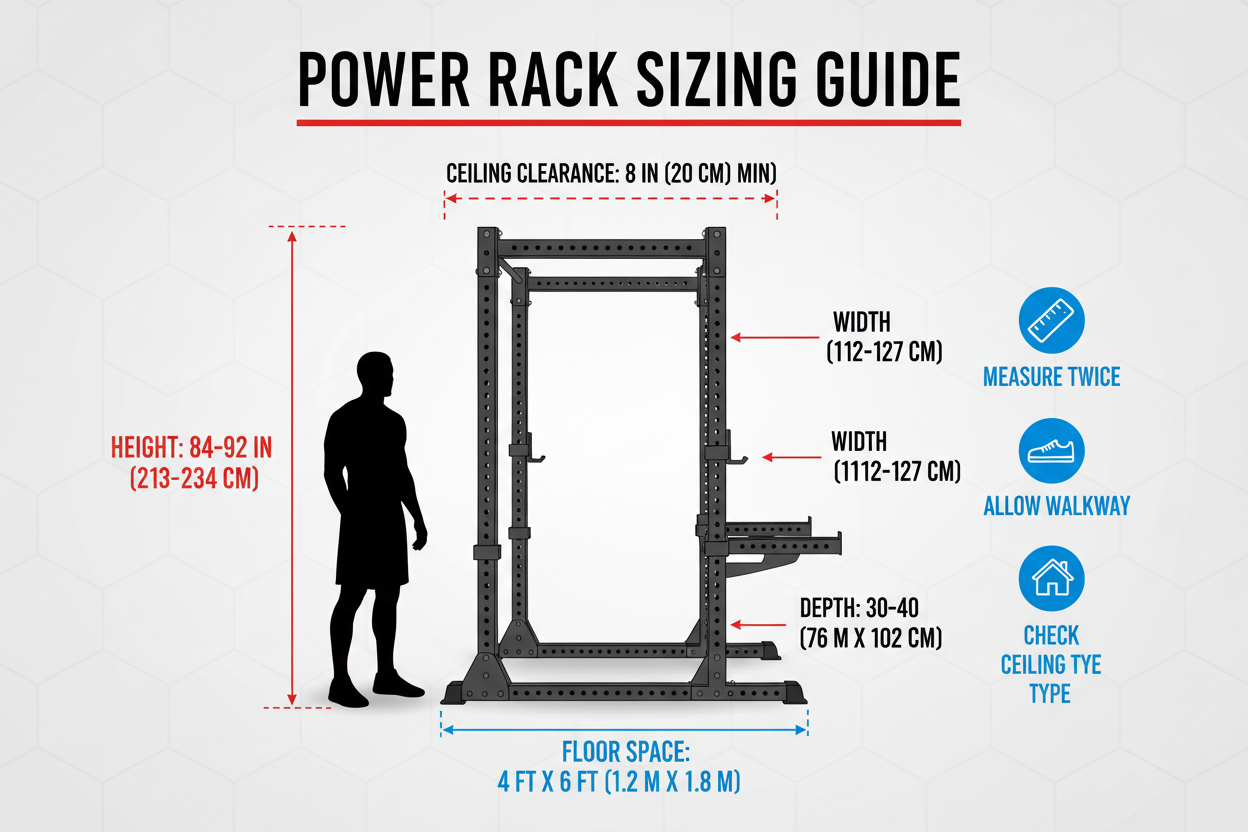
A power rack, also called a squat cage or power cage, is essentially a four-posted steel frame with adjustable safety bars and J-hooks. The standard squat rack dimensions typically fall within a specific range, but there's more variation than you might think. Most commercial-grade power racks measure between 48 to 50 inches wide, 48 to 54 inches deep, and here's the kicker – they range from 82 to 90 inches tall. That height measurement is crucial, especially if you're setting up in a garage or basement with lower ceilings.
The power rack size you choose depends on several factors: your available space, ceiling height, the exercises you plan to do, and whether you'll be using attachments like lat pulldown systems or dip bars. I learned this the hard way when I nearly ordered a rack that would have left me with just inches of clearance above – not ideal when you're lifting a loaded barbell overhead.
How Tall Is a Power Rack? Breaking Down the Height Factor
So, how tall is a power rack exactly? The answer isn't one-size-fits-all. Entry-level racks designed for home use often start at around 82 inches (just under 7 feet), which works brilliantly for standard residential spaces with 8-foot ceilings. Mid-range models typically measure 84 to 87 inches, while professional-grade racks can reach 90 inches or even taller when you factor in pull-up bar attachments.
Here's what many people don't consider: you need clearance above the rack. If you're doing pull-ups or using the top-mounted pull-up bar, you'll want at least 10 to 12 inches of space between the top of the rack and your ceiling. This gives you room to actually perform the movement without smacking your head. Trust me, training with proper form is hard enough without worrying about ceiling clearance.
For those with lower ceilings – say 7 to 7.5 feet – there are shorter power rack options available, sometimes called "low-ceiling racks" or "compact power racks." These modified versions typically stand around 72 to 78 inches tall, sacrificing some versatility but making home training possible in spaces that would otherwise be unsuitable.
Width and Depth: The Often Overlooked Dimensions
While height gets most of the attention, the width and depth of your power rack matter just as much for functionality and safety. The standard width of 48 to 50 inches provides enough space for a 7-foot Olympic barbell to sit comfortably on the J-hooks with room to spare. This measurement is fairly consistent across brands because it's dictated by the standard length of barbells.
The depth, however, varies more significantly. A rack that's 48 inches deep gives you adequate space for squatting and benching, but if you plan to add attachments or want more room to move, you might prefer something in the 54-inch range. I opted for a slightly deeper rack because I knew I'd eventually add a lat pulldown attachment, and I'm so glad I did. The extra depth makes the whole setup feel less cramped and gives me proper clearance when stepping in and out of the rack with a loaded barbell.
Interior Spacing: The Dimension That Affects Your Training
Here's something many first-time buyers overlook: the interior width of the rack. This is the space between the uprights where you'll actually be lifting. Most power racks have an interior width of 42 to 49 inches. This might not sound like much variation, but it makes a real difference when you're squatting or benching.
A narrower interior (around 42 inches) can feel restrictive if you have a wider stance or if you're used to commercial gym equipment. On the flip side, a wider interior (48 to 49 inches) gives you more freedom of movement but requires more overall floor space. I've trained in both, and personally, I prefer the 47 to 48-inch interior width – it's that sweet spot where you have room to move without the rack taking over your entire gym space.
Measuring Your Space: The Critical First Step
Before you fall in love with any particular power rack, grab a tape measure and get realistic about your available space. You'll need to account for more than just the rack's footprint. Here's what I recommend measuring:
First, measure your ceiling height at the exact spot where the rack will go. Garages and basements often have beams, ductwork, or sloped ceilings that can affect placement. Add at least 10 inches to your desired rack height to ensure you have working clearance.
Second, measure your floor space and add at least 2 to 3 feet on all sides of the rack. You'll need room to load and unload plates, walk around the equipment, and potentially add a bench or other accessories. When I set up my rack, I initially thought I could squeeze it into a tighter space, but after actually using it for a week, I realized I needed to rearrange to give myself proper working room.
Third, consider the path you'll use to get the rack into your space. Power racks are heavy and awkward to move. Make sure doorways, hallways, and staircases can accommodate the packaged dimensions, which are often different from the assembled size.
Adjustability and Hole Spacing
The hole spacing on your power rack's uprights determines how precisely you can adjust the safety bars and J-hooks. Commercial racks often feature 1-inch hole spacing in the bench press zone (roughly 20 to 50 inches from the ground) and 2-inch spacing elsewhere. This gives you fine-tuned adjustability where it matters most.
Budget racks might have 2 or 3-inch spacing throughout, which can be frustrating when you're trying to set the perfect height for bench press or find the ideal safety bar position. I've trained with both, and while you can make do with wider spacing, the 1-inch spacing in key zones is worth paying extra for if your budget allows.
Making the Final Decision
Choosing the right power rack size comes down to balancing your space constraints with your training needs. If you're working with a standard garage or spare room, a rack that's 84 inches tall, 48 inches wide, and 48 to 54 inches deep will serve most people brilliantly. This gives you the versatility to squat, bench, do pull-ups, and add attachments without overwhelming your space.
For those with ceiling limitations, don't compromise on safety by choosing a rack that's too tall. A shorter rack that fits your space properly is infinitely better than a taller one that restricts your movement or creates a safety hazard. And remember, the most expensive rack in the world is useless if it doesn't fit your space or meet your actual training needs.
Setting up a home gym is one of the best investments you can make in your fitness journey. Taking the time to properly measure, research, and choose the right power rack dimensions ensures you'll have a safe, functional training space that serves you for years to come. Your future self will thank you for getting it right the first time.