The Only Dumbbell Glute Workout You Need for Real Growth
You do not need a barbell or a crowded squat rack to build impressive, strong glutes. While heavy compound lifts have their place, dumbbells offer a unique advantage: they allow for a greater range of motion and force each side of your body to work independently, correcting imbalances that a barbell might hide. If you are looking for the best dumbbell glute exercises to transform your lower body, the answer lies in mastering the hip hinge, unilateral movements, and loaded stretching.
Many lifters assume that without hundreds of pounds on their back, they cannot stimulate hypertrophy. That is simply untrue. By manipulating tempo, increasing time under tension, and perfecting your form on specific movements like Romanian deadlifts and split squats, you can achieve results that rival any heavy barbell session. Let’s look at how to structure a routine that actually works.
Why Dumbbells Might Be Better Than Barbells
I learned the value of dumbbells the hard way. A few years ago, I tweaked my lower back trying to push a personal best on the barbell back squat. I was sidelined from heavy spinal loading for months. I thought my progress would stall completely. Forced to train in a small home gym with adjustable dumbbells, I shifted my focus to single-leg stability and higher volume. To my surprise, my glutes didn't shrink; they grew. The focus required to balance a dumbbell during a lunge recruited stabilizing muscle fibers I had completely neglected, and the freedom of movement allowed me to find angles that felt natural for my hip structure rather than forcing my body to conform to a rigid bar path.
The Fundamentals of Glute Training
To select the best dumbbell exercises for glutes, you must understand what the glutes actually do. Their primary function is hip extension—moving your thigh backward inline with your torso. They also handle hip abduction (moving the leg away from the centerline) and external rotation.
A comprehensive workout needs to hit the glutes in both the stretched position (like at the bottom of a lunge) and the shortened position (like at the top of a bridge). If you only do squats, you are missing out on the peak contraction. If you only do kickbacks, you miss the muscle-tearing stretch necessary for growth.
1. The Dumbbell Romanian Deadlift (RDL)
If you only do one movement, make it this one. The RDL is widely considered the king of posterior chain development. Unlike a standard deadlift where you bend your knees to drop the hips, the RDL keeps the hips high and focuses purely on the hinge.
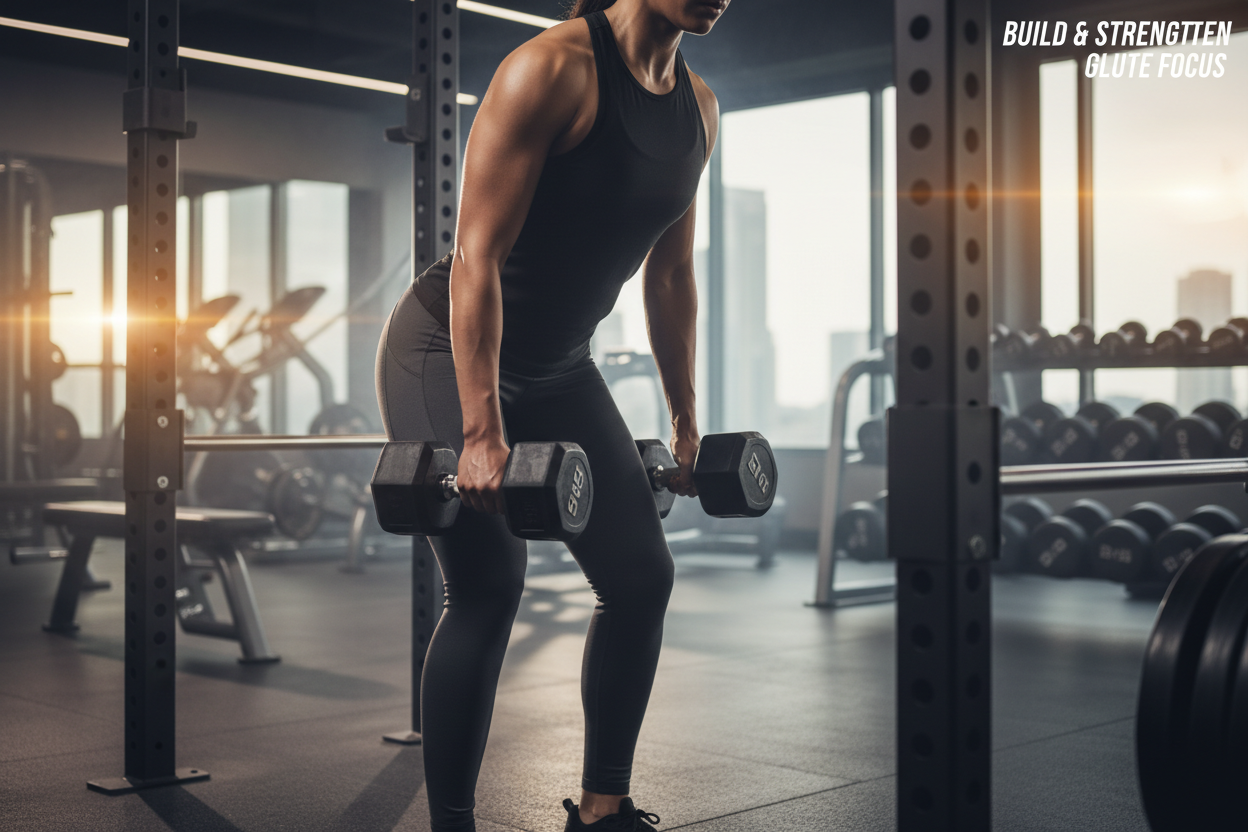
Hold a dumbbell in each hand in front of your thighs. Keep your feet hip-width apart and your knees slightly bent but rigid—do not squat. Push your hips backward as if you are trying to close a car door with your butt. As you lower the weights, keep them close to your shins. Go only as low as your flexibility allows without rounding your back. You should feel an intense stretch in your hamstrings and glutes. Drive your hips forward to return to the top, squeezing hard. This movement allows for significant loading, making it one of the best dumbbell glute exercises for raw strength.
2. The Bulgarian Split Squat
This exercise has a reputation for being grueling, and for good reason. It places the glute under an immense load while in a fully stretched position. Because you are balancing on one leg, your glute medius (the side of the hip) has to work overtime to keep you stable.
Stand a few feet in front of a bench or sturdy chair. Place the top of your rear foot on the bench. Holding dumbbells at your sides, lower your back knee toward the floor. To make this one of the best glute dumbbell exercises rather than a quad exercise, lean your torso slightly forward (about 30 to 45 degrees). This slight lean shifts the tension from the knee joint to the hip joint. Drive through the front heel to stand back up. The unilateral nature ensures that your dominant side doesn't take over.
3. Dumbbell Glute Bridge / Kas Glute Bridge
While squats and lunges work the glutes in a lengthened state, bridges work them in the shortened state. This is essential for that "hard" look and peak contraction. While a barbell hip thrust is popular, the dumbbell variation is easier to set up and less intrusive on the hips.
Lie on the floor or position your upper back against a bench. Place a heavy dumbbell across your hips, holding it steady with your hands. Drive your hips toward the ceiling, focusing on tilting your pelvis posterior (tucking your tailbone) at the top. If you are doing a Kas Glute Bridge, the range of motion is smaller; you only lower your hips a few inches and drive back up, keeping constant tension on the glutes without engaging the quads or hamstrings too much.
4. Dumbbell Sumo Squat
Standard squats are great, but the sumo stance specifically targets the glutes and adductors due to the wider foot position and external rotation of the hips. This is a fantastic compound movement to add volume to your routine.
Stand with your feet wider than shoulder-width, toes pointed out at roughly 45 degrees. Hold a single heavy dumbbell with both hands, letting it hang between your legs. Lower your hips straight down, keeping your chest tall. Imagine you are sliding your back down a wall. Drive your knees out as you descend—do not let them cave in. Push through your heels to return to the start. The depth you can achieve here often exceeds a standard squat, activating more muscle fibers in the posterior chain.
Structuring Your Routine
Knowing the moves is half the battle; programming them correctly is what generates results. The best glute workouts with dumbbells rely on progressive overload. You cannot use the same 20-pound weight forever and expect changes. You must increase the weight, increase the reps, or slow down the tempo over time.
A solid session might look like this:
- Dumbbell RDL: 3 sets of 8-10 reps (Heavy, focus on the stretch)
- Bulgarian Split Squat: 3 sets of 10-12 reps per leg (Moderate weight, focus on stability)
- Dumbbell Sumo Squat: 3 sets of 12-15 reps (Constant tension)
- Single-Leg Glute Bridge: 2 sets to failure (Burnout)
Rest for 90 seconds to 2 minutes between sets. Your glutes are large, powerful muscles that require adequate recovery between bouts of intense effort to perform at maximum capacity.
Common Mistakes to Avoid
The most frequent error in glute training is lumbar hyperextension. When you reach the top of a squat, deadlift, or bridge, many people arch their lower back aggressively to "squeeze" the glutes. This puts dangerous pressure on the spine and actually disengages the glutes. Instead, think about locking your ribcage down and bringing your pelvis forward to meet it.
Another issue is rushing the eccentric (lowering) phase. Muscle damage, which signals growth, happens largely during the lowering portion of the lift. If you drop into your split squat or RDL without control, you are cheating yourself out of gains. Take two to three seconds to lower the weight, pause for a split second, and then explode up.
Final Thoughts on Dumbbell Training
Dumbbells provide versatility that machines cannot match. They require you to control the weight in three-dimensional space, leading to better joint health and functional strength. Whether you are training at home or in a high-end health club, these movements form the foundation of a strong lower body. Consistency with these key lifts, combined with a focus on feeling the muscle work rather than just moving weight from point A to point B, will yield the physique changes you are looking for.
Frequently Asked Questions
Can I really get big glutes with just dumbbells?
Yes, absolutely. Muscle growth requires mechanical tension and metabolic stress, both of which can be achieved with dumbbells. As long as you are close to failure by the end of your sets and progressively increasing the challenge, your muscles will grow regardless of the tool used.
How often should I train my glutes?
For most people, training glutes 2 to 3 times per week is optimal. This frequency allows you to stimulate the muscle often while providing roughly 48 hours of rest between sessions for recovery and repair.
What if my grip gives out before my glutes do?
This is common with exercises like RDLs and Split Squats. Using lifting straps or grips is highly recommended; they take the forearm strength out of the equation so you can continue training until your glutes are truly fatigued.