The Only 5 Pieces of Equipment You Actually Need in Your Home Gym
Building a home gym doesn't require a second mortgage or turning your entire basement into a commercial fitness center. After spending three years training clients in both high-end gyms and minimal home setups, I've learned that the most effective home gyms focus on versatility over quantity. The best home gym items are those that serve multiple purposes, fit your available space, and actually get used consistently—not the ones gathering dust in the corner.
The real question isn't about having every piece of equipment imaginable. It's about identifying what will give you the most comprehensive workout options while respecting your budget and floor space. Let me walk you through what actually matters.
The Foundation: Adjustable Dumbbells Take the Crown
If you're looking for the best piece of equipment for home gym training, adjustable dumbbells deserve serious consideration. A quality set can replace an entire rack of traditional dumbbells, saving you both money and precious square footage. Modern adjustable systems let you switch from 5 pounds to 50+ pounds in seconds, making them perfect for everything from shoulder raises to goblet squats.
I remember when I first moved into a small apartment and had to downsize from my garage setup. Those adjustable dumbbells became my lifeline. They handled my upper body days, added resistance to lunges, and even worked for core exercises like weighted Russian twists. The investment paid for itself within months compared to a gym membership.
Look for sets with secure locking mechanisms and comfortable grips. The dial-adjust models from reputable brands tend to be more reliable than pin-based systems, though they come at a higher price point. Either way, this single purchase can cover 60-70% of your strength training needs.
The Power Rack: Your Gym's Backbone
Among the best pieces of home gym equipment, a power rack stands out for serious strength training. This isn't just a squat stand—it's a complete training station that enables safe heavy lifting without a spotter. You can perform squats, bench presses, overhead presses, and pull-ups all from one piece of equipment.
The safety bars are what make this investment worthwhile. They catch the barbell if you fail a rep, which means you can push yourself during solo training sessions without risking injury. Add a bench and a barbell, and you've got the foundation for any serious strength program.
Space-conscious buyers should consider half racks or fold-away models that mount to the wall. These options provide the same safety features while reclaiming floor space when not in use. The key is ensuring whatever you choose has a weight capacity well above what you plan to lift—aim for at least 700-1000 pounds to future-proof your setup.
The Versatility Champion: Resistance Bands
Don't let their simplicity fool you. Resistance bands punch well above their weight class in terms of exercise variety and portability. A complete set with varying resistance levels costs less than a single month at most gyms, yet provides hundreds of exercise options.
Bands excel at mobility work, warm-ups, and assistance exercises that complement heavier lifting. They're also phenomenal for home workouts when you're traveling or recovering from injury. The constant tension they provide creates a different muscle stimulus than free weights, making them a valuable addition rather than just a budget alternative.
Loop bands, mini bands, and tube bands with handles each serve different purposes. A comprehensive collection of all three types still fits in a shoebox and gives you tools for everything from banded squats to face pulls to glute activation work.
The Conditioning Cornerstone: Kettlebells
Kettlebells bridge the gap between strength and cardiovascular training in ways that few other tools can match. A single kettlebell enables hundreds of exercises, from traditional swings and Turkish get-ups to goblet squats and single-arm presses.
The offset center of gravity creates unique stabilization demands that improve functional strength and core engagement. This makes kettlebells particularly valuable for athletes and anyone interested in real-world strength application beyond just moving weight in straight lines.
Starting with one moderate-weight bell (around 35 pounds for men, 20 pounds for women) gives you plenty to work with. As your budget allows, adding a lighter and heavier option creates a versatile three-bell setup that covers most training scenarios. Cast iron bells offer the best value, while competition-style bells maintain consistent dimensions across weights.
The Cardio Solution: Jump Rope or Rowing Machine
Cardiovascular equipment often gets expensive quickly, but you have options. A quality jump rope costs under $30 and delivers brutal conditioning workouts in minimal space. Ten minutes of jump rope intervals can rival any treadmill session for calorie burn and cardiovascular benefits.
For those with a bigger budget and space, a rowing machine provides low-impact, full-body cardio that complements strength training beautifully. Concept2 rowers are the gold standard—they're built to last decades and maintain resale value remarkably well. Air bikes offer another space-efficient alternative that delivers punishing interval training.
The choice here depends on your goals and limitations. Joint issues might push you toward the rower. Limited space makes the jump rope unbeatable. Either way, having some dedicated cardio option rounds out a complete home gym.
Building Your Setup Strategically
The biggest mistake people make is buying everything at once. Start with what addresses your immediate training needs, then expand as you identify gaps in your routine. Someone focused on strength should prioritize the power rack and barbell setup. Those interested in general fitness might start with adjustable dumbbells and resistance bands.
Quality matters more than quantity. One excellent barbell will serve you better than three mediocre ones. Buy once, cry once—especially for items that take mechanical stress like barbells, racks, and benches. These are investments that should last years, if not decades.
Consider used equipment for big-ticket items. Home gym equipment typically sees light use compared to commercial gear, and many people sell barely-used equipment when they move or lose motivation. Facebook Marketplace and Craigslist often have fantastic deals on power racks, benches, and weights.
Making It Work in Your Space
Even a spare bedroom or garage corner can accommodate an effective setup. Measure your space carefully before buying anything large. Account for the equipment footprint plus the space needed to actually use it—you need room to move around a power rack, not just store it.
Flooring protection saves your floors and reduces noise. Rubber stall mats from farm supply stores offer the best value for durable gym flooring. They're designed to handle horses, so your deadlifts won't faze them.
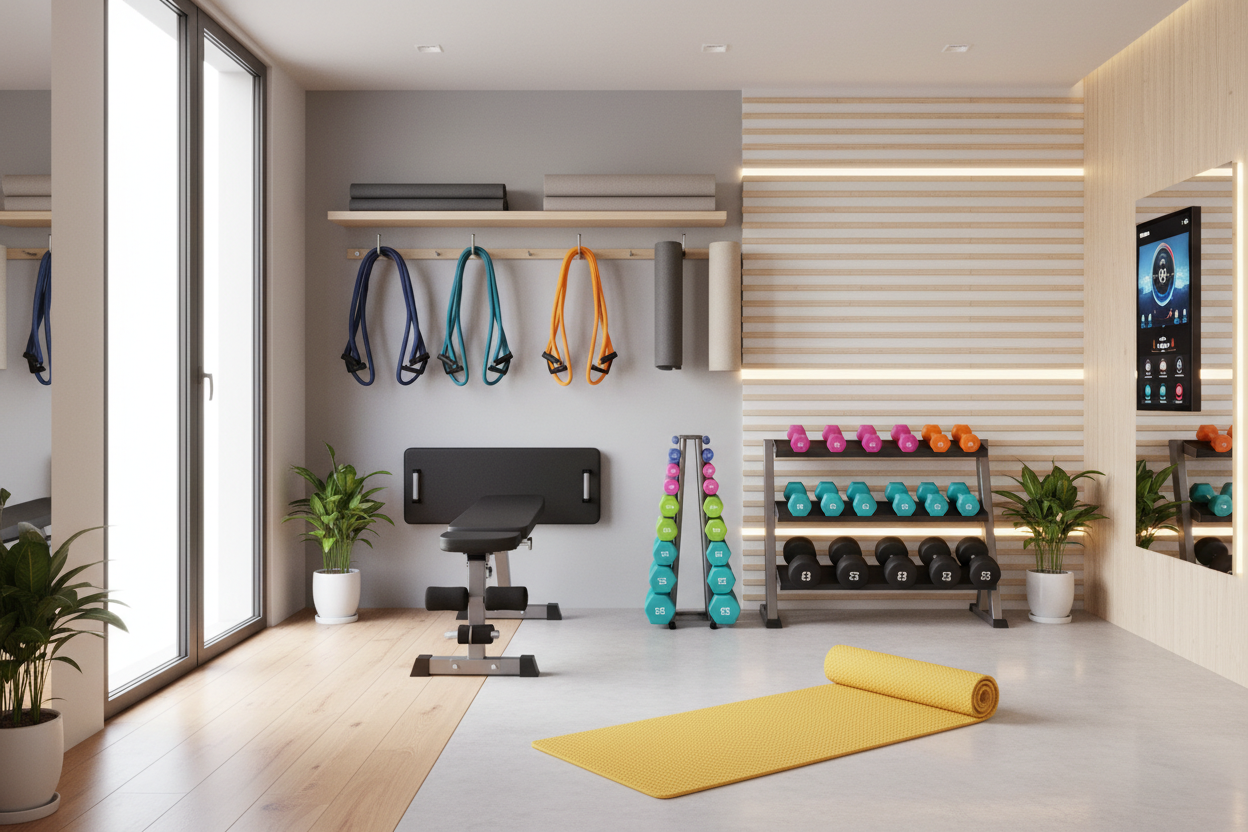
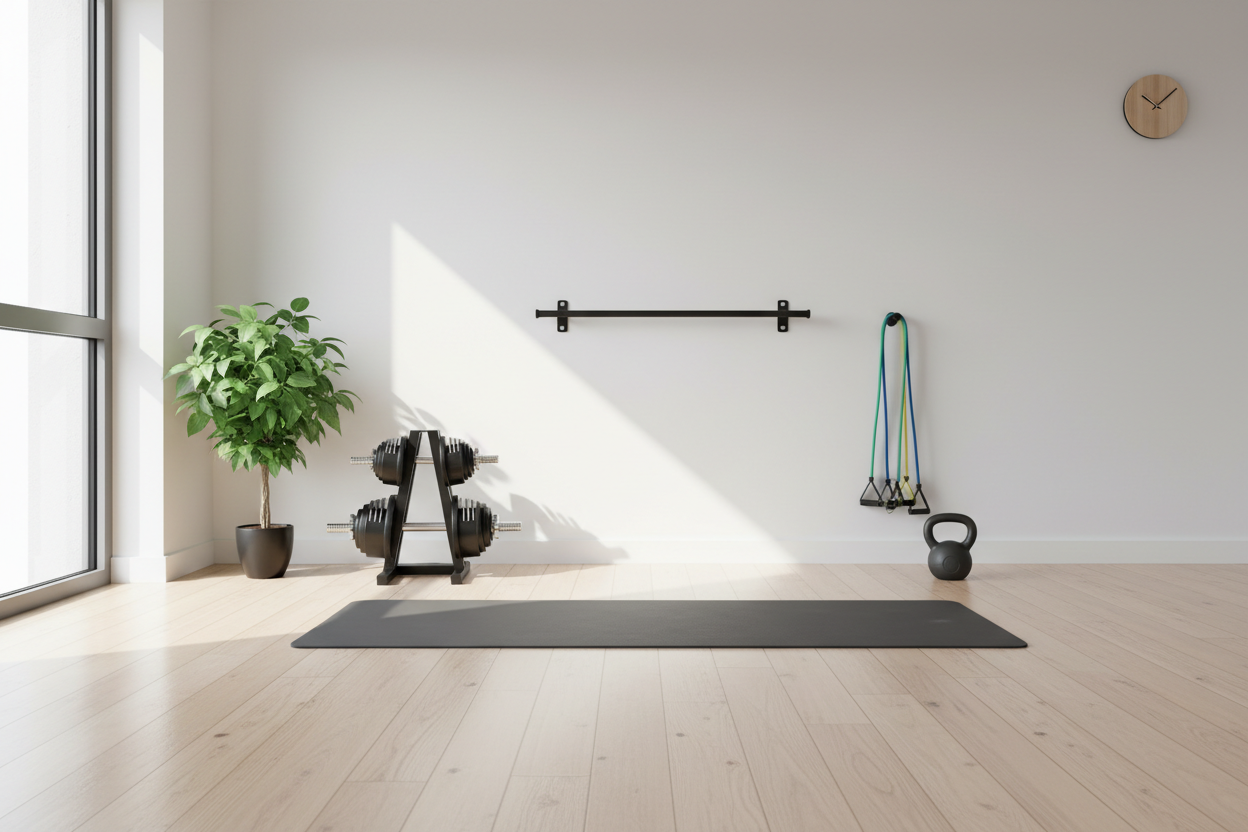
Wall-mounted solutions maximize usable space. Fold-away racks, wall-mounted pull-up bars, and pegboard storage for bands and smaller items keep your training area functional without permanently sacrificing living space.
Frequently Asked Questions
How much should I budget for a basic home gym?
A functional home gym can start around $500-800 with adjustable dumbbells, resistance bands, and a kettlebell. Adding a power rack, barbell, and plates pushes the budget to $1,500-2,500. These investments typically pay for themselves within a year compared to gym memberships, and the equipment lasts for decades with proper care.
Can I build muscle effectively with just dumbbells and bodyweight exercises?
Absolutely. Progressive overload—gradually increasing difficulty over time—drives muscle growth more than equipment variety. Adjustable dumbbells up to 50+ pounds combined with bodyweight exercises provide enough resistance for most people to build significant muscle. Adding a pull-up bar expands your options considerably for back and arm development.
What's the most space-efficient home gym setup?
Adjustable dumbbells, resistance bands, a suspension trainer, and a jump rope create an incredibly capable gym that fits in a closet. This combination covers strength training, mobility work, and cardio in about two square feet of storage space. You can execute complete workouts in a 6x6 foot area, making it perfect for apartments or shared spaces.