The Minimalist Leg Day: Will Just Squats and Lunges Actually Build Muscle?
We have all been there—staring at a crowded gym floor, dreading the machine circuit, and wondering if we can just stick to the squat rack and call it a day. The short answer to your burning question is yes, but with a major caveat. If your goal is purely to build larger quadriceps and stronger glutes, you can achieve impressive results with a minimalist approach. However, if you want a fully functional, injury-proof lower body, relying solely on squats leaves significant gaps in your posterior chain development.
Many lifters, from garage gym enthusiasts to powerlifters, have tried to simplify their training. The idea that can i just do squats for legs and ignore the hamstring curl machine is appealing. While squats are arguably the most productive movement you can do, they are not a magic bullet for every muscle fiber in your lower body. Understanding the biomechanics of the movement helps explain why a squat-heavy routine builds massive thighs but might leave you prone to hamstring tears.
The Case for the Squat as the King
There is a reason why people constantly ask, are squats the best exercise for legs? When you load a barbell on your back and descend, you are engaging the quadriceps, glutes, adductors, calves, and core simultaneously. The systemic stress placed on the body triggers a significant hormonal response, promoting growth not just in the legs, but partially throughout the entire body.
If you are looking at pure efficiency, the squat reigns supreme. It allows for progressive overload—adding weight over time—better than almost any other leg movement. For the front of your thighs, are squats enough for quads? Absolutely. In fact, high-bar squats are one of the most effective ways to isolate and grow the quadriceps. You would be hard-pressed to find a bodybuilder with small quads who squats heavy and deep regularly.
The Imbalance Issue
The problem arises when we confuse "quad dominance" with "complete leg development." When you ask, can you just do squats for legs, you are essentially asking if you can train the front of your body while neglecting the back. Squats involve knee extension (quads) and hip extension (glutes/adductors), but they do not actively recruit the hamstrings to a high degree. The hamstrings function primarily as dynamic stabilizers during the squat, not prime movers.
I learned this lesson the hard way a few years back. I was traveling for work and had access to a very basic hotel gym that only had a rack and a bench. For three months, I performed a squat only leg workout three times a week. My pant legs definitely got tighter, and my squat numbers went up. However, when I returned to my regular gym and tried to deadlift, my strength had plummeted, and I developed a nagging pain behind my knee. My quads had overpowered my hamstrings, creating a tension imbalance at the knee joint. This is the reality of neglecting the hip hinge movement pattern.
Adding Lunges to the Mix
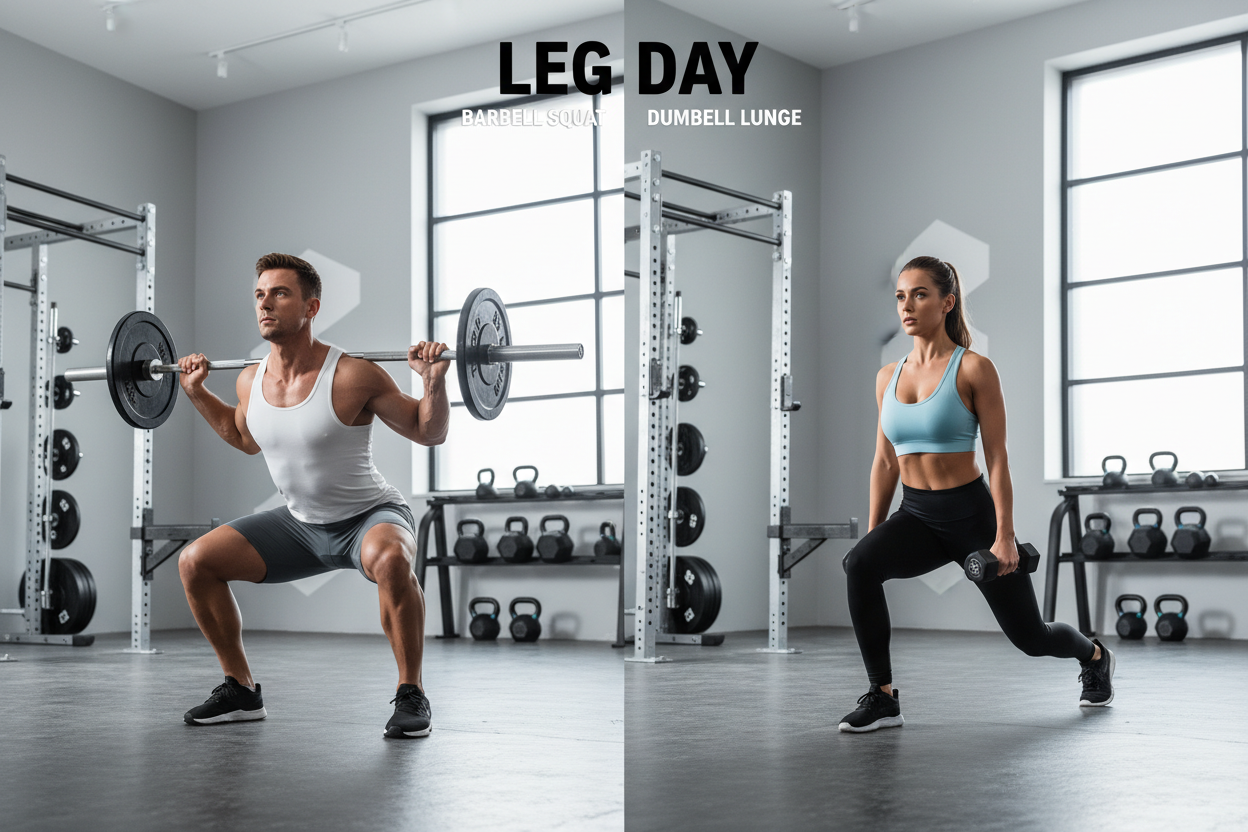
Since squats are bilateral (using both legs at once), they can mask asymmetries. One leg might be pushing harder than the other without you realizing it. This is where the lunge becomes a vital companion. So, are squats and lunges enough for legs? This combination is significantly better than squats alone. Lunges introduce unilateral training, forcing each leg to carry its own weight and stabilizing the hip joint.
Lunges also hit the glutes in a way that squats sometimes miss, especially at the bottom of the movement where the stretch is deepest. Walking lunges or reverse lunges can also recruit a bit more hamstring than a standard squat, although still not enough to replace a deadlift or leg curl. If you are strictly limited to these two movements, you have a potent recipe for size and athleticism, provided you understand you are still missing direct hamstring work.
Designing a Squat-Centric Routine
If you are limited by equipment or time and have decided that are squats the only leg exercise i need for your current lifestyle, you need to be smart about how you program them. Doing the same 3 sets of 10 reps every session will lead to stagnation. You have to manipulate the variables.
To make a squat only leg workout effective, vary your stance and bar placement. A low-bar back squat will recruit more posterior chain (glutes and lower back), while a front squat or high-bar squat will torch the quads. You can structure a week like this:
- Day 1: Heavy Low-Bar Squats (Strength focus, 3-5 reps)
- Day 2: Walking Lunges and Bulgarian Split Squats (Hypertrophy and balance focus, 8-12 reps)
- Day 3: Front Squats or Goblet Squats (Quad focus, 10-15 reps)
This variation prevents mental burnout and changes the mechanical stress on the joints, reducing the risk of overuse injuries common with repetitive motion.
The Verdict on Minimalist Leg Training
Ultimately, can i just do squats for legs and look good? Yes. Most of the aesthetic "meat" of the leg is the quadricep and the glute, both of which are hammered by deep squats. If you are a general fitness enthusiast, a hiker, or just want to fill out a pair of jeans, squats are sufficient.
However, if you want to run faster, jump higher, or lift heavy objects off the floor safely, you need to hinge. A stiff-legged deadlift or a Romanian deadlift is the perfect partner to the squat. If you absolutely cannot do them, lunges help bridge the gap, but they don't fully close it. The best legs are built on a foundation of squats, refined by lunges, and balanced by hamstring work.
Frequently Asked Questions
Will skipping calf exercises hurt my squat progress?
Skipping direct calf work likely won't stall your squat numbers significantly, as calves act as stabilizers rather than prime movers in the lift. However, weak ankles and calves can limit your depth and stability at the bottom of the hole, so some calf raises are beneficial for joint health.
How deep do I need to squat for maximum leg growth?
You should aim to break parallel, meaning your hip crease drops below the top of your knee. This depth ensures maximum activation of the glutes and adductors while placing the quadriceps under the greatest stretch, which is the primary driver for muscle growth.
Can I replace back squats with goblet squats?
Yes, especially if you are a beginner or have lower back issues. Goblet squats are fantastic for learning proper mechanics and still provide a great stimulus for the quads and core, though you will eventually be limited by how much weight you can hold in your hands.