The Best At Home Workout Program Scales With Your Energy
Imagine walking into your garage at 6 AM. It is 40 degrees, your lower back feels stiff from sitting in a desk chair for 10 hours yesterday, and your spreadsheet says it is time for 5 sets of heavy deadlifts at 85% of your one-rep max. If you force those reps, you risk injury. If you skip the workout entirely, you feel like a failure. This binary thinking is exactly why so many garage setups turn into expensive storage units. Finding the best at home workout program is not about downloading the most hardcore, unyielding spreadsheet you can find. It is about building a system that bends so it does not break.
When you train in isolation, you lack the visual cues, loud music, and social pressure of a commercial facility. You have to rely entirely on your own internal drive. That is why the most successful home lifters treat their routines as flexible frameworks rather than rigid mandates.
Quick Takeaways
- Treat your training plan as a flexible menu, adjusting daily volume based on bio-feedback.
- Keep core movement patterns (push, pull, squat, hinge) consistent, but scale the weight up or down.
- Invest in versatile gear that allows for rapid intensity changes when your energy is low.
- Set up a comfortable, shock-absorbing physical space to encourage proper warm-ups and mobility work.
The Trap of Rigid Routines in a Home Gym
When I first started outfitting garages for clients, I would hand them the exact same linear progression templates I used in commercial facilities. Add five pounds to the bar every week, hit your 5x5 rep schemes, and push through the fatigue. It worked for about three weeks. Then, life intervened. Sleep tanked, work stress spiked, and the reality of training alone set in.
Treating your basement exactly like a commercial facility is a fast track to central nervous system burnout. In a public gym, the ambient energy can carry you through a grueling set. At home, it is just you, a cold barbell, and the washing machine running in the background. When you lock yourself into an unyielding program, a bad night of sleep turns a heavy squat session from a positive stimulus into a danger zone.
You end up grinding through garbage reps, accumulating joint fatigue, and dreading your next session. Eventually, you start skipping days entirely. This all-or-nothing mindset destroys consistency, which is the only variable that actually matters for long-term physical adaptation.
Why Auto-Regulation Defines the Best Home Fitness Program
The solution to this burnout trap is a concept called auto-regulation. In plain English, auto-regulation means adjusting your sets, reps, and effort based on real-time bio-feedback. You do not ignore your plan entirely; you simply modulate the intensity dial based on what your body can actually handle on that specific day.
When you embrace this philosophy, you quickly realize that the best home fitness program is one that breathes with you. If you slept eight solid hours and your joints feel lubricated, you push the heavy 5-rep maxes. If you are running on four hours of sleep and high cortisol, you swap the heavy barbell squats for 3 sets of 15 goblet squats with a 50-pound dumbbell, focusing on a deep stretch and a slow eccentric tempo.
This approach keeps the habit alive. You still show up, you still get a muscular stimulus, but you do not dig a recovery hole you cannot climb out of. Over the years, I have noticed my clients who use auto-regulation actually end up lifting heavier weight at the end of the year compared to the ones who try to force linear progression. They take fewer unplanned rest days and suffer fewer nagging shoulder tweaks.
Reading Your Body's Daily Readiness Score
Before you touch a single weight, you need to assess your daily readiness. I teach my clients to run through a quick mental checklist during their five-minute warm-up.
First, rate your sleep quality and stress levels on a scale of 1 to 5. If both are sitting at a 2, today is not the day to test your deadlift max. Next, assess joint stiffness. Do your knees ache walking down the stairs? Does your right shoulder pinch when you reach overhead?
Finally, grip strength is a massive indicator of central nervous system recovery. Grab a heavy dumbbell or hang from a pull-up bar. If your grip feels unusually weak or your hands feel sensitive, your nervous system is likely fatigued. Use these subjective markers to assign yourself a green, yellow, or red light for the day's training volume.
Structuring the Best At Home Workout Program Framework
So, how do we build this? You still need a skeleton. I usually recommend a modular push/pull/legs split or a three-day full-body setup. The core movements—a squat, a hinge, a horizontal press, a vertical pull—remain constant. What changes is the application of stress.
Let us say today is a lower body day. Your baseline framework says you need to do a squat variation, a hamstring movement, and some calf work. That is the best home workout program framework because it provides structure without dictating the exact tool or load.
On a green light day, you might load up 225 pounds on the barbell for 4 sets of 6 reps. On a yellow light day, you might drop the weight to 135 pounds, pause for three seconds at the bottom of every rep, and do 3 sets of 8. The mechanical tension is still there, but the absolute load is lower, sparing your spine. On a red light day, you might just do bodyweight Bulgarian split squats and heavy band leg curls for a massive pump, getting in and out in 30 minutes.
Scaling Intensity With Your Available Gear
To make auto-regulation work smoothly, you need gear that allows for rapid intensity adjustments. If your only tool is a fixed 100-pound sandbag, you cannot exactly scale down on a low-energy day. This is why selecting the best home fitness equipment is heavily reliant on versatility. I personally tested a popular set of 5-80 lb adjustable block dumbbells for six months in my own 10x10 foot shed. They are phenomenal for auto-regulating because I can change weights in three seconds. However, I will share one honest downside: their bulky square footprint can feel incredibly awkward during goblet squats, forcing you to slightly alter your mechanics.
Despite minor quirks, adjustable tools let you instantly drop the load by 20 pounds if your shoulders are barking. On days when your stabilizing muscles are completely fatigued but you still want to push some volume, guided movements are a lifesaver. Integrating the best home workout machines, like a simple plate-loaded lat pulldown or a compact leg extension unit, pays off immensely here. You do not have to worry about balancing a barbell; you just sit down, pin the weight, and focus entirely on the muscle contraction safely.
Grounding Your Practice: The Physical Space
Auto-regulation requires you to pay close attention to how your body moves in space. If you are lifting on cold, hard concrete, your joints will naturally feel stiffer, giving you false feedback about your recovery status. Creating a dedicated, comfortable environment encourages you to actually get down on the floor for proper warm-ups and mobility assessments.
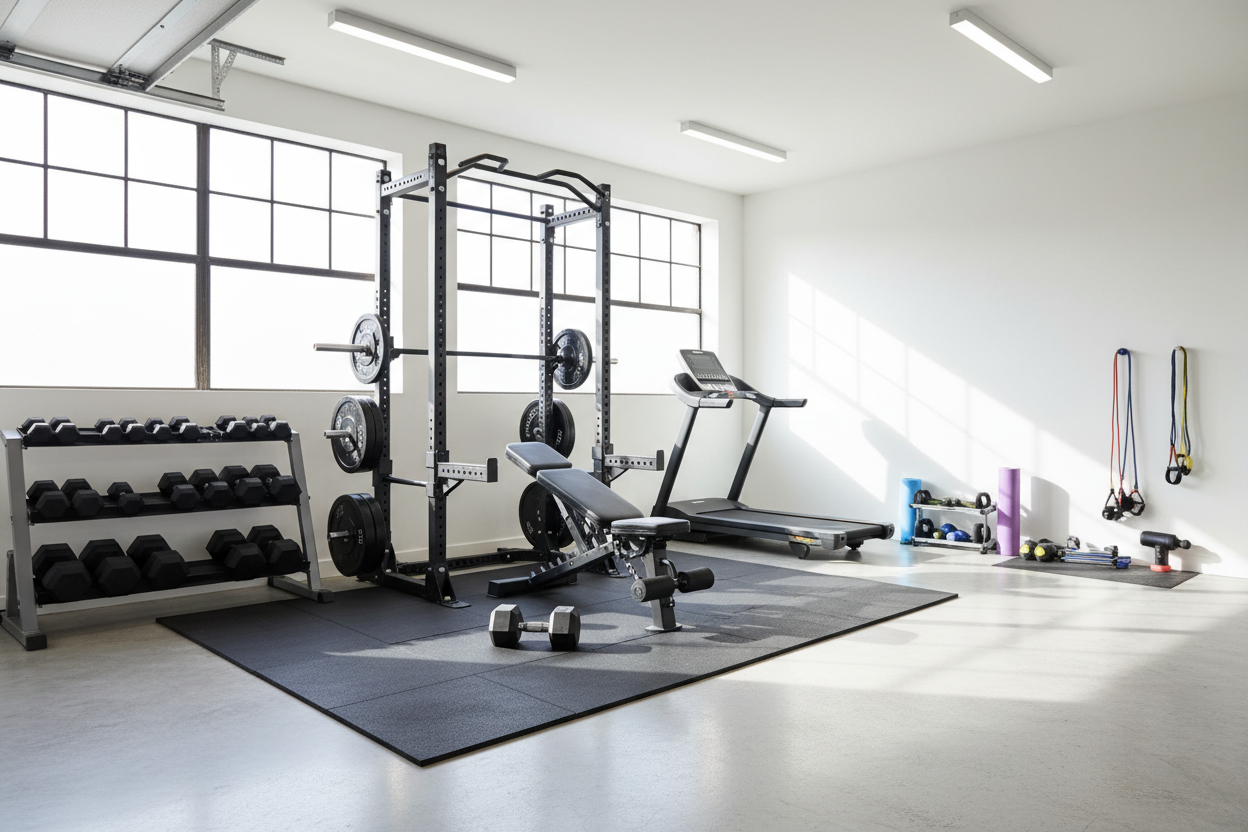
I learned this the hard way after tweaking my lower back doing kettlebell swings on a slippery garage floor. You need a dedicated, shock-absorbing area. Throwing down a large exercise mat instantly transforms a raw garage or spare bedroom into a legitimate training facility. It dampens the noise of dropping weights and provides the traction needed for heavy lifting.
For most clients setting up a permanent footprint for their flexible routines, I specifically recommend laying down a 6x8ft exercise mat. It is thick enough to protect your subfloor from a dropped 50-pound dumbbell, yet firm enough that your feet will not squish or shift during heavy deadlifts.
Measuring Real Progress Without Chasing Numbers
When you stop forcing linear weight increases every single week, tracking progress looks a little different. Instead of just logging raw weight lifted, start logging your Rate of Perceived Exertion (RPE) and your movement quality.
If you squatted 185 pounds for 8 reps last month and it felt like an RPE 9 (an absolute grinder), but you do the same weight today and it feels like an RPE 7 (smooth, with reps left in the tank), you got stronger. You did not add weight to the bar, but your physical capacity improved.
Keep a notebook near your rack. Jot down the sets and reps, but also add a quick note: 'Felt explosive today' or 'Lower back was tight, swapped to lunges.' Over a 12-week training cycle, you will see a clear trend of improved work capacity, fewer missed sessions, and a much healthier relationship with your home training space.
Frequently Asked Questions
How long should an auto-regulated home workout last?
Usually between 30 to 55 minutes. On high-energy days, you might push an hour with longer rest periods between heavy sets. On low-energy days, you can blast through a lighter, circuit-style session in 25 minutes and call it a win.
Can beginners use auto-regulation?
Yes, but with guardrails. Beginners should stick to a set rep range (like 8-12 reps) and focus heavily on form. The auto-regulation comes into play by adjusting the weight down if technique starts to break down due to fatigue.
What if I have a red light day all week?
If you are constantly fatigued, your program is not the problem—your recovery is. Look at your sleep hygiene, daily protein intake, and work stress. Take three full days off, focus on walking and mobility, and return to the weights when your grip strength normalizes.