Transform Your Total Body Fitness With A Rowing Machine Machine
You walk into the gym, scan the cardio floor, and likely bypass the one piece of equipment that offers the highest return on investment for your time. I am talking about the rowing machine machine. It often sits empty while lines form for the treadmills, mostly because it looks intimidating or people simply don't know how to use it.
Many assume it is purely an upper-body workout. Others try it, hurt their lower back within five minutes, and never return. The truth is, when executed with proper technique, this apparatus provides a premier cardiovascular workout that engages 86% of your muscle mass.
If you want to build a rhythmic, powerful engine without the joint impact of running, you need to understand the mechanics behind the movement.
Key Takeaways: Mastering the Stroke
- Power Distribution: The stroke is not an arm pull. It is 60% leg drive, 20% body swing, and 20% arm pull.
- Sequence Matters: Remember "Legs, Body, Arms" on the drive, and "Arms, Body, Legs" on the recovery.
- Damper Setting: Setting the fan resistance to 10 does not mean a better workout; it usually leads to poor form and injury. Aim for a setting of 3-5.
- Grip: Keep a loose grip on the handle to prevent forearm fatigue and unnecessary tension.
Why the Rower Trainer is Superior to the Treadmill
The debate between running and rowing usually comes down to impact. Running is high-impact; every step sends a shockwave through your ankles, knees, and hips. A rowing exercise machine removes that gravity-induced stress entirely.
Because your feet remain in contact with the footplates and your glutes are supported, you can push your heart rate to anaerobic zones without destroying your connective tissue. This makes rowing machines the ideal tool for longevity and rehabilitation.
Furthermore, running is primarily lower-body dominant. Rowing forces your posterior chain—hamstrings, glutes, and erectors—to work in unison with your lats and rhomboids. You aren't just burning calories; you are building functional postural strength.
Deconstructing the Stroke: It's Not a Pull
The biggest misconception is that you pull the handle toward you. If you treat the movement like a seated cable row, you will fatigue your biceps and strain your lumbar spine.
The Catch
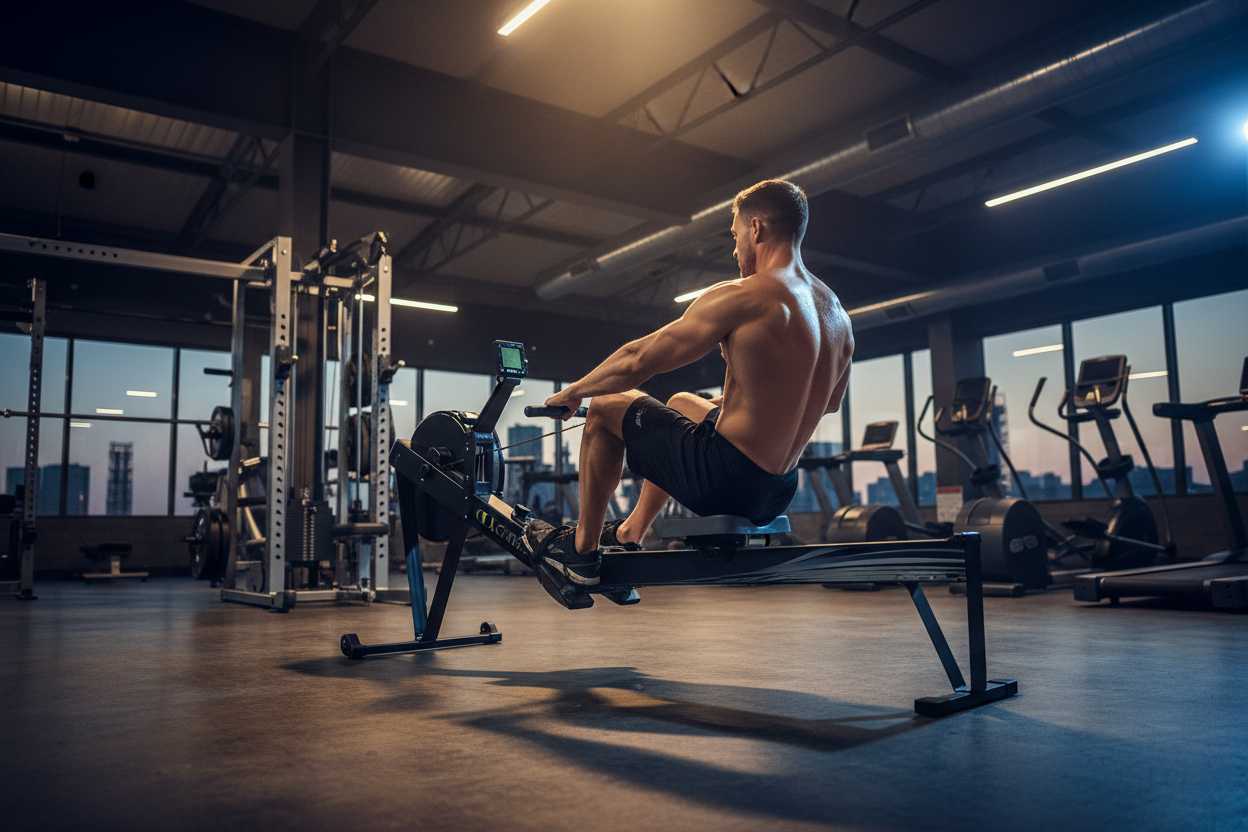
This is the starting position. Your shins should be vertical, arms extended, and body leaning slightly forward (about 11 o'clock position). You are a coiled spring here. Do not hunch your shoulders; keep them relaxed.
The Drive
Explode back by pushing through your heels. This is a leg press, not a row. Keep your arms straight until your legs are almost fully extended. Only then do you swing your torso back to the 1 o'clock position and pull the handle to your sternum.
The Finish and Recovery
At the finish, your legs are flat, core engaged, and the handle is at your lower chest. To return, extend your arms first. Hinge your hips forward. Then bend your knees to slide back to the catch. If you bend your knees before your hands pass them, you'll have to lift the handle over your knees, disrupting the smooth chain of the rowing machine machine mechanism.
The "Damper" Myth Explained
Look at the side of the flywheel housing. That lever labeled 1 through 10 is not a difficulty setting. It is a damper that controls airflow.
Think of it like gears on a bicycle. A setting of 10 is like a heavy gear; it requires more force to get the wheel moving but slows down faster. A setting of 3 or 4 mimics the drag of a sleek boat on water. This lower setting allows for a faster stroke rate and better aerobic conditioning without overloading your muscles prematurely.
My Training Log: Real Talk
I have spent countless hours strapped into a rower trainer, and I want to be honest about the unpolished reality of this machine. It isn't always graceful.
The first thing you will notice isn't the cardio burn; it's the blisters. Specifically, right where your fingers meet your palm. I used to grip the handle like I was strangling it, which is a rookie mistake. But even with a loose grip, if you are doing a 5,000-meter session, you are going to feel the friction. I eventually learned to just tape the hotspots rather than wearing gloves, which ruin the feel of the connection.
Another detail the manuals don't mention is the "numb butt" syndrome. About 20 minutes into a long steady-state piece, the seat can feel like concrete. I learned the hard way that wearing thick cotton shorts is a disaster—they bunch up and chafe. Compression gear is non-negotiable here. And finally, there is the "erg cough." After a maximum effort 2k test, the dry air hitting the back of your throat leaves you with a metallic taste and a cough that lasts for an hour. It’s brutal, but it tells you you truly emptied the tank.
Conclusion
Mastering the rowing machine machine requires patience. It is a skill-based conditioning tool, not a mindless calorie burner. Focus on your sequence—legs, body, arms—and respect the recovery phase.
Start with short intervals to maintain perfect form. Once your technique holds up under fatigue, you will find that rowing offers a level of fitness that running simply cannot match.
Frequently Asked Questions
Can I lose belly fat using a rowing machine?
Yes, rowing is highly effective for fat loss because it is a full-body cardiovascular workout that burns a high number of calories per hour. However, spot reduction is impossible; you will lose body fat systemically through a combination of rowing intensity and a caloric deficit.
How long should a beginner row for?
Start with 5 to 10 minutes focused entirely on technique. Do not worry about speed. Once your form is consistent, aim for 20-minute sessions at a moderate pace, or break it up into intervals (e.g., 30 seconds work, 30 seconds rest) for 15 minutes.
Is rowing bad for your back?
Rowing is only bad for your back if your form is incorrect. If you round your spine (slouch) or initiate the drive with your back instead of your legs, you risk injury. With proper posture and core engagement, rowing actually strengthens the back muscles and improves posture.