The Best At Home Exercises For Primal Movement Patterns
I remember standing in a cramped 400-square-foot apartment a few years ago, watching a client try to do lateral raises with heavy encyclopedias. We were both frustrated. When you do not have access to a full rack of dumbbells or cable machines, trying to isolate individual muscles feels awkward and inefficient. That is when I realized we needed a completely different approach. If you want to find the best at home exercises, you have to stop thinking about your biceps and hamstrings, and start thinking about how your body evolved to move.
The best home exercises are built around primal movement patterns. Instead of training body parts, you train functions: squatting, hinging, pushing, pulling, and crawling. I have tested dozens of home workout programs over the last decade, and this shift in mindset is what actually produces a strong, functional body without stepping foot in a commercial facility.
Quick Takeaways
- Ditch the bodybuilding splits; train movements like the squat, hinge, push, pull, and crawl.
- A solid, non-slip floor space is your most critical piece of equipment.
- Use exercise tempo (slowing down the movement) to increase difficulty without adding weight.
- Treat your core as a dynamic stabilizer through crawling, rather than just doing crunches.
Stop Training Muscles and Start Training Movements
Bodybuilding-style training relies on isolation. It requires a massive variety of equipment—think 5 to 52.5 lb adjustable dumbbells, leg extension machines, and cable towers—to hit every muscle from multiple angles. In a living room environment, trying to replicate this is a recipe for frustration. You simply do not have the heavy loads required to make isolation exercises effective.
This is where the primal pattern perspective takes over. Your nervous system does not actually recognize individual muscles; it recognizes movements. By focusing on multi-joint, compound patterns, you recruit maximum muscle fiber using just your own bodyweight and gravity. When I transitioned my remote clients to this style of training, their joint pain decreased and their functional strength skyrocketed.
We focus on five main pillars: the squat, the hinge, the push, the pull, and the crawl. Mastering these patterns ensures balanced muscular development and uncovers the most effective ways to challenge your body in a limited space.
Setting Up Your Primal Movement Space
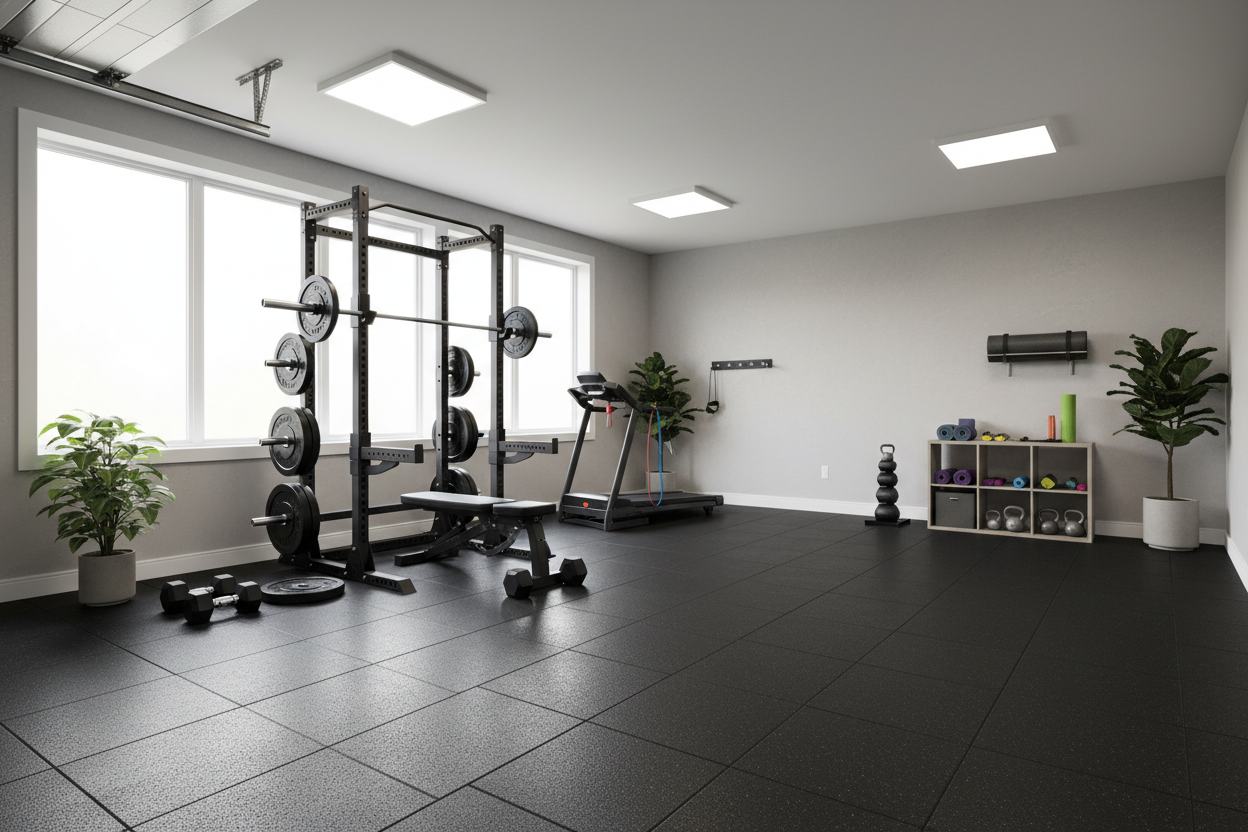
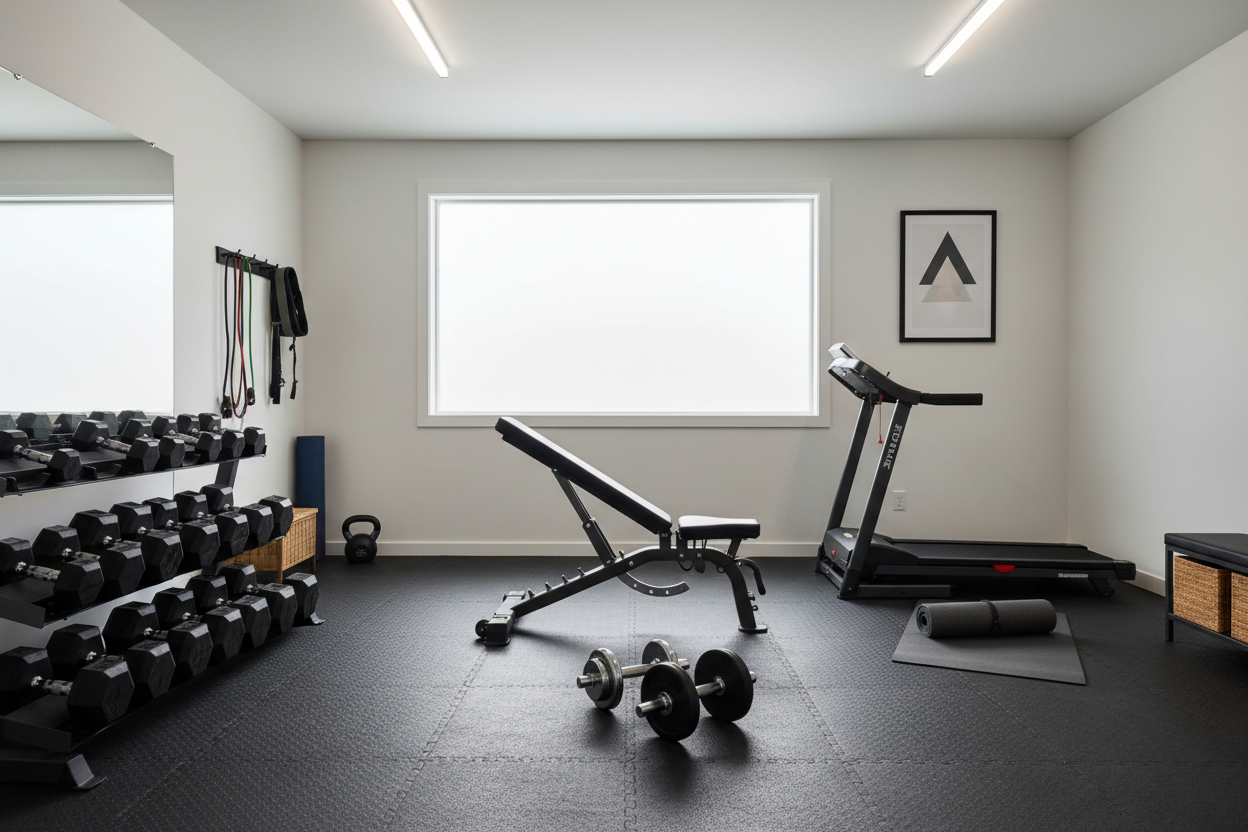
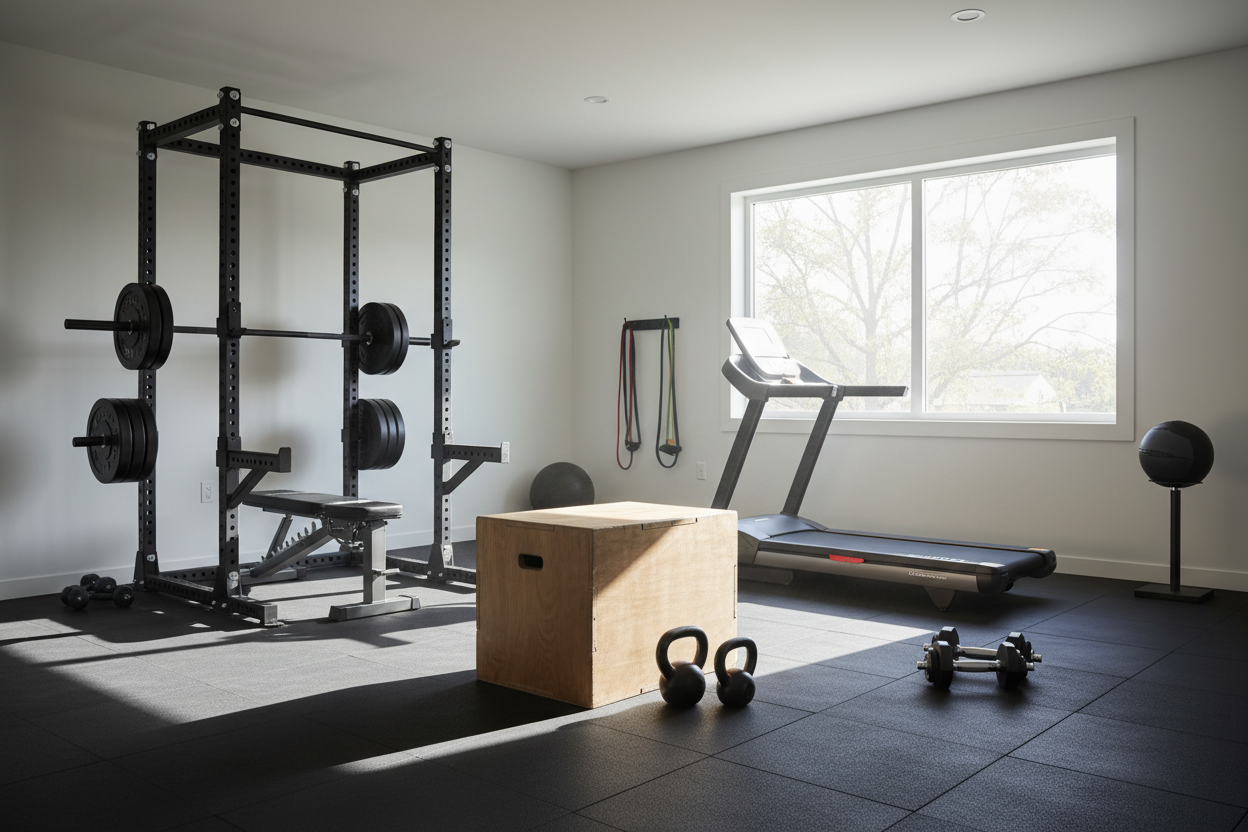
You do not need a garage full of steel to get a great workout, but you do need a dedicated, safe environment. Dynamic, multi-directional movements require solid traction. Doing jump squats or bear crawls on a slick hardwood floor while sweating is incredibly dangerous.
When assessing client setups, the only true prerequisite for safely executing primal movement patterns without slipping on hard floors is a large exercise mat for home gym. You want something that absorbs impact and provides a high-friction surface. A standard 6x6 foot area is usually plenty of room to lunge, jump, and crawl without kicking your coffee table. Clear the clutter, roll out your surface, and you instantly have a high-performance training zone.
The Squat Pattern: Building Your Base
The squat is the fundamental lower body movement. It teaches your hips, knees, and ankles to flex and extend together while your core stabilizes the spine. At home, you start with the basic bodyweight air squat. I always have clients aim for 3 sets of 15 to 20 reps, focusing on driving the knees out and keeping the chest tall.
Once air squats get too easy, we manipulate leverage and tempo. Slowing your descent to a 4-second count drastically increases the time under tension. From there, transition to unilateral (single-leg) movements like reverse lunges and Bulgarian split squats. Elevating your rear foot on a couch or chair forces the front leg to do all the work, mimicking the heavy load of a barbell.
One honest downside to pure bodyweight squats is that highly advanced lifters might eventually miss the absolute top-end resistance of a heavy barbell. However, if you manipulate tempo and angles, you can still trigger serious growth. If you want to advance this pattern into targeted hypertrophy, check out my favorite resource on the best exercises for quads at home.
The Hinge Pattern: Bulletproofing Your Back
While squats are knee-dominant, the hinge is hip-dominant. This pattern targets your posterior chain—the hamstrings, glutes, and lower back. Most people sit at desks all day, leaving their posterior chain weak and tight. Hinging is the antidote.
Start with glute bridges. Lie on your back, plant your feet flat, and drive your hips toward the ceiling. Squeeze the glutes hard at the top. For a greater challenge, switch to single-leg glute bridges. Once you master floor-based hinging, stand up and practice the single-leg Romanian deadlift (RDL). Stand on one leg, keep a slight bend in the knee, and push your hips straight back until your torso is nearly parallel to the floor.
The single-leg RDL requires intense balance and hamstring flexibility. It is one of the most demanding bodyweight exercises you can do. For explosive power, add broad jumps. Hinging your hips back and exploding forward trains your fast-twitch muscle fibers, completely transforming your athletic ability without any weights.
The Push and Pull: Upper Body Fundamentals
Upper body training at home usually defaults to endless push-ups. While the push-up is incredible for chest, shoulder, and triceps development, you have to vary the angles. Incline push-ups (hands on a chair) are great for beginners, while decline push-ups (feet elevated) target the upper chest and shoulders. I recommend keeping your elbows tucked at a 45-degree angle to protect your rotator cuffs.
The real challenge at home is the pulling pattern. Without a pull-up bar or heavy dumbbells, your back can easily become neglected, leading to poor posture. To fix this, I use sliding floor pulls. Lie on your stomach on a slick surface (like a towel on hardwood), reach forward, press your palms into the floor, and pull your body forward. It mimics a lat pulldown.
You can also use door frame rows. Stand in a sturdy doorway, grab the frame, sit back into a partial squat, and pull your chest to the wood. These are simple effective exercises that create balanced shoulder mechanics and prevent the rounded-shoulder look so common in people who only do push-ups.
The Crawl Pattern: Dynamic Core Stability
If you are still doing hundreds of crunches to build your core, it is time to upgrade. The primary function of your core is not to flex your spine, but to resist unwanted movement and transfer force between your upper and lower body. Crawling patterns do exactly this.
The bear crawl is my absolute favorite. Get on all fours, lift your knees one inch off the ground, and slowly walk forward, moving opposite arm and opposite leg. Keep your back flat enough to balance a glass of water on it. This lights up your shoulders, quads, and entire abdominal wall.
Because crawling requires significant floor space, a 6x8ft exercise mat is the ideal footprint for performing crawling and locomotion patterns without running out of space. Moving dynamically across the floor is truly the secret to a stronger core, forcing your obliques and transverse abdominis to fire constantly to keep you stabilized.
Putting It Together: Your Weekly Blueprint
Knowing the patterns is only half the battle; arranging them into a routine is where the results happen. I recommend a full-body circuit approach three to four days a week. This keeps your heart rate elevated and maximizes your time.
Try this zero-equipment blueprint: Perform 45 seconds of work followed by 15 seconds of rest for each movement. Start with a Squat (Bulgarian split squats), move to a Push (decline push-ups), transition to a Hinge (single-leg RDLs), follow up with a Pull (sliding floor pulls), and finish with a Crawl (bear crawls). Complete four total rounds.
This structure guarantees you hit every major muscle group in a balanced, functional way. It takes less than 30 minutes, requires no commute, and builds a resilient body.
Can I build muscle with just bodyweight exercises?
Absolutely. Muscle growth requires tension and progressive overload. By slowing down your tempo, increasing your reps, and moving to harder variations (like single-leg squats or decline push-ups), you can provide plenty of stimulus for hypertrophy without external weights.
How much space do I actually need?
For most primal movements, a 6x6 or 6x8 foot area is perfect. This gives you enough runway for lunges, broad jumps, and a few paces of bear crawling without feeling restricted.
Are these movements safe for bad knees?
Yes, provided you control your range of motion. Bodyweight exercises allow you to stop exactly where you feel discomfort. Focus on the hinge pattern (glute bridges) to strengthen the hamstrings, which takes pressure off the knees during squatting movements.