The Best At Home Beginner Workout Uses Floor Friction
Last year, a client named Sarah came to me living in a cramped 400-square-foot apartment. She had zero budget for dumbbells, and her downstairs neighbors complained every time she tried doing jumping jacks. She needed a solution that was silent, free, and effective. That is when I introduced her to floor friction. Finding the best at home beginner workout does not require a maxed-out credit card or a massive garage setup. You just need a pair of socks on a hardwood floor, or two paper plates on a carpet.
By sliding your limbs instead of lifting and dropping them, you create a brutal, highly effective tension that forces your muscles to adapt. I have built dozens of home gyms over my career, but I always start my absolute beginners with this zero-equipment method. It safely bridges the gap between a sedentary lifestyle and traditional weightlifting.
Quick Takeaways
- Friction training uses socks or paper plates to create constant muscle tension.
- Sliding movements eliminate joint impact, making them incredibly safe for knees and lower backs.
- You can effectively train your entire body in a compact 4x6 foot space.
- Self-regulated resistance means you control the difficulty simply by pressing harder into the floor.
Why Floor Friction is the Best At Home Beginner Workout
When I design a routine for a new client, my first goal is to remove every possible barrier. Traditional weights can feel intimidating. Dumbbells require a dedicated storage spot, and learning proper lifting form takes time. A sliding resistance workout bypasses all of that. You are simply moving your body across the floor, fighting the natural drag of your socks on wood or paper plates on carpet.
This approach makes it the best beginner home workout because you are in total control of the resistance. If a movement feels too hard, you just press less weight into the floor. If it feels too easy, you push down harder. This self-regulating mechanism prevents injuries that often happen when new trainees grab weights that are too heavy for their current joint stability.
Sliding also keeps your feet and hands in constant contact with the ground. There is no jumping, no hard landings, and no shock to your knees or lower back. I have tested this exact method with clients ranging from 20-something tech workers to 60-year-old retirees. The results are always the same: rapid improvements in balance, core strength, and muscle tone without the delayed onset muscle soreness that typically discourages beginners.
The Science of Constant Tension for New Lifters
Finding the best workout for beginners at home means understanding how muscles actually grow and adapt. You do not need heavy loads to trigger a response; you need tension. When you perform a standard bodyweight squat, there is a moment at the top where your muscles relax. Your bones are stacked, and the tension drops to zero. Friction training eliminates this resting phase.
When you slide your foot backward into a lunge and pull it back to the starting position, your muscles are firing 100 percent of the time to overcome the drag. This constant tension forces your core to stabilize continuously. Every sliding movement is secretly a deep abdominal exercise. Your obliques and transverse abdominis have to work overtime to keep your torso from twisting as your limbs move away from your center of gravity.
I have seen clients build more core strength in three weeks of sliding workouts than they did in months of traditional crunches. The continuous muscle engagement also spikes your heart rate. You get a cardiovascular benefit without ever leaving the floor, making it highly efficient for fat loss and conditioning. Because the muscle is under tension longer, you stimulate hypertrophy and endurance simultaneously.
The Best Exercises For Beginners At Home Using Friction
You do not need a massive exercise library to see results. The best exercises for beginners at home focus on mastering a few fundamental movement patterns. We are going to target your legs, posterior chain, and core using just three highly effective sliding movements. These exercises require minimal space. If you have enough room to lie down flat, you have enough room to complete this entire routine. Grab your socks or paper plates, and let's break down the mechanics of each movement.
The Sliding Reverse Lunge
The sliding reverse lunge is my absolute favorite lower-body builder for new trainees. Stand tall with your feet together, placing your sliding foot firmly on the floor. Slowly slide that foot straight back while bending your stationary front knee. Drop your back knee until it hovers just above the ground, then pull the sliding foot forward to return to the start.
Keep your chest up and push your front heel into the floor. Because your back foot never leaves the ground, you eliminate the harsh knee shear that often comes with stepping lunges. I usually have clients aim for 3 sets of 8 to 12 reps per leg. The burn in your quads and glutes will be intense, but the movement remains entirely joint-friendly.
The Floor-Slide Hamstring Curl
Training the back of the legs at home is notoriously difficult without a machine, but the floor-slide hamstring curl solves this problem perfectly. Lie flat on your back with your knees bent and your heels resting on your sliders. Bridge your hips up toward the ceiling.
Slowly slide both heels away from your body until your legs are nearly straight, keeping your hips elevated. Then, dig your heels into the floor and pull them back to your glutes. I tested this specific movement with a client recovering from a mild knee strain, and it allowed them to rebuild hamstring strength without any pain. It isolates the posterior chain brilliantly. Aim for 3 sets of 10 reps, moving at a slow, controlled tempo.
The Plank Slider Reach
To build bulletproof shoulders and a rigid core, the plank slider reach is unmatched. Start in a modified plank position on your knees. This is where a little bit of comfort goes a long way. I recommend setting up on a 6x4ft yoga mat to cushion your knees and elbows, while your hands slide on the bare floor just beyond the edge.
Place a slider under your right hand. Keeping your core tight and your hips perfectly square to the floor, slide your right hand forward about 12 inches. Pull it back to the starting position. Alternate sides for 3 sets of 8 reaches per arm. Your abdominals will scream as they fight to keep your lower back from sagging.
Structuring Your Best Beginner Home Workout Routine
Knowing the exercises is only half the battle. To see real progress, you need a structured weekly schedule. I recommend performing this friction routine three days a week, leaving a day of rest between each session. Monday, Wednesday, and Friday is a classic split that works for almost everyone.
Start your workout with a simple five-minute warmup of arm circles, torso twists, and high knees to get your blood flowing. Move into the sliding reverse lunges, completing all sets for one leg before switching to the other. Rest for 60 seconds between sets. Next, hit the floor-slide hamstring curls, focusing entirely on the mind-muscle connection. Finish with the plank slider reaches to torch your core.
Keep your workouts under 30 minutes. As a beginner, consistency beats intensity every single time. Stick to this exact routine for four to six weeks. You will notice your balance improving and your joints feeling significantly more stable. Once you can easily complete 15 reps of every exercise with perfect form, you will know it is time to progress. When that time comes, you can explore the best at home workout programs for beginners to find your next challenge.
Upgrading Your Space as You Progress
One honest downside to friction training is that eventually, your stabilizing muscles will outgrow your body weight. You will hit a ceiling where sliding just is not enough resistance anymore. That is a great problem to have because it means you are getting stronger.
When you are ready to transition from bare floors to a dedicated setup, start small. The logical first step is investing in a large exercise mat for home gym use. This gives you a dedicated, non-slip zone to start incorporating traditional bodyweight movements like pushups, squats, and eventually dumbbell work.
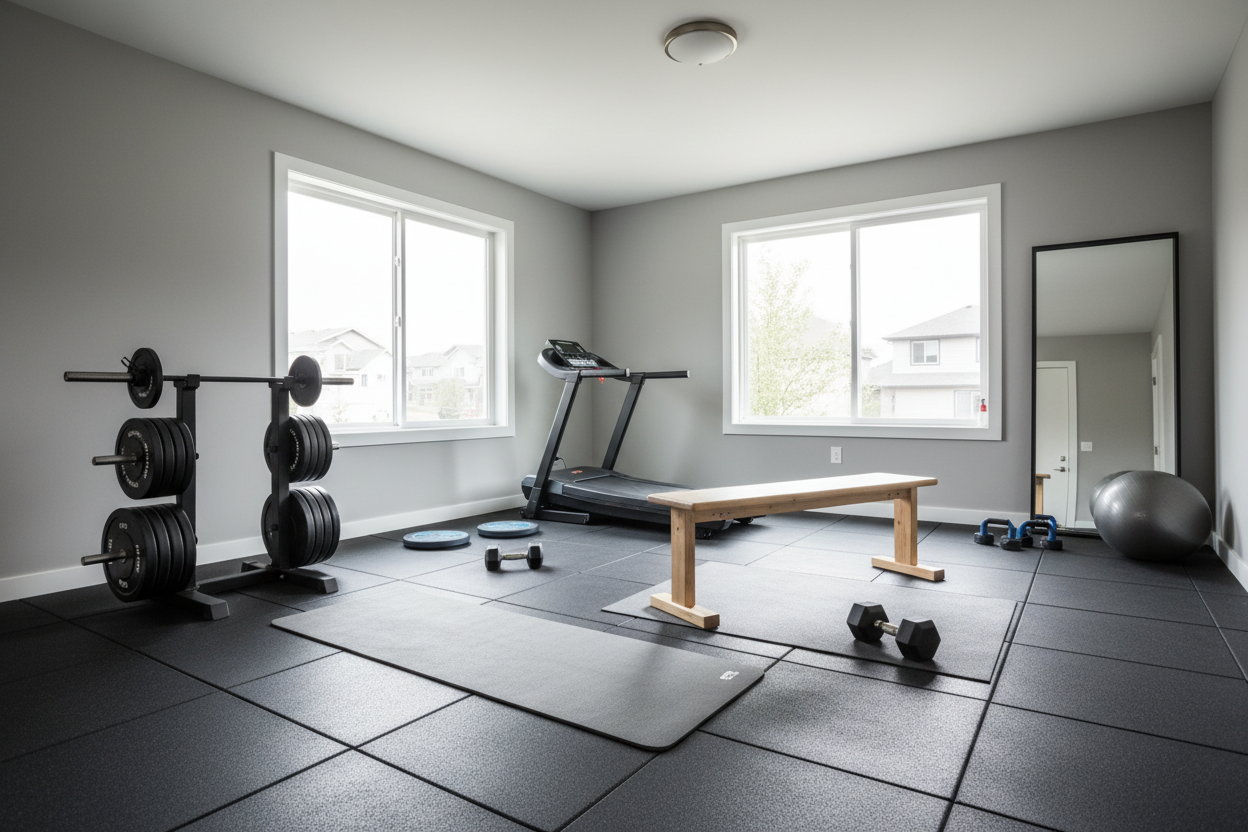
I usually point my clients toward a 6x8ft exercise mat because it provides ample room for dynamic movements, stretching, and storing a set of adjustable dumbbells (like a 5-52.5 lb pair) right on the corner. You do not need a massive power rack right away. A high-quality, durable floor base completely changes the feel of your workout space, turning a spare bedroom into a legitimate training zone.
Moving Forward: What Every Best Home Workout Beginner Needs
Your success comes down to showing up. As a best home workout beginner, your primary goal is to build the habit of exercising regularly. Track your workouts in a simple notebook. Write down how many reps you completed and how the friction felt.
If your paper plates ripped or your socks got holes in them, write that down too. It is all data. Celebrate the small victories, like doing one more lunge than last week or holding your hips higher during a hamstring curl. Listen to your body, upgrade your space when you are ready, and keep pushing forward.
FAQ
Do I need special sliders for this workout?
No. Thick cotton socks work perfectly on hardwood or tile floors. If you have carpet, cheap paper plates or plastic Tupperware lids provide the exact same sliding effect.
How often should a beginner work out at home?
Aim for three days a week. This provides enough stimulus to build muscle and improve cardiovascular health while allowing your nervous system 48 hours to recover between sessions.
Will friction training build actual muscle?
Yes. Muscle growth requires mechanical tension and progressive overload. By manipulating your body weight and fighting the drag of the floor, you create enough tension to stimulate significant muscle growth in beginners.