Structuring a Complete 7-Day Gym Workout Plan: Daily Split Design, Active Recovery, and Ground Setup
Principles of Structuring a Sustainable 7-Day Gym Workout Plan
Executing a 7-day gym workout plan requires thoughtful structural planning to avoid excessive fatigue and joint wear. When training across seven consecutive days, the primary goal is not maximal daily exhaustion, but rather the strategic management of volume, exercise intensity, and movement selection. Rather than performing random daily sessions, a structured 7-day workout split alternates muscle groups and training stimuli to allow worked tissues to recover while adjacent muscle groups are loaded.
A well-designed 7-day fitness plan balances multi-joint compound resistance exercises with targeted isolation movements and low-impact active recovery. If you are establishing baseline training habits, reviewing a foundational beginners workout plan guide helps reinforce core movement mechanics before committing to daily scheduling. In a full weekly routine, regulating lifting intensity ensures that the nervous system remains fresh and ready for each training session without unnecessary physical burnout.
The 7-Day Push-Pull-Legs and Upper-Lower Hybrid Split
A reliable framework for a 7 day workout schedule is a hybrid split that pairs a classic Push-Pull-Legs progression with a dedicated active recovery day and an Upper-Lower cadence. This setup organizes daily efforts into distinct mechanical categories, preventing overlapping strain on primary movers and stabilizing joints.
Days 1 to 3: Push, Pull, and Leg Foundations
The weekly cycle opens with fundamental compound lifts to establish structural tension and movement quality:
- Day 1 (Push Focus): Horizontal and vertical pressing movements targeting the chest, shoulders, and triceps, complemented by overhead dumbbell work and floor-based push-ups.
- Day 2 (Pull Focus): Barbell rows, lat pulldowns, chest-supported rows, and bicep flexion to build upper back support and grip control.
- Day 3 (Leg Focus): Multi-joint knee and hip extensions, including squats, split squats, Romanian deadlifts, and calf raises.
For individuals structuring multi-phase strength routines, exploring an exercise plan men guide provides clear sequencing ideas for managing lower-body and upper-body mechanical balance.
Day 4: Floor-Based Active Recovery, Mobility, and Core Integrity
Day 4 avoids high-load resistance training in favor of active restoration. Instead of remaining completely sedentary, utilizing this session for multi-planar hip mobility, thoracic spine rotations, ankle flexibility, and isometric core holds keeps blood flowing and restores joint ranges of motion. Laying down a supportive surface for quadruped reaches, bird-dogs, and deep breathing drills provides a clean platform to reset movement mechanics mid-week.
Days 5 to 7: Upper Hypertrophy, Lower Dynamics, and Conditioning
The final three days complete the 7-day workout plan to build muscle with higher-rep hypertrophy work and full-body conditioning:
- Day 5 (Upper Hypertrophy): Incline dumbbell presses, cable lateral raises, face pulls, and arm supersets focusing on sustained muscular tension.
- Day 6 (Lower Dynamics & Posterior Chain): Hip thrusts, Bulgarian split squats, hamstring curls, and kettlebell swings focusing on unilateral balance.
- Day 7 (Full-Body Conditioning & Aerobic Flush): Bodyweight circuits, light dumbbell complexes, core circuits, and moderate aerobic work to finish the 7 day gym split.
Floor Staging and Substrate Stability Across Daily Workouts
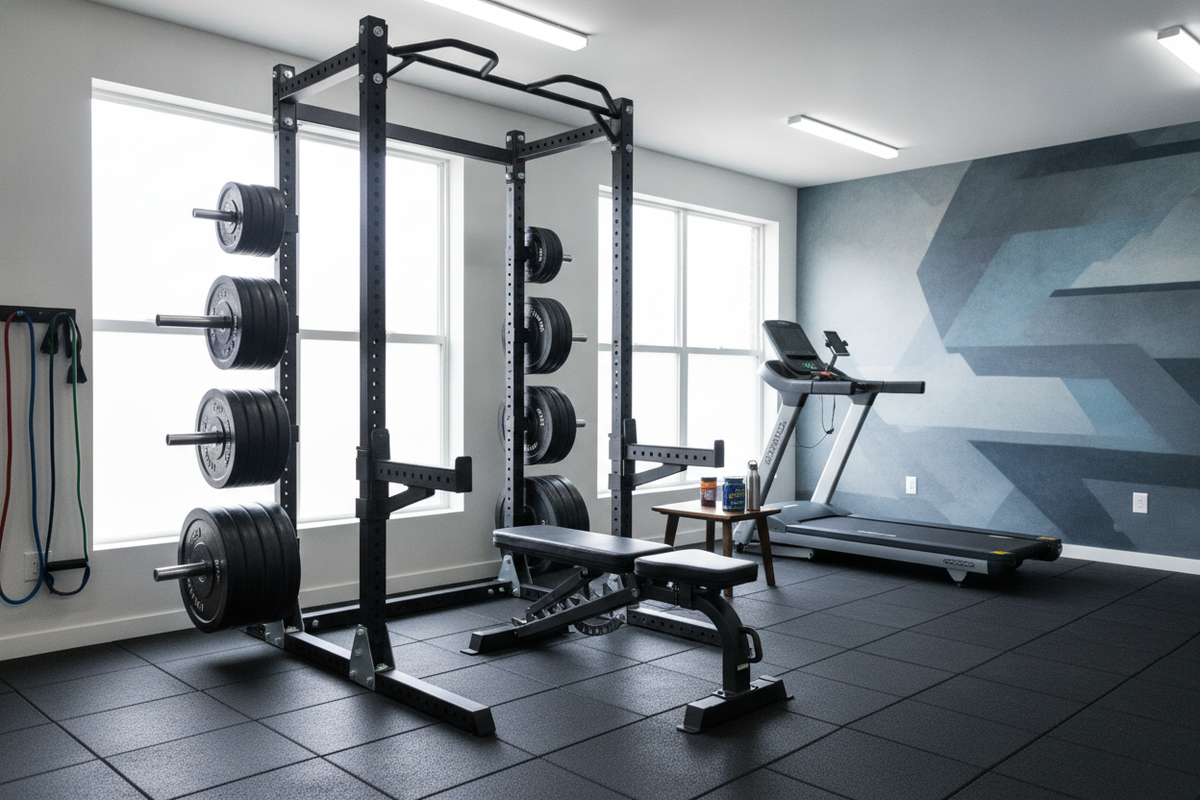
Training seven days a week places significant demands not just on your body, but also on your training environment. A stable, non-slip foundation is essential for heavy barbell setups, dumbbell presses, lunges, and floor-based mobility work. Utilizing dedicated gym flooring from an exercise gym collection provides uniform traction, helps absorb vibration from foot strikes, and protects household subfloors from accidental impacts.
When performing heavy squats or dumbbell lunges, firm underfoot support prevents foot slippage and ensures consistent force transmission from the floor through the kinetic chain. In my view, having a dependable, high-density floor mat transforms an ordinary training space into an inviting, professional-grade lifting environment that encourages daily adherence.
Equipment Placement, Dumbbell Zones, and Mat Maintenance
To run a seamless daily routine at home, layout optimization is just as important as the workout structure itself. Staging a dedicated large-format mat, such as an exercise gym workout product, establishes a dedicated perimeter for free-weight movements, bench positioning, and ground-level stretching.
Keep high-traffic lifting zones clear of clutter by racking dumbbells, kettlebells, and resistance bands along the perimeter of the mat. Regular maintenance—such as wiping down the mat surface after sweat-heavy sessions with a mild cleanser and damp cloth—preserves surface grip, prevents residue buildup, and extends the service life of your protective flooring across a demanding seven-day schedule.
Progressive Overload, Joint Longevity, and Weekly Cycle Adjustments
Maintaining a 7 day a week workout plan over months requires disciplined tracking of recovery markers. Rather than adding heavy weight every single session, progressive overload can be achieved through additional repetitions, slower eccentric tempos, tighter rest intervals, or improved exercise technique.
If joint discomfort or systemic fatigue accumulates, adjust your plan by swapping barbell variations for dumbbell or cable movements, or substituting an extra floor-based mobility session in place of a heavy lifting day. Listening to biomechanical feedback and pairing smart programming with a supportive training surface ensures consistent progression, joint comfort, and sustained fitness development.