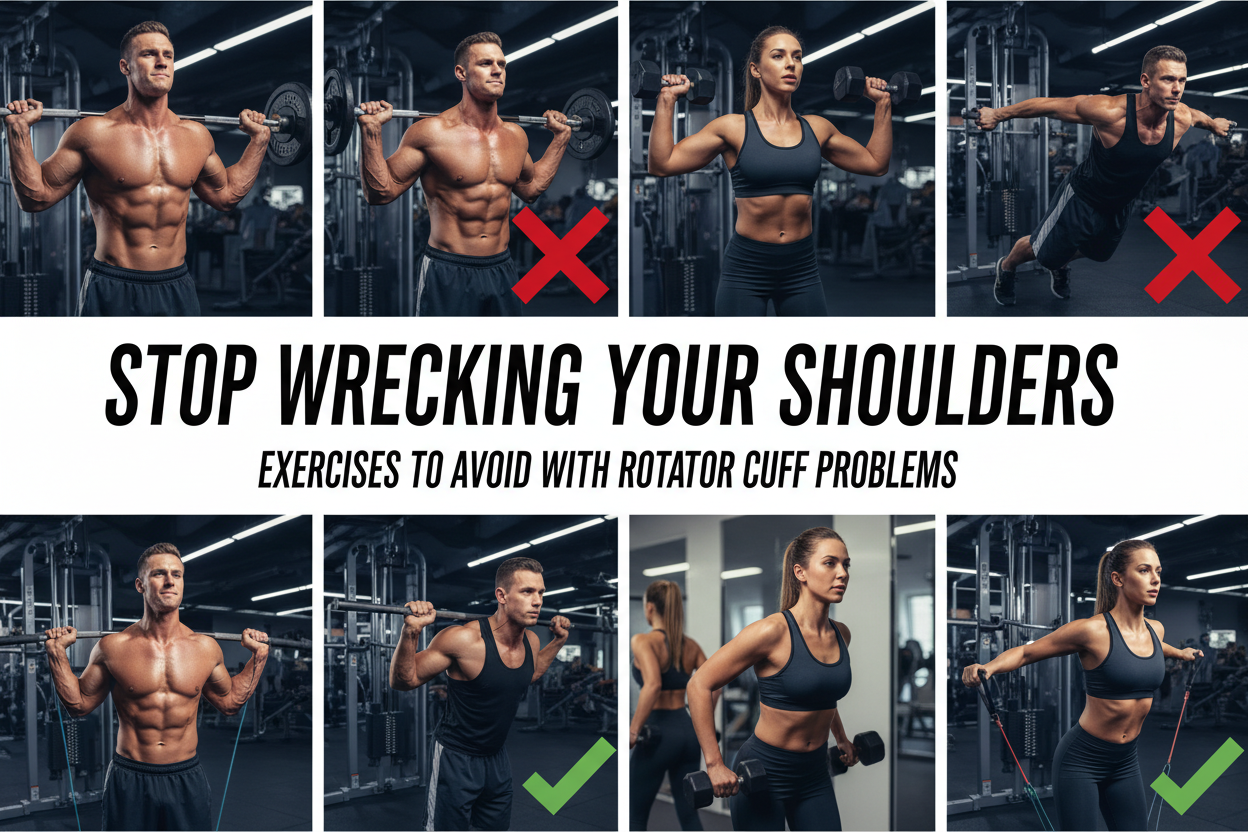
Stop Wrecking Your Shoulders: Exercises to Avoid with Rotator Cuff Problems
You know the feeling. It’s that sharp, sudden pinch when you reach for a seatbelt, or the dull, toothache-like throb that keeps you awake at night. If you are training through pain, you are likely making things worse. Understanding the specific exercises to avoid with rotator cuff problems is not just about skipping a gym session; it is about preventing a surgical intervention down the road.
The shoulder is the most mobile joint in the body, but that mobility comes at a cost: stability. When the small stabilizer muscles—specifically the supraspinatus—are frayed or inflamed, standard gym movements turn into joint grinders. Let’s look at how to modify your training to heal while maintaining strength.
Quick Summary: The Danger Zone
- Upright Rows: Forces the shoulder into internal rotation while elevating, causing immediate impingement.
- Behind-the-Neck Presses: Places extreme stress on the anterior capsule and cervical spine.
- "Empty Can" Lateral Raises: Aggravates the supraspinatus tendon by closing the subacromial space.
- Deep Chest Dips: excessive extension stretches the front of the shoulder capsule dangerously.
- Full Range Bench Press: The bottom position often strains the tendon insertion points.
Why Certain Movements Are "Rotator Cuff Killers"
To understand what exercises aggravate rotator cuff issues, you have to understand impingement. Imagine your rotator cuff tendon is a rope passing through a narrow tunnel (the subacromial space). When you perform movements that combine lifting your arm (elevation) with turning it inward (internal rotation), you are essentially sawing that rope against the bony roof of the tunnel.
This is why shoulder tendonitis exercises to avoid almost always involve overhead pressing or awkward leverage points. It isn't that the exercise is inherently "evil," but for an inflamed shoulder, it is mechanically destructive.
The Critical List: Exercises to Avoid with Rotator Cuff Injury
1. Upright Rows (The Worst Offender)
If there is one movement to banish immediately, it is the barbell upright row. This movement forces your shoulders into a position of maximal internal rotation while lifting a load. This creates a "pincer" effect on the supraspinatus tendon. It is the fastest way to turn a minor ache into a tear.
2. Behind-the-Neck Presses and Pulldowns
Old-school bodybuilders loved these, but they require a level of thoracic mobility and external rotation that 99% of the population lacks. When you force the bar behind your head, you are stretching the front of the shoulder capsule to its limit. If you have a torn rotator cuff, exercises to avoid like this are non-negotiable.
3. The "Empty Can" Lateral Raise
For years, coaches taught lateral raises with thumbs pointing down (like pouring out a can). We now know this is biomechanically flawed. Internal rotation reduces the space in the shoulder joint. If you are dealing with supraspinatus tear exercises to avoid, this is at the top of the list. It grinds the exact spot you are trying to heal.
4. Tricep Dips (Bench or Bar)
Dips place the shoulder in significant extension (arm behind the body). When you lower your body weight, the head of the humerus (arm bone) tilts forward, putting massive shear force on the rotator cuff tendons. If your shoulders roll forward at the bottom of a dip, you are doing damage.
Smart Alternatives: How to Train Around the Injury
Just because there are shoulder pain exercises to avoid doesn't mean you stop training. You simply need to change the angle and the lever arm.
Switch to Neutral Grip
When pressing (if pain-free), use dumbbells with palms facing each other. This opens up the subacromial space, giving the tendons room to breathe. The Landmine Press is arguably the best variation here, as it allows for an angled press rather than straight overhead.
Floor Press Instead of Bench Press
The bench press is often a bad exercise for rotator cuff issues because the bottom portion of the lift stretches the compromised tissue. By doing a floor press, your triceps hit the ground before the shoulder enters that danger zone, protecting the joint while still loading the chest and triceps.
My Training Log: Real Talk
I want to be transparent about my own battle with this. I spent six months ignoring a nagging pain in my left shoulder because I didn't want to drop my overhead press numbers. I thought I could foam roll it away.
The reality check hit me during a set of heavy incline bench presses. It wasn't a snap, but a sickening feeling of weakness—like the power cord to my arm was suddenly unplugged. I couldn't even un-rack the empty bar without a sharp, electrical jolt running down my deltoid.
The most frustrating part wasn't the gym; it was sleeping. I remember waking up every time I rolled onto my left side, feeling a deep, dull ache that throbbed all the way to my elbow. I had to stop doing all overhead work for 12 weeks. I replaced everything with isometric holds and band pull-aparts. It was boring, and my ego took a hit, but it was the only way I got back to pressing pain-free. If you feel that "catch" or weakness, stop immediately. Do not try to push through the grit.
Conclusion
Shoulder health is a long game. Identifying the exercises to avoid shoulder injury is the first step toward recovery. You cannot strengthen a muscle that is actively being ground down by bone. Swap the ego-lifting for smart mechanics, avoid the movements listed above, and give your tendons the biological time they need to reorganize and heal.
Frequently Asked Questions
Can I do push-ups with a rotator cuff injury?
It depends on the severity. Standard push-ups can be aggravating due to the internal rotation at the top. However, doing push-ups on handles (neutral grip) or elevated on a bar often relieves the pressure. If there is pain, stop immediately.
Are dead hangs good for rotator cuff problems?
Dead hangs can be controversial. For impingement, they can actually help open up the joint space (traction). However, if you have an acute tear or instability, the dead hang might provoke the injury. Test gently with feet on the floor first.
What is the worst exercise for rotator cuff tears?
The upright row is widely considered the worst exercise for rotator cuff health due to the combination of internal rotation and elevation under load, which directly impinges the supraspinatus tendon.