Stop Wasting Time: The Only Glute Routine You Need for Real Growth
Building a strong, powerful posterior chain isn't just about aesthetics; it is the engine for athletic performance and the foundation for a pain-free lower back. Yet, walking into a commercial fitness facility can be overwhelming. You see people doing acrobatic maneuvers on the Smith machine or endlessly kicking backward with resistance bands, and it is hard to discern what is effective from what is merely trendy. The answer to building significant muscle mass lies in physics and anatomy, not social media fads. To truly stimulate growth, you must prioritize exercises for glutes at gym setups that allow for progressive overload—gradually increasing the weight or tension over time.
Your glutes are comprised of three main muscles: the maximus, medius, and minimus. The gluteus maximus is the powerhouse responsible for the majority of the size and shape, while the medius and minimus handle stabilization and abduction (moving the leg away from the body). A well-rounded routine hits all three, but the bulk of your energy should go toward heavy compound movements that challenge the glutes in their lengthened and shortened positions.
The King of Glute Development: The Barbell Hip Thrust
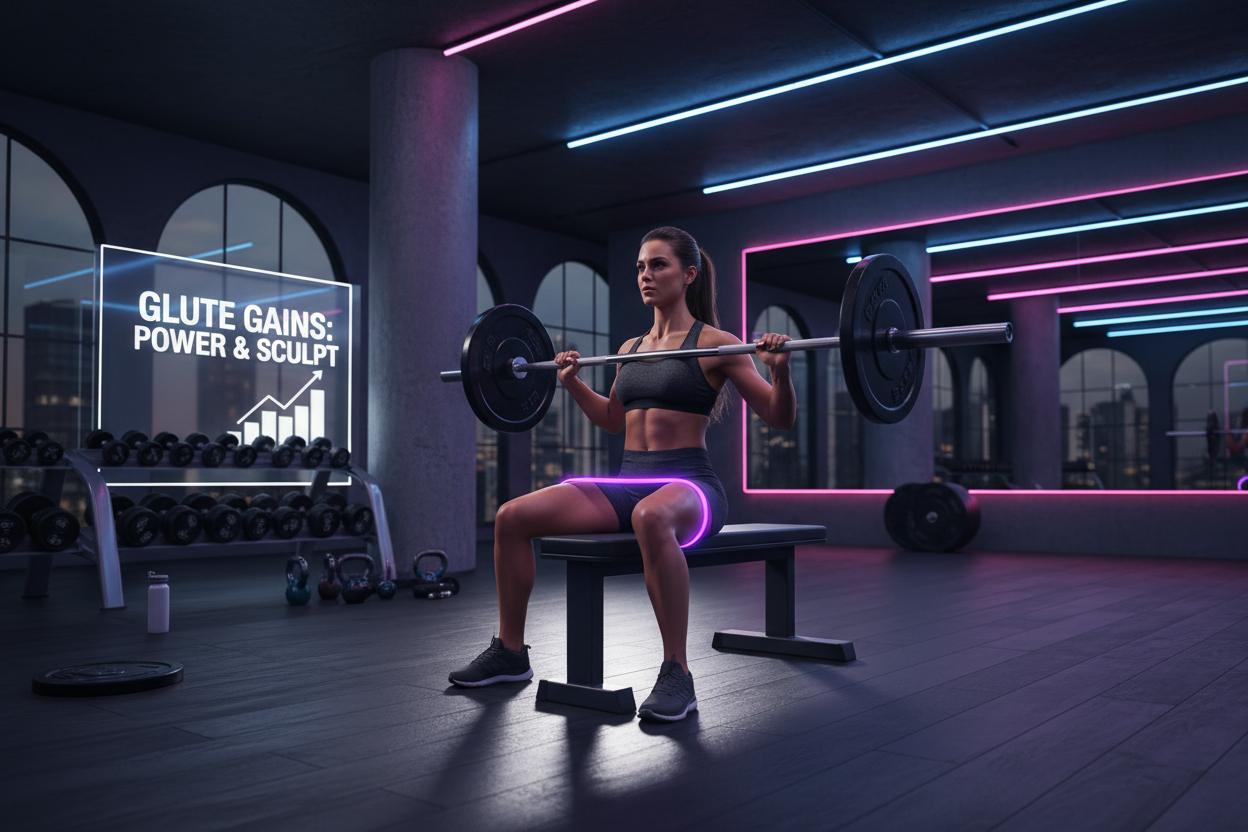
If you have limited time and can only choose one movement, this is it. The hip thrust isolates the glutes better than almost any other compound lift because it keeps constant tension on the muscle at its peak contraction. Unlike a squat, where the tension on the glutes decreases at the top of the movement, the hip thrust is hardest right when your glutes are fully squeezed.
Set up a bench against a wall so it doesn't slide. Sit on the floor with your upper back against the bench, shoulder blades resting on the edge. Roll a barbell over your hips (use a foam pad to protect your pelvic bone). Plant your feet shoulder-width apart. Drive through your heels to lift your hips until your torso is parallel to the floor. The visual cue here is essential: keep your chin tucked against your chest and your ribs down. If you look up at the ceiling, you are likely arching your lower back, which transfers the load away from your glutes and onto your lumbar spine. Squeeze hard at the top, then lower with control.
Romanian Deadlifts (RDLs)
While the hip thrust challenges the glute in the shortened (contracted) position, the Romanian Deadlift is the superior choice for challenging the glute in the lengthened (stretched) position. This stretch under load is a massive driver for hypertrophy. This is arguably the most technical glute exercise in gym environments because it requires strict hip hinge mechanics.
Stand with a barbell or heavy dumbbells in your hands. Keep a slight bend in your knees—this bend should not change throughout the movement. Imagine there is a car door open behind you and you are trying to close it with your butt. Push your hips back as far as they can go while keeping the weight close to your shins. You should feel a deep stretch in your hamstrings and glutes. Once your hips cannot travel back any further, drive your hips forward to return to the starting position. Do not go all the way to the floor; range of motion is dictated by how far back your hips can push, not how low the bar gets.
My Personal Shift in Perspective
I spent the first two years of my lifting journey terrified of heavy weights. I stuck to the abduction machine and high-repetition kickbacks thinking that the "burn" equaled growth. I would do sets of 30 or 40 reps, feeling an intense fire, but my physique barely changed. It wasn't until I swallowed my pride and walked over to the squat rack that things started happening. I remember the first time I managed to hip thrust my own body weight for 10 reps. It was humbling, but the soreness the next day was different—it felt deep within the muscle belly rather than just a surface-level burn. Shifting my focus from "feeling the burn" to "moving more weight with perfect form" was the catalyst that finally changed my body composition. You have to earn the growth by forcing the muscle to adapt to heavier loads.
Bulgarian Split Squats
This movement has a reputation for being miserable, and for good reason. It is incredibly taxing, but the payoff is unmatched. Unilateral (single-leg) training ensures that you don't have muscle imbalances where one side takes over for the other. It also places the glute under immense tension while stabilizing the pelvis.
To bias the glutes rather than the quads, you need to adjust your torso angle. Place your back foot on a bench or a low box. Step your front foot out far enough so that when you lower yourself, your shin remains relatively vertical. As you descend, lean your torso forward slightly (think 45 degrees). This forward lean stretches the glute more effectively. Drive through the heel of the front foot to stand back up. If you stay upright, you will feel it mostly in your front thigh; lean forward, and it becomes a glute destroyer.
Cable Glute Kickbacks
Once the heavy compound lifting is done, you can move to isolation work to shape the glutes and hit the upper shelf (gluteus medius). The cable machine provides constant tension throughout the range of motion, which dumbbells cannot do for this specific movement pattern.
Attach an ankle strap to a low pulley. Lean your torso forward until it is almost parallel to the floor and hold onto the machine for stability. Kick your leg back and slightly out at a 30-degree angle. This slight abduction hits the upper glute more effectively than kicking straight back. Keep your core braced and avoid swinging your lower back. The movement should come entirely from the hip joint.
Rounding Out the Routine: 45-Degree Hyperextensions
Most gyms have a hyperextension bench, usually relegated to lower back warmups. However, with a slight tweak, this becomes one of the best exercises for glutes at gym stations. The standard way to do this is with a flat back, which targets the spinal erectors. To switch the focus to your posterior chain, round your upper back intentionally (slouch) and tuck your chin. As you lower yourself, think about stretching the hamstrings. As you rise, focus purely on driving your hips into the pad and squeezing your glutes. Stop before your back arches. The rounded spine takes the lower back muscles out of the equation, forcing the glutes to do the heavy lifting.
Programming for Success
You do not need to do every single one of these exercises every session. A solid approach is to pick one heavy compound lift (like the Hip Thrust or Squat) and pair it with a stretch-focused lift (like the RDL) and one isolation movement (like the Kickback). Aim for 3 to 4 sets per exercise. For the heavy compounds, keep the reps lower (6 to 10 reps) to focus on strength. For the isolation movements, push the reps higher (12 to 15 reps) to induce metabolic stress. Consistency and tracking your weights are the final ingredients. If you lifted 100lbs this week, try for 105lbs next week. That small addition is what forces the body to change.
Frequently Asked Questions
How often should I train my glutes for maximum growth?
Most lifters see the best results training glutes 2 to 3 times per week. This frequency allows for high-quality volume while giving the muscles roughly 48 hours to recover and rebuild between sessions.
Why do I feel leg exercises in my lower back instead of my glutes?
This usually happens due to poor core bracing or hyperextending the spine at the top of the movement. Focus on keeping your ribs knit down and your chin tucked, and ensure you are squeezing your glutes to finish the lift rather than arching your back.
Can I build glutes using only machines?
Yes, machines like the leg press and smith machine can be very effective if used with proper foot placement (usually high and wide). However, incorporating free weights helps develop stabilizer muscles and functional strength that machines often neglect.