Wake Up Your Glutes: The Pre-Workout Routine That Actually Works
You have likely experienced the frustration of finishing a heavy leg day only to feel the soreness exclusively in your quads and lower back the next morning. Your glutes remain stubbornly fresh, as if they didn't participate in the workout at all. This is a common issue known as "glute amnesia," where your posterior chain fails to fire correctly during compound movements. To fix this, you need to understand what are glute activation exercises and how to implement them effectively before you touch a barbell.
Glute activation exercises are low-load, isolation movements performed specifically to establish a mind-muscle connection with the gluteal muscles (maximus, medius, and minimus). Unlike strength building sets where the goal is muscle failure, the goal here is neural drive. You are trying to wake the muscle up, not exhaust it. If you spend the majority of your day sitting at a desk, your hip flexors tighten and your glutes lengthen and deactivate. Jumping straight into squats from this state usually results in your lower back taking over the load, which is a recipe for injury rather than growth.
How Long Does It Take to Activate Glutes?
One of the biggest misconceptions is that a warm-up needs to be a twenty-minute ordeal. If you are wondering how long does it take to activate glutes, the answer is surprisingly brief. You only need about five to ten minutes. The objective is to reach a point where you feel a distinct burn or contraction in the muscle belly. Once you feel the muscle firing, you move on. Doing too much can actually fatigue the muscle before your main lifts, which is counterproductive. A quick, focused circuit is all that is required to prime your body for heavier loads.
My Battle With "Sleepy" Glutes
I learned the importance of this the hard way. Years ago, I hit a plateau on my deadlift that I couldn't break. Worse, I developed a nagging ache in my lumbar spine. I assumed I just needed to strengthen my back, but a movement assessment revealed the opposite. My glutes were essentially dormant. During heavy lifts, my body naturally sought the path of least resistance, bypassing my glutes and loading my spine. Incorporating a specific glute activation routine didn't just cure the back pain; it added significant weight to my lifts within a month because I was finally using the largest muscle group in my body effectively.
The Best Glute Activation Exercise for Beginners
If you were forced to choose the single best exercise to activate glutes, the standard Glute Bridge is the reigning champion. It is accessible, requires no equipment, and directly targets the gluteus maximus while taking the hamstrings largely out of the equation if performed correctly. To get the best glute activation, lie on your back with knees bent and feet flat on the floor. The trick is to drive through your heels and tuck your pelvis slightly (posterior pelvic tilt) before you lift your hips. Squeeze hard at the top for two seconds. If you feel it in your hamstrings, move your feet closer to your butt. If you feel it in your quads, move them further away.
Building Your Routine: Essential Booty Activation Exercises
While the bridge is fantastic, the glutes are complex muscles that move the leg in multiple directions. A comprehensive warm-up should include movements that target abduction (moving the leg away from the body) and rotation. Here are the top booty activation exercises to include in your rotation.
The Clamshell
This is arguably the best way to activate glutes specifically targeting the gluteus medius, which sits on the side of your hip. The medius is responsible for hip stability. Weakness here often leads to knees caving inward (valgus) during squats. Lie on your side with legs stacked and knees bent at a 45-degree angle. Keeping your feet touching, open your top knee like a clam. Place your hand on your side hip to feel the muscle contracting. This is a staple in physical therapy for a reason.
Banded Lateral Walks
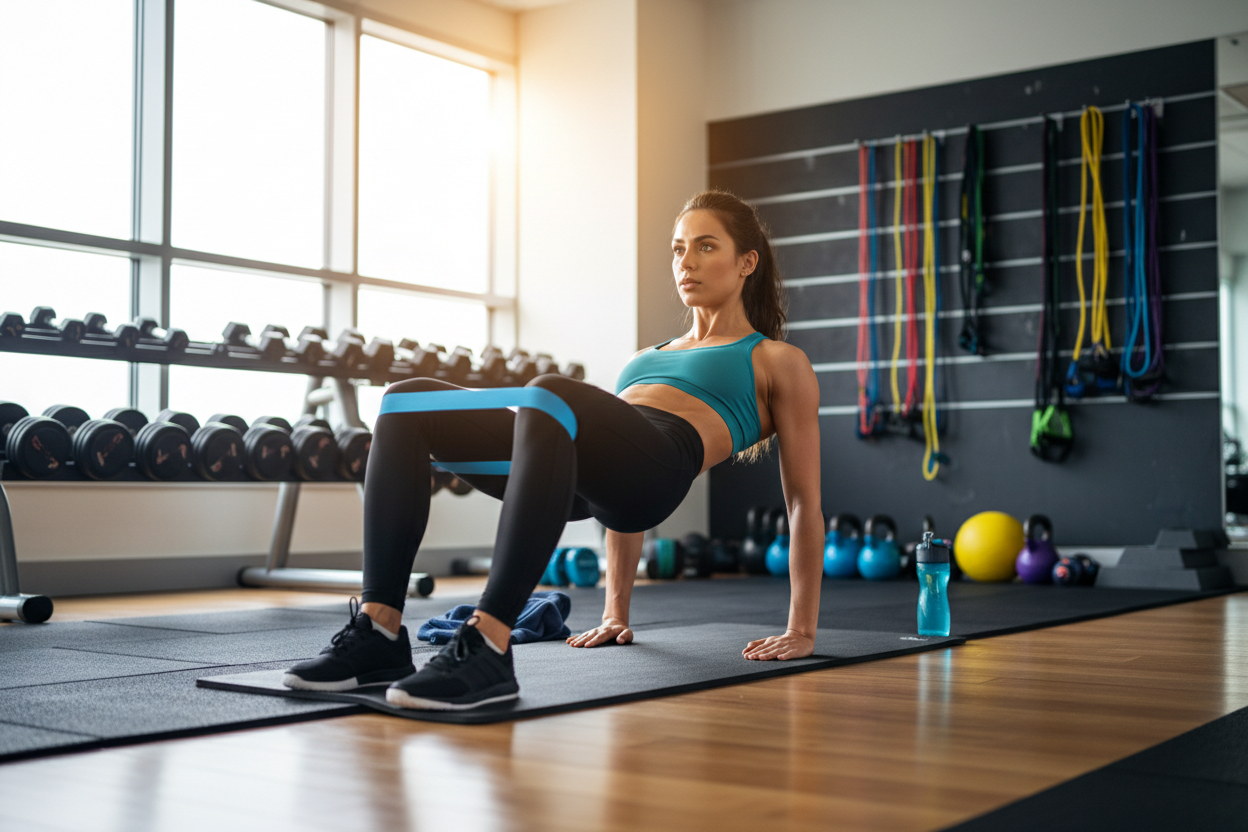
For dynamic movement, lateral walks are superior. Place a mini-band around your thighs (just above the knee) or around your ankles. Assume a quarter-squat position and step sideways. The constant tension forces your glutes to fire to keep your knees from collapsing inward. This serves as both a pulse-raiser and a targeted activator.
Donkey Kicks
Start on all fours. Kick one leg back and up towards the ceiling, keeping the knee bent at 90 degrees. The focus here must be on the hip extension. Many people arch their back to get the leg higher, but that transfers the work to the lumbar spine. Keep your core braced and your back flat. The range of motion might be smaller, but the isolation will be significantly higher.
Leg and Glute Activation Exercises for the Gym
When you have access to equipment, you can upgrade your warm-up. Glute activation exercises gym settings allow for include cable pull-throughs and banded goblet squats. The cable pull-through is unique because it mimics the hip hinge pattern of a deadlift while maintaining constant tension from behind. Stand facing away from a low cable pulley, holding the rope attachment between your legs. Hinge forward at the hips, feeling a stretch in the hamstrings, and then squeeze the glutes to stand tall.
Another excellent option is the banded goblet squat. Place a resistance band around your knees while performing a lightweight goblet squat. The band tries to pull your knees in, forcing your glutes to fight back to maintain proper knee alignment. This effectively kills two birds with one stone: it warms up the squat pattern and fires up the abductors simultaneously.
Daily Glute Activation Exercises for Desk Workers
You do not need to wait for leg day to work on this. If you work a sedentary job, incorporating daily glute activation exercises can prevent hip pain and improve posture. You can perform standing glute squeezes while waiting for your coffee to brew. Simply stand tall and squeeze your glutes as hard as possible for 10 seconds, then release. Another option is the seated abduction: while sitting in your chair, press your knees outward against your hands or a resistance band. These micro-sessions keep the neural pathways active throughout the week, making it easier to engage the muscles when you actually hit the gym.
Structuring the Perfect Glute Activation Routine
To put this all together, you need a flow that transitions smoothly into your workout. Do not overcomplicate it. A solid sequence looks like this:
- Glute Bridges: 15 reps with a 2-second hold at the top.
- Clamshells: 12 reps per side.
- Bird-Dogs: 10 reps per side (great for core and glute coordination).
- Banded Lateral Walks: 15 steps each direction.
Perform this circuit one or two times. You should feel warm and your hips should feel loose. Once you move to your main compound lift, do one or two warm-up sets with lighter weight where you deliberately focus on squeezing the glutes at the top of the movement.
Troubleshooting: Why You Still Can't Feel It
If you try these exercises and still struggle to feel the burn, check your hip flexors. Tight hip flexors can inhibit glute activation through a process called reciprocal inhibition. Essentially, if the muscles on the front of your hip are short and tight, the brain tells the opposing muscles (the glutes) to relax. Before starting your activation routine, try a quick lunge stretch to open up the front of the hips. This mechanical release often unlocks the door for the glutes to function properly.
Remember that consistency is the missing link. You cannot undo eight hours of sitting with one set of bridges performed once a month. By making these movements a non-negotiable part of your warm-up, you protect your back, improve your posture, and finally start seeing the athletic performance and aesthetic results you have been working toward.
Frequently Asked Questions
Can I do glute activation exercises every day?
Yes, you can perform these exercises daily, especially if you have a sedentary job. Since activation exercises use low loads and body weight, they generally do not require the 48-hour recovery window that heavy lifting sessions do. Doing them daily can help combat "glute amnesia" caused by prolonged sitting.
Do I need resistance bands for these exercises to work?
While resistance bands are highly effective for increasing the intensity and feedback of the movement, they are not strictly necessary for beginners. You can achieve significant activation using just body weight and high mental focus on the contraction. However, as you get stronger, bands are an inexpensive tool to ensure progressive overload in your warm-up.
Will glute activation exercises make my glutes bigger?
On their own, activation exercises are usually not intense enough to stimulate significant muscle hypertrophy (growth). Their primary purpose is to wake up the muscle so it fires correctly during heavy compound lifts like squats and deadlifts. It is the heavy lifting performed after activation that primarily drives muscle growth.