Stop Wasting Reps: How to Build Thigh Muscle at Home Correctly
Let's be honest: doing endless air squats while watching Netflix isn't going to give you the leg development you want. If you want to change your physique, you have to treat your living room like a serious training facility. The biggest misconception people have is that you need heavy iron to trigger growth.
You don't need a squat rack, but you do need intensity. If you are wondering how to build thigh muscle at home, the secret isn't in the equipment you lack, but in how you manipulate the weight of your own body.
Key Takeaways for Home Leg Growth
- Prioritize Unilateral Movements: Training one leg at a time effectively doubles the load on the target muscle.
- Master Time Under Tension (TUT): Slowing down your rep speed forces the muscle to work harder without adding external weight.
- Train to Failure: Without heavy weights, you must push sets closer to technical failure to stimulate hypertrophy.
- Consistency Over Variety: Stick to compound movements like split squats rather than doing random 'influencer' exercises.
The Science of Home Hypertrophy
Your muscles are blind. They do not know if the tension they feel is coming from a $500 barbell or your own body weight. They only understand mechanical tension and metabolic stress.
To build size (hypertrophy), you need to recruit high-threshold motor units. In the gym, we do this by stacking plates. At home, we must achieve this by increasing the lever arm or decreasing stability.
Why High Reps Aren't Enough
If you can do 50 squats in a row without stopping, you are training endurance, not building muscle. To trigger growth, the set needs to become difficult within the 8 to 20 rep range. If it's too easy, we have to change the mechanics, not just add more reps.
The Unilateral Advantage
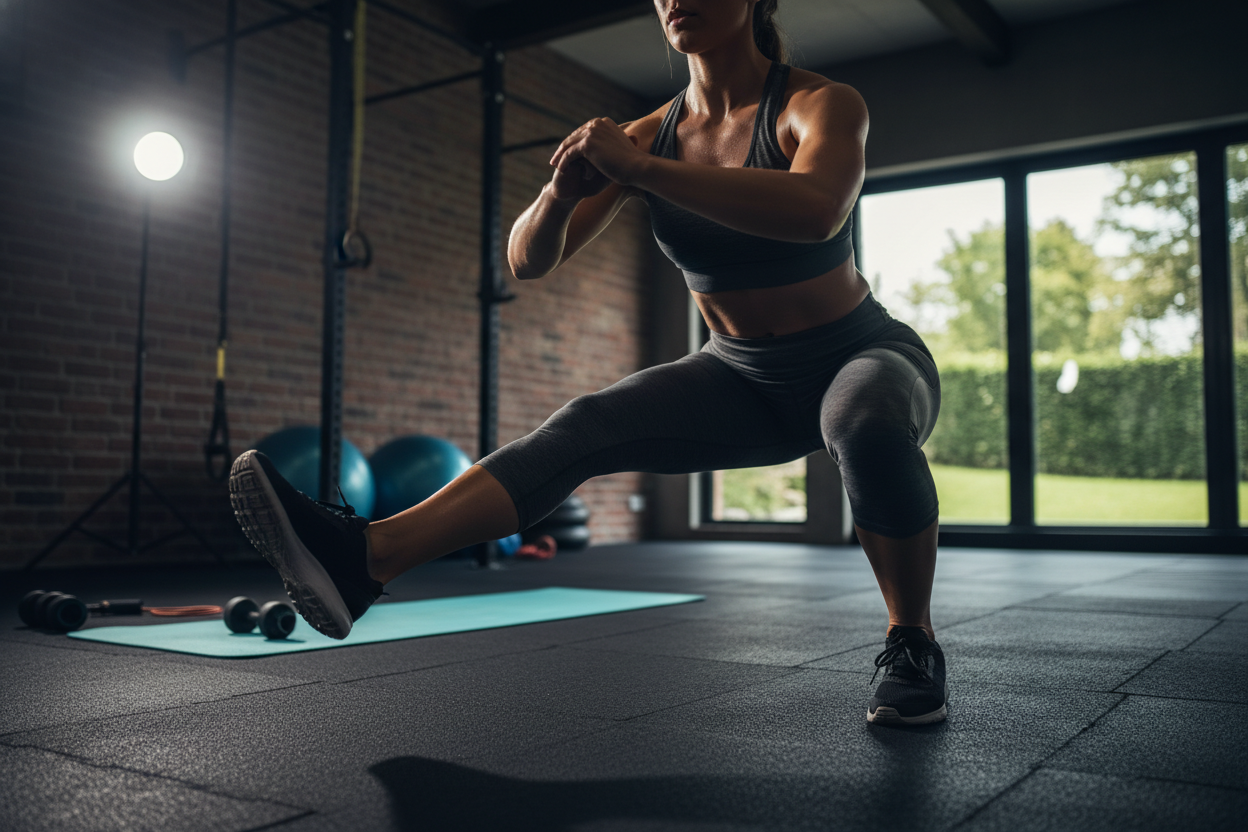
The fastest way to increase intensity at home is to take one leg off the ground. By shifting to single-leg exercises, you place 100% of your body weight on one thigh.
The Bulgarian Split Squat
This is the king of home leg workouts. By elevating your rear foot on a couch or chair, you isolate the front quadricep and glute. It requires balance, which engages stabilizer muscles, and allows for a deep stretch.
The Pistol Squat Progression
The pistol squat is the ultimate bodyweight leg builder. It requires immense mobility and strength. If you cannot do a full pistol squat yet, use a chair to sit down and stand up using only one leg. This 'box squat' variation builds the raw strength needed for the full movement.
Manipulating Tempo and Tension
Since we can't add plates, we add time. This is often overlooked but highly effective.
The 3-1-1 Tempo
Lower yourself for 3 seconds. Pause at the bottom for 1 second. Explode up for 1 second. That slow eccentric (lowering) phase causes micro-tears in the muscle fiber, which is exactly what we want for growth. Do not rush the bottom portion of the movement; that is where the muscle is under the most stretch.
1.5 Reps
To make a light exercise feel heavy, use 1.5 reps. Go all the way down, come halfway up, go back down, and then stand up fully. That counts as one rep. This increases the time your muscles spend under tension, creating a massive burn without any weights.
My Personal Experience with how to build thigh muscle at home
I want to share something from my actual training logs during a period when I didn't have gym access. Everyone talks about Bulgarian Split Squats being great, but no one warns you about the setup pain.
The first few times I did these in my living room, I used my dining chair. It was too high. I vividly remember the cramp in the arch of my rear foot because the ankle angle was too steep. It wasn't the quad burn that stopped me; it was my foot screaming.
I had to switch to using the edge of my sofa, putting a throw pillow under my rear ankle to stop the joint from grinding. Also, without the texture of gym flooring, my front foot kept sliding on the carpet as I got sweaty. I eventually had to do them barefoot to grip the floor properly. It wasn't pretty, and I often ended up collapsing onto the couch between sets, but the soreness the next day was arguably worse than my heavy barbell squat sessions.
Conclusion
Building legs at home requires a shift in mindset. You have to be willing to embrace the discomfort of high-intensity, single-leg work. It won't be easy, and it certainly won't be comfortable, but if you apply these principles of tension and progressive overload, your legs will grow.
Frequently Asked Questions
Can I really build big legs without weights?
Yes, but only up to a point. For advanced bodybuilders, external weight eventually becomes necessary. However, for the general population and intermediate lifters, bodyweight unilateral exercises taken to failure are sufficient for significant muscle growth.
How often should I train legs at home?
Since bodyweight training causes less systemic fatigue than heavy spinal loading, you can train legs more frequently. A frequency of 2 to 3 times per week is optimal for most people to maximize protein synthesis.
What if I have bad knees?
Home training can actually be better for knees because the absolute load is lower. Focus on reverse lunges rather than forward lunges, as they place less shear force on the knee joint. Always control the descent.