Stop Wasting Money on Useless Weight Lifting Accessories
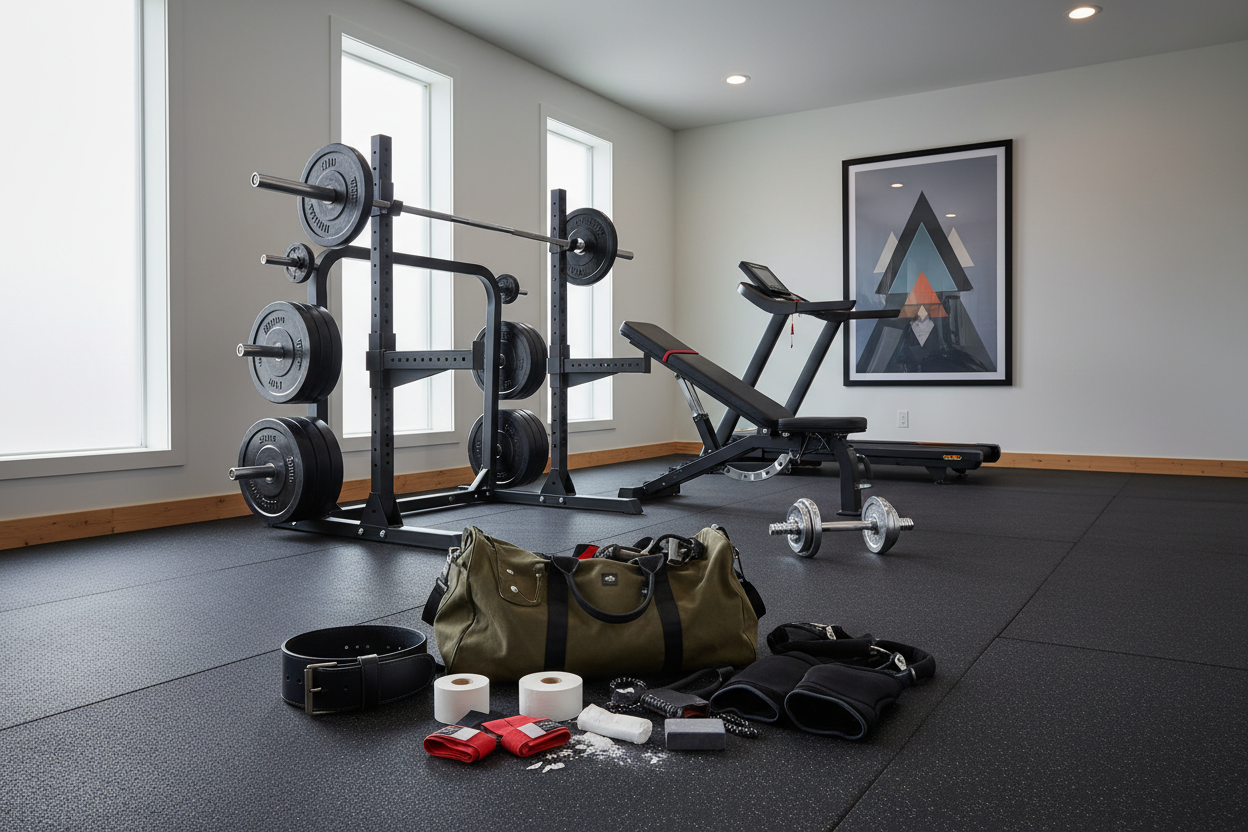
I recently helped a friend move his home gym across town. Between the 45-lb plates and the power rack, I noticed a separate, bulging duffel bag that weighed nearly 40 pounds on its own. Inside were three different pairs of lifting shoes, two belts, four sets of wrist wraps, and enough liquid chalk to paint a house. He has been training for six months and hasn't hit a 225-lb squat yet.
That is when I realized the industry has successfully convinced us that weight lifting accessories are a prerequisite for strength, rather than a supplement to it. We are scrolling Amazon at midnight, comparing the stitching on wrist wraps, while our actual programming is a mess. It is time to empty the bag and see what actually helps you move iron.
Quick Takeaways
- Most gear is a distraction until you hit intermediate strength numbers.
- A 10mm or 13mm leather belt is the only belt you will ever truly need.
- Grip straps are essential for back development but should be used sparingly.
- Knee sleeves are for joint warmth and comfort, not for adding weight to your squat.
- Lifting gloves and elevation masks are a total waste of your hard-earned cash.
Why Your Gym Bag Weighs More Than Your Warm-Up
Social media is a curated lie. You see an athlete with a massive following performing a basic set of lat pulldowns while wearing a lever belt, elbow sleeves, and specialized grip pads. It looks professional, so you assume that is the standard. It is not. Most lifters are lugging around $400 worth of nylon and neoprene before they have even learned how to breathe and brace correctly.
The modern obsession with weightlifting accessories has turned the gym into a fashion show. Buying more gear will not fix a weak upper back or a shallow squat. I have seen guys at the local gym spend ten minutes 'kitting up' for a set of 135-lb bench press. They have the wrist wraps, the elbow sleeves, and the smelling salts. It is theater, not training. You are spending more time adjusting your velcro than you are under the bar.
The Holy Trinity of Lifting Gear That Actually Works
I am not a purist. I do not believe you have to lift in a loincloth on a dirt floor to be 'hardcore.' There is a time and a place for lifting accessories that serve a mechanical purpose. When you start moving weights that are double your body weight, the stress on your joints and the limitations of your grip become real factors.
You want gear that acts as a force multiplier or a safety net. If you are building out your kit, focus on high-quality strength training accessories that are built from heavy-duty leather and reinforced nylon. These are the items that actually survive a garage gym environment and help you push through plateaus.
A Good Leather Belt Will Outlast You
Forget those flimsy, tapered nylon belts with the velcro straps. They are useless for heavy lifting. Your spine does not need a soft hug; your abdominal wall needs a rigid surface to push against. A 10mm or 13mm thick leather belt that is four inches wide all the way around is the gold standard. It creates massive intra-abdominal pressure, stabilizing your spine from the inside out.
I have had my 10mm single-prong belt for eight years. It has survived three house moves and a flooded garage. It will probably outlive me. Whether you choose a prong or a lever is personal preference, but the material must be high-quality leather. A belt does not make your back stronger—it allows you to use your existing strength more efficiently by providing a solid bracing point.
Straps vs. Grips: Stop Dropping Your Deadlifts
Your back is almost always stronger than your hands. If your deadlift stalls at 315 because your fingers are slipping, you are no longer training your posterior chain; you are just testing your grip. This is where straps become essential. Lasso straps are the standard—they are cheap, versatile, and they fit in any pocket.
Figure 8 straps are a bit of a 'cheat code' for max effort pulls because they practically lock you to the bar, though they can be tricky to bail from. Then you have modern grips, which are fast to set up for high-volume rows. Just do not use them for every single set or your forearms will end up looking like pool noodles. Save the straps for your heaviest working sets.
Knee Sleeves (For Warmth, Not Ego)
Knee sleeves are often misunderstood. People buy them thinking they will add 50 pounds to their squat like a pair of powerlifting wraps. They will not. What they will do is keep your knee joint warm, which increases blood flow and keeps the 'creaky' feeling at bay during your warm-up sets. They provide proprioception—that feeling of tightness that helps you stay mindful of your knee position.
I have gone through several pairs over the years. My current 7mm sleeves are stiff enough to offer some support but comfortable enough to wear for an entire hour-long leg session. If you are just starting out, you do not need them. Once you are squatting significant weight, your joints will thank you for the extra warmth and compression.
The Overpriced Placebos You Should Skip
Now for the stuff you should leave on the shelf. Lifting gloves are the biggest waste of money in the fitness industry. They add a layer of padding between you and the bar, which actually makes the bar feel thicker and harder to hold. They kill your natural callous development and get incredibly smelly after a few weeks. Use chalk instead; it is cheaper and more effective.
Then there are the 'altitude' masks. They do not simulate altitude; they just restrict your breathing, making your heart rate spike without any actual aerobic benefit. It is a gimmick that makes you look like a Batman villain. Finally, if you are primarily using weight lifting machines for your training, you really do not need any of this supportive gear anyway. The machine handles the stability for you, making most weightlifting accessories redundant.
Do Beginners Even Need Gear to Get Stronger?
If you are in your first year of training, your goal should be to build a 'natural' belt out of your obliques and core. Relying on accessories lifting too early can stunt the development of your stabilizing muscles. You need to feel the bar in your hands and the floor under your feet without any interference. You need to learn how to move before you learn how to gear up.
The weightlifting or weight lifting debate often distracts from the basics: your first six months should be about movement patterns. Milk those 'newbie gains' for everything they are worth before you start adding layers of leather and neoprene. Once you can deadlift twice your body weight, then you have earned the right to start looking at the gear. It makes the transition to intermediate lifting feel like a reward rather than a crutch.
Personal Experience
I once spent $200 on a pair of 'performance' lifting shoes because a YouTuber said they would fix my squat depth. It turned out I just had tight calves and poor ankle mobility. The shoes were a band-aid that cost me two weeks of groceries. I eventually went back to basics, fixed my mobility in bare feet, and now those expensive shoes gather dust in my closet. I learned the hard way that gear cannot replace physical preparation.
FAQ
Do I need a lever or a prong belt?
Prong belts are easier to adjust if your body weight fluctuates or if you wear different layers of clothes. Lever belts are faster to flick on and off but require a screwdriver to adjust the sizing.
When should I start using lifting straps?
Use them only on your top sets when your grip becomes the limiting factor. If you use them for every warm-up, your natural grip strength will never improve.
Is chalk better than lifting gloves?
Yes. Chalk provides friction and absorbs sweat without changing the mechanics of how you hold the bar. Gloves increase the bar's diameter and reduce your tactile feedback.