Stop Wasting Money on Flimsy Exercise Home Gym Equipment
I remember the first time I bought a 'deal' on a weight bench from a big-box store. It looked fine in the glossy photos, but the first time I loaded 225 pounds on the bar, the frame groaned like a sinking ship. It is a terrifying feeling when your exercise home gym equipment starts to flex mid-set.
Most people start their home gym journey by trying to save a buck, only to realize that budget gear is often just expensive scrap metal. If you are serious about training, you need stuff that can handle a missed lift without folding like a lawn chair. You are building a sanctuary, not a graveyard for plastic pulleys and hollow steel tubes.
Quick Takeaways
- Steel gauge is king: 11-gauge steel is the gold standard for racks; 14-gauge is for clothes hangers.
- Flooring is structural: It protects your joints and your foundation from the impact of heavy iron.
- Skip the gadgets: A solid rack and a versatile barbell will always outperform 'as seen on TV' machines.
- Hardware matters: Look for 5/8-inch or 1-inch bolts; if the hardware looks small, it probably is.
The Brutal Truth About Budget Fitness Gear
The market for fitness equipment for home workout routines is flooded with what I call 'disposable gear.' These are the racks made of thin, 2-inch by 2-inch steel with welds that look like they were applied by a hobbyist. When you start getting strong, that thin steel becomes a liability.
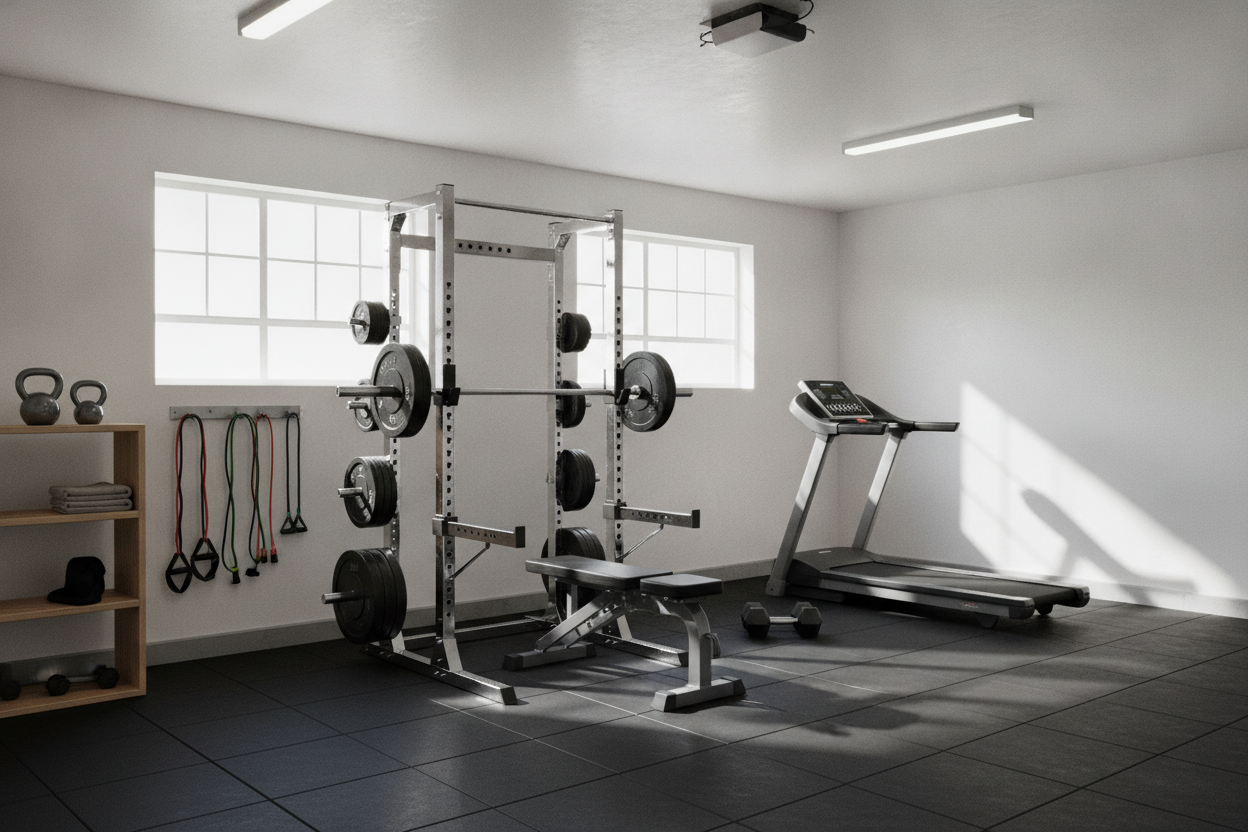
I have seen budget racks sway several inches just from racking a moderately heavy squat. That lack of stability ruins your confidence under the bar. Real gym equipment for home workouts should be made of at least 3-inch by 3-inch 11-gauge steel. It is heavy, it is hard to move, and that is exactly what you want when you are benching alone in a garage.
Your Joints Deserve Better Than Bare Concrete
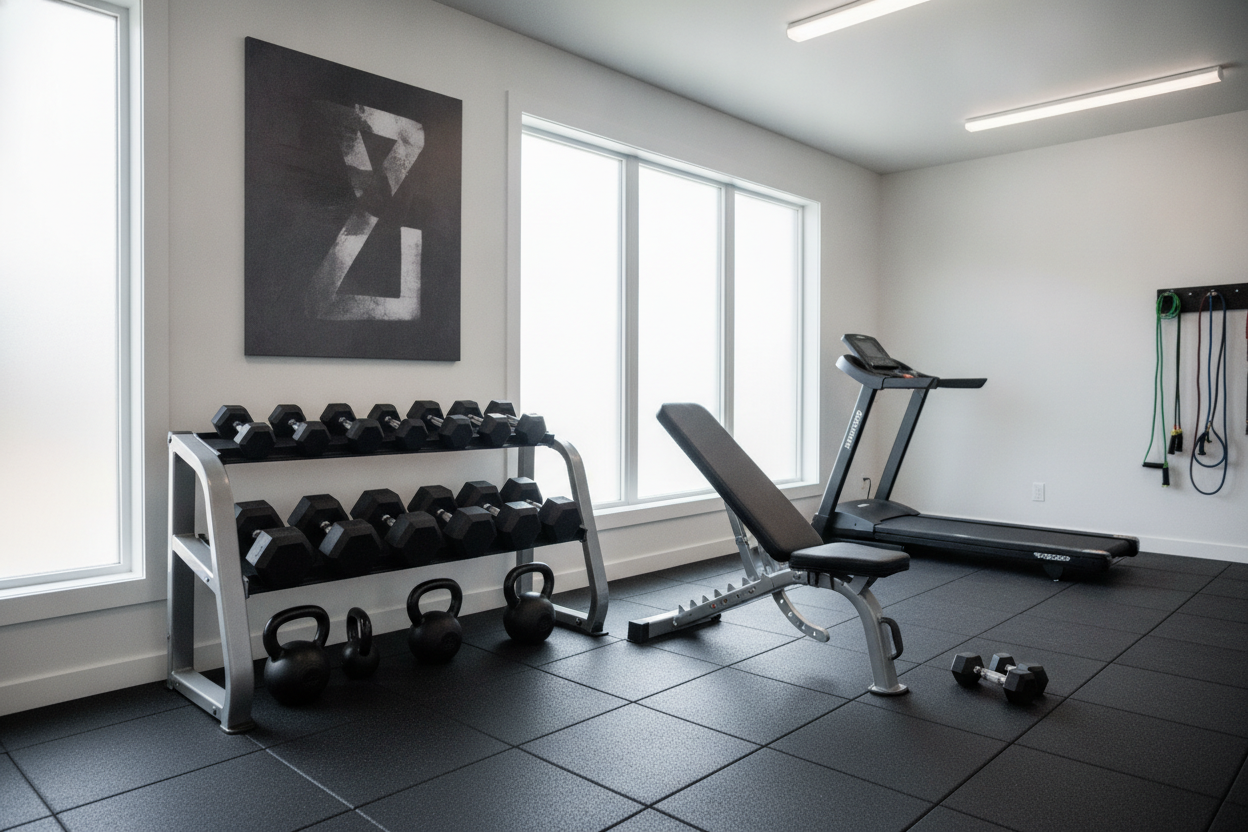
Lifting on bare concrete is a recipe for chronic inflammation. Every time you jump, land, or even just stand for an hour-long session, that concrete is pushing back against your ankles and knees. You need a dedicated large exercise mat to provide the necessary shock absorption for your joints.
Beyond your body, you have to think about the floor itself. Dropping a 45-pound plate on unprotected concrete will eventually lead to spiderweb cracks that are expensive to fix. If you are setting up a power rack, you need at least a 6x8 foot footprint of high-density gym flooring for home workouts to ensure your weights and your foundation stay intact.
Stop Buying Gadgets and Focus on the Foundation
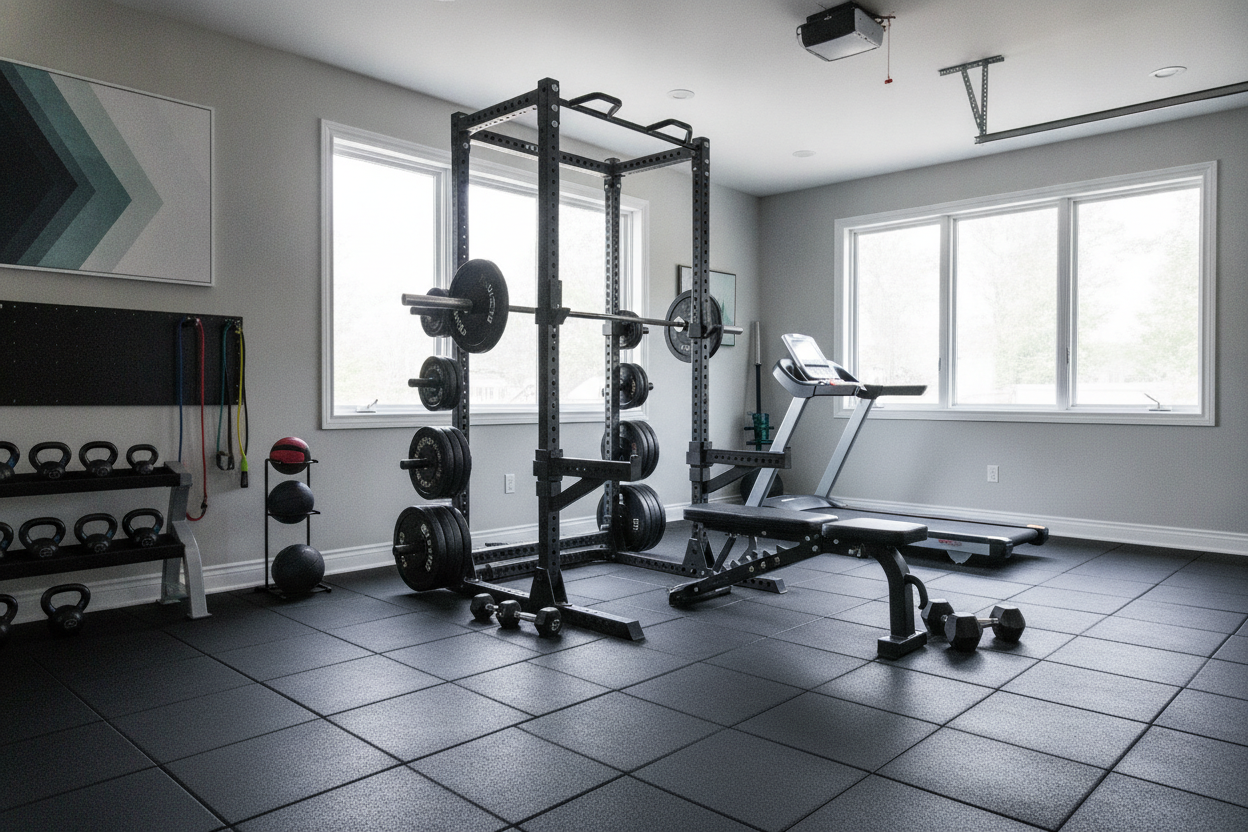
The biggest mistake I see is people filling their spare rooms with 'at home equipment' that only does one thing. Those abdominal crunch machines and folding treadmills usually end up as expensive laundry racks. Instead, focus on the big three: a rack, a barbell, and a bench.
When you build an effective at home gym setup, you are prioritizing versatility. A solid power rack allows you to squat, press, and pull safely with adjustable spotter arms. It is the core of your training. Everything else is just an accessory to the heavy lifting you do in that cage.
The 'Buy Once, Cry Once' Rule for Heavy Iron
I am a firm believer in 'buy once, cry once.' It is better to spend $800 on a rack that will last thirty years than $300 on a rack you will have to replace in eighteen months because it is rusted or bent. Look at the details: Are the J-cups lined with UHMW plastic to protect your bar's knurling? Are the holes laser-cut or punched?
Punched holes often have burrs that can scratch your gear, while laser-cut holes are precise and clean. Also, check the weight capacity. If a bench is only rated for 500 pounds, and you weigh 200 pounds, you only have 300 pounds of 'headroom' for your weights. That limit comes up faster than you think.
Sizing Your Gear for Your Actual Space and Body
Not all stuff for home gym spaces is built for every body type. If you are 6'4', a compact rack might be too short for you to overhead press inside the cage. Conversely, if you have smaller hands, a standard 29mm power bar might feel like a telephone pole. This is why specialized home gym equipment for women exists, offering 25mm shafts that allow for a more secure grip.
Measure your ceiling height twice. There is nothing worse than assembling a beautiful new pull-up bar only to realize your head will hit the rafters every time you clear the bar. Give yourself at least 12 to 18 inches of clearance above the highest point of your equipment.
My Personal Lesson in Cheap Steel
Years ago, I bought a cheap adjustable bench because it was on sale for $99. It felt 'okay' for a few months. Then, during a heavy incline press, the adjustment pin sheared off. I ended up flat on my back with 185 pounds hovering over my chest. I walked away with a bruised ego and a sore back, but it could have been a trip to the ER. I threw that bench in the scrap heap that afternoon and bought a commercial-grade version. Don't wait for a failure to upgrade.
Frequently Asked Questions
What is the best steel gauge for a home gym rack?
Look for 11-gauge steel. It is roughly 1/8-inch thick and provides the structural integrity needed for heavy lifting. Avoid 14-gauge or higher for any load-bearing equipment.
How much space do I really need for a home gym?
A standard 7-foot barbell needs at least 9 feet of width so you can actually load the plates. For a full setup, a 10x10 foot area is the 'sweet spot' for most lifters.
Is rubber flooring better than foam?
Yes, 100%. Foam is for yoga and kids' playrooms. For lifting, you need high-density vulcanized rubber. It won't compress under heavy racks or tear when you drop dumbbells.