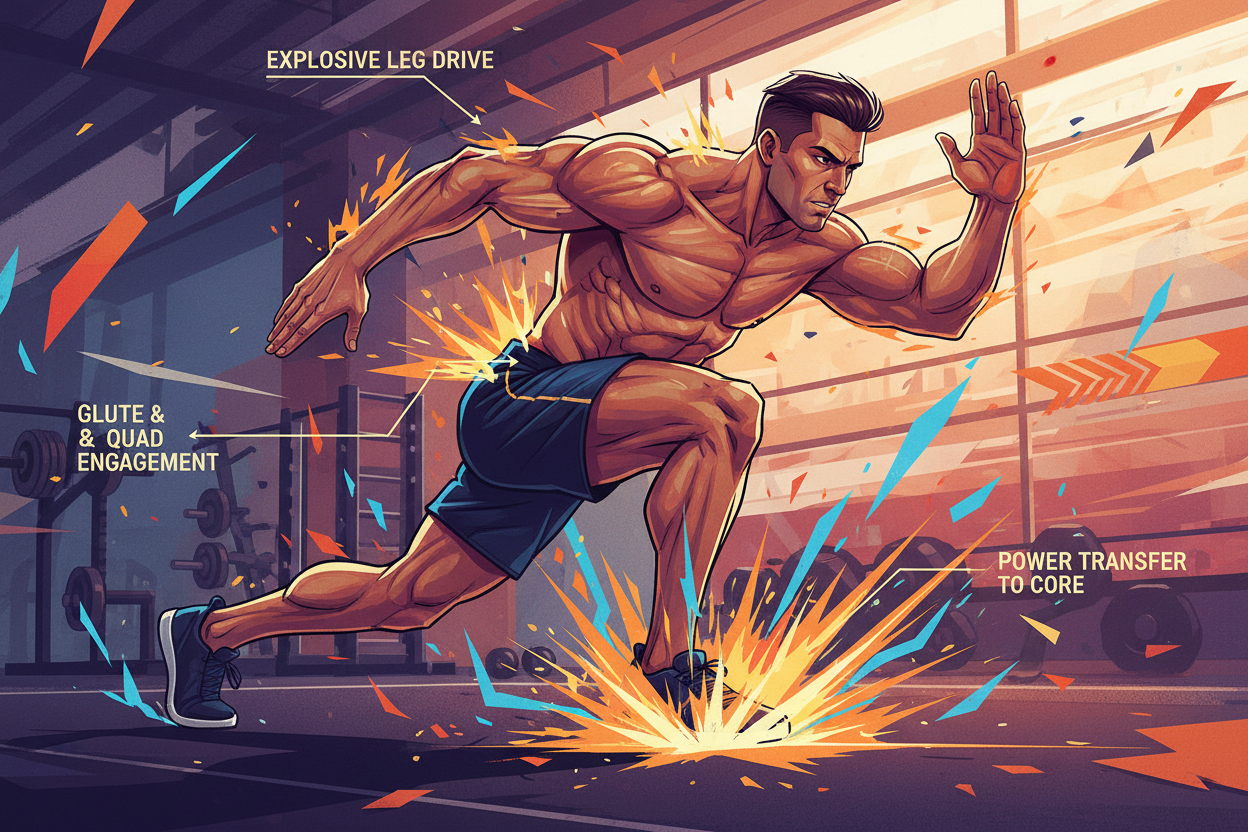
Stop Wasting Energy: How Leg Drive Unlocks Your True Power
Most people view the bench press strictly as an upper-body movement or sprinting as purely a matter of how fast you can move your feet. This limited perspective leaves a massive amount of strength and speed on the table. The secret to breaking through plateaus in both the weight room and on the track lies in understanding how to transfer force from the ground up. Whether you are lying on a bench or driving off the starting blocks, your connection to the floor dictates your power output. This concept is broadly known as leg drive, and mastering it changes everything about how you move.
Force generation always starts at the point of contact. When you fail to utilize your lower body during compound upper-body lifts, you are essentially firing a cannon from a canoe. The stability is gone, and the energy dissipates before it ever reaches the bar. By actively engaging your quads, glutes, and hamstrings, you create a rigid arch and a stable foundation. This tension radiates upward, allowing your upper body muscles to focus entirely on pressing the weight rather than stabilizing your torso.
The Mechanics of Leg Drives in the Bench Press
If you have ever watched powerlifters move massive amounts of weight, you might have noticed their entire body seems to tense up before the bar even lowers. This isn't accidental. Leg drives in the context of the bench press involve pushing your feet into the floor to drive your body backward toward the rack, not upward toward the ceiling. This horizontal force keeps your upper back pinned against the bench, creating a solid platform.
To implement this, set your feet firmly on the ground. Depending on your hip mobility, your feet might be flat or on your toes, but they must remain static. Once the bar is in your hands, push the floor away as if you are trying to slide your body off the head of the bench. You shouldn't actually slide because the weight of the bar and the friction of the bench pad hold you in place. Instead, that energy becomes stored tension. This tension protects your shoulders and allows for a more explosive press off the chest.
A Lesson Learned the Hard Way
I spent the first few years of my training career completely ignoring my lower half during chest days. I was stuck at the same bench press weight for months, convinced that my triceps or pecs were simply too weak. One afternoon, an older lifter at the gym walked over while I was struggling with a rep. He told me to stop flailing my feet and plant them like roots.
He instructed me to squeeze the bench with my thighs and push the ground away the moment the bar touched my chest. The difference was jarring. The weight didn't feel lighter, but I felt stable for the first time. The bar moved with a velocity I hadn't experienced before. That session taught me that strength isn't just about muscle contraction; it is about rigidity and force transfer. Ignoring the lower body during upper body lifts is a mistake I haven't made since.
Transitioning to Athletics: The Single Leg Drive
While the bench press utilizes a static, bilateral push, athletic movement requires dynamic, unilateral force. This is where the concept of the single leg drive becomes critical. In sprinting or jumping, you never have both feet pushing with equal force at the same time. You are constantly balancing on one limb, absorbing force, and redirecting it.
A proper single leg drive involves triple extension: the simultaneous extension of the hip, knee, and ankle. When you sprint, the leg on the ground must drive backward violently to propel the body forward. If this drive is weak or cut short, your stride length suffers, and you lose speed. Many athletes make the mistake of focusing on reaching forward with their front foot rather than driving back with their rear foot. Speed comes from the ground you leave behind, not the ground you are reaching for.
Mastering the Single Leg Knee Drive
The counterpart to the push is the recovery phase, often called the single leg knee drive. As one leg achieves triple extension against the ground, the opposite leg must punch forward and up. This knee drive serves two purposes. First, it prepares the leg for the next ground contact. Second, and often overlooked, is that a forceful knee drive adds vertical and horizontal momentum to your center of mass.
You can train this specific mechanic with wall drills. Lean against a wall at a 45-degree angle with your body in a straight line. Keep one foot planted and drive the other knee up toward your chest aggressively, keeping the toe dorsiflexed (pulled up toward the shin). The movement should be sharp and rhythmic. This drill isolates the hip flexors and teaches the coordination required to synchronize the push of the stance leg with the punch of the swing leg.
Choosing the Right Leg Drive Exercise
To build the specific strength required for these movements, you need to select a leg drive exercise that mimics the demands of your sport or goal. Squats and deadlifts are fantastic for raw strength, but they are bilateral and stable. To improve your drive mechanics, you need unilateral instability.
Sled Pushes
The heavy sled push is perhaps the ultimate teacher of drive angles. Because you are leaning forward, you are forced to engage the posterior chain and drive the ground away behind you. It removes the eccentric (lowering) phase, allowing you to focus purely on concentric force production. It forces you to understand that power comes from the hips and feet.
Step-Ups with Knee Drive
This variation bridges the gap between the weight room and the track. Place one foot on a box. Drive through that heel to stand up, but instead of stopping at the top, continue the movement by driving the opposite knee up into the air. This forces the working glute to stabilize the hip while the opposite hip flexor works explosively. It replicates the exact pattern of a sprint stride under load.
Rear-Foot Elevated Split Squats
Often called Bulgarian Split Squats, these place a tremendous stretch on the rear leg's hip flexor while demanding high force output from the front leg. This opens up tight hips—a common inhibitor of good drive mechanics—while building unilateral strength.
Common Pitfalls to Avoid
Implementing these techniques requires patience and attention to detail. In the bench press, the most common error is "heaving," where the hips shoot off the bench. This is technically a foul in powerlifting competitions, but more importantly, it puts your lower back in a compromised position. The goal is horizontal drive, not vertical bridging. Keep your glutes glued to the pad.
In sprinting and dynamic movements, the error is often casting the foot out. If you drive your knee up but then let your foot swing out in front of your center of mass, you act as a brake when you land. The foot must land directly under the hips to continue the forward momentum. Focus on striking the ground with a piston-like action rather than a sweeping motion.
Coordination takes time. Whether you are trying to add ten pounds to your bench press or shave a tenth of a second off your sprint, the principle remains the same. You must use the ground. Connect your kinetic chain from the floor through your core and into the movement. Once you master this connection, you stop leaking energy and start expressing your full potential.
Frequently Asked Questions
Does leg drive actually help you bench press more weight?
Yes, significantly. Leg drive creates a stable base and allows for better force transfer through the torso, which stabilizes the shoulder joint. This stability signals your nervous system that it is safe to produce maximum force, often resulting in an immediate strength increase.
What muscles are primarily used in a single leg knee drive?
The primary movers are the hip flexors (iliopsoas and rectus femoris) and the core musculature. However, the movement relies heavily on the stability provided by the glute and hamstring of the opposite standing leg to maintain balance and posture.
How often should I perform leg drive exercises?
For sprinting mechanics, drills like wall marches or sled pushes can be done 2-3 times a week as part of a warm-up or speed day. For strength-based movements like step-ups, treat them as a primary accessory lift and include them once or twice a week on lower body days.