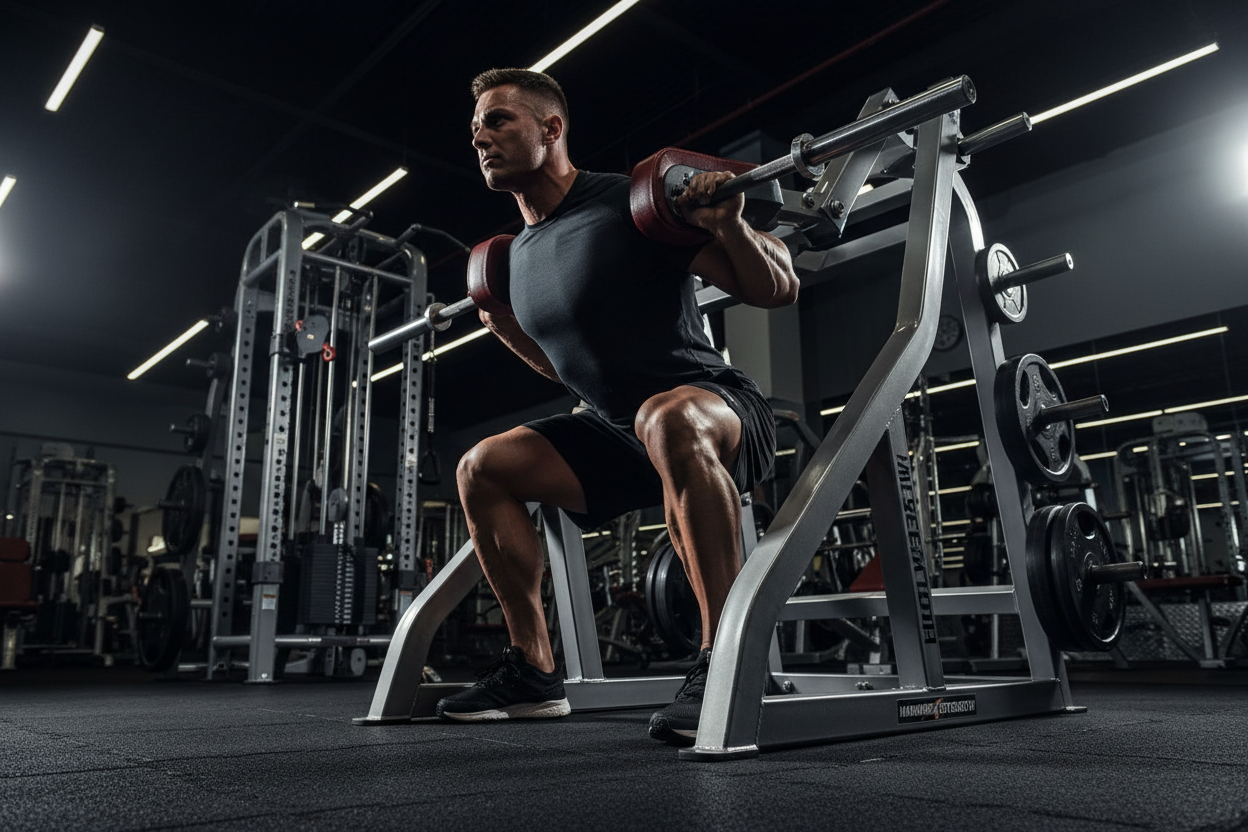
Stop Using the Hammer Strength V-Squat Until You Read This
Leg day often presents a brutal choice: load up a barbell and risk your lower back, or stick to leg extensions and miss out on serious mass. For years, I struggled to find the middle ground. Then I started using the hammer strength v-squat.
This isn't just another leg press variation. It is a biomechanical masterpiece designed to bridge the gap between free-weight movement and machine stability. If you are looking to add size to your quads and glutes without compressing your spine into dust, this machine is your answer. But, like any precision tool, using it incorrectly will yield poor results.
Key Takeaways
- Natural Arc of Motion: Unlike linear hack squats, the V-Squat moves on a curved path, mimicking the natural hip hinge of a free-weight squat.
- Reduced Spinal Load: The pivot point design shifts the load onto your legs, sparing your lower lumbar.
- Versatility: You can perform standard squats for quads or reverse-facing squats to target glutes and hamstrings.
- Starting Resistance: The unloaded carriage typically offers substantial starting weight, making it effective even before adding plates.
Why the Hammer Strength Squat Machine is Superior
Many gym-goers confuse the hammer squat machine with a standard hack squat. The difference lies in the physics. A hack squat slides on a linear rail—straight up, straight down. While effective, human bodies don't naturally move in straight lines.
The hammer v-squat operates on a pivot system. As you descend, the machine guides you through a slight arc. This squat machine curved platform design reduces shear force on the knees and allows for a deeper, more comfortable range of motion. It forces your hips back naturally, which is exactly what a coach would yell at you to do during a barbell squat.
Targeting Specific Muscles
The beauty of this plate-loaded v-squat is the ability to manipulate muscle recruitment through foot placement:
- Quad Bias: Place your feet lower on the platform and shoulder-width apart. This increases knee flexion.
- Glute Bias: Place your feet higher and wider. This increases hip flexion and recruits the posterior chain.
How to Execute the Perfect Rep
Don't just hop on and start rep. Setup is everything on the squat hammer strength station.
- The Setup: Step onto the platform. Position your shoulders snugly under the pads. Your lower back should be pressed firmly against the back pad—do not let it arch excessively.
- Unracking: Stand up fully to disengage the weight. Locate the safety handles (usually by your shoulders or hips depending on the model) and disengage the catch.
- The Descent: Lower yourself slowly. Control the negative. Because of the v squat hammer strength mechanics, you might feel you can drop faster than usual. Don't. Stop when your thighs are at least parallel to the footplate.
- The Drive: Push through your heels (for glutes) or mid-foot (for quads). Keep your chest up and head neutral.
The "Reverse" V-Squat Technique
You will often see athletes facing the machine. This is the "Reverse V-Squat." It turns the hammer strength v squat machine into a standing hip-thrust hybrid.
This variation destroys the glutes. However, be careful with your neck position. Since there is no chest pad, you have to maintain a rigid upper back to avoid folding over. It is highly effective, but requires more core stability than the standard facing-out variation.
The Weight Question: What are you actually lifting?
One common confusion regarding the hammer squat involves the math. How much are you lifting before you add a single plate?
The v-squat machine weight without plates typically clocks in around 54 lbs (approx. 24.5 kg) regarding starting resistance, though this varies slightly by model year. It is not zero. If you are rehabbing an injury, account for this starting load.
My Training Log: Real Talk
I want to be honest about my experience with this machine. The specs look great on paper, but here is the reality of the grind.
The first time I maxed out on this, I realized something about the shoulder pads. When you are deep in the hole with four plates on each side, the padding tends to compress significantly. I have bony shoulders, and I vividly remember the specific, burning pressure on my clavicles that had nothing to do with my legs. It wasn't pain, just a raw discomfort.
Also, there is a "sweet spot" with the safety latch. On the older models, if you don't stand up all the way—I mean fully locking out your knees—before trying to twist the handle to re-rack, the latch won't catch. I once spent an awkward 10 seconds shaking at the top of a rep, calves cramping, trying to get the hook to engage because I was half an inch too low. Learn the latch mechanism with an empty carriage before you load it heavy.
Conclusion
The hammer strength v-squat is more than a leg press alternative; it is a mass-building staple that protects your back while destroying your quads. By respecting the arc of motion and controlling your tempo, you can achieve hypertrophy levels that free weights alone might struggle to provide safely. Load it up, check your foot placement, and respect the machine.
Frequently Asked Questions
How much does the Hammer Strength V-Squat starting weight weigh?
The starting resistance of the carriage (the v-squat machine weight without plates) is typically around 54 lbs (24.5 kg). This is the weight you are lifting before adding any Olympic plates.
Is the V-Squat better than a Hack Squat?
"Better" depends on your goals. The Hack Squat moves linearly, which is excellent for isolating the vastus medialis (teardrop muscle). The V-Squat moves on a curved arc, which mimics a natural squat and recruits more glutes and hamstrings while placing less shear force on the knees.
Can I do calf raises on the Hammer Strength V-Squat?
Yes. Because the shoulder pads are fixed and the carriage moves smoothly, it is an excellent machine for standing calf raises. Place the balls of your feet on the edge of the platform and allow your heels to drop for a full stretch.