Are Your Squats Actually Effective? The Honest Truth
You load the bar, you drop down, and you stand back up. On paper, it looks like you did the work. But if your lower back is screaming while your quads feel fresh, you aren't performing effective squats. You are just moving weight from point A to point B.
There is a massive difference between moving a heavy load and stimulating muscle growth. Too many lifters let their ego dictate the weight, turning a leg exercise into a lower-back survival struggle. If you want to build real trunk stability and massive legs, you need to stop counting reps and start making every inch of the movement count.
Key Takeaways: What Makes a Squat Effective?
- Vertical Bar Path: The weight must travel in a straight line over your mid-foot to maintain balance and leverage.
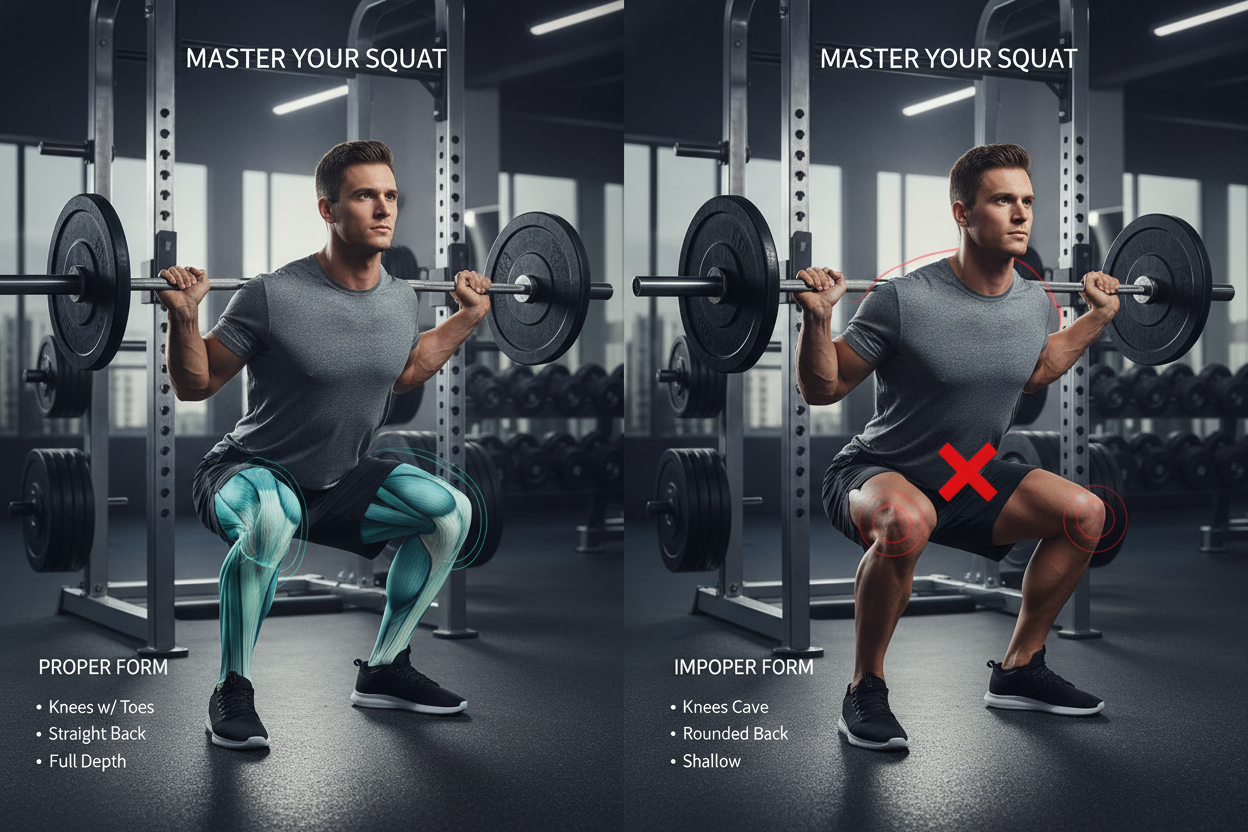
- Proper Depth: Breaking parallel (hip crease below the top of the knee) ensures full muscle activation.
- Tension, Not Just Movement: Controlling the eccentric (lowering) phase creates more hypertrophy than bouncing out of the hole.
- Torso Rigidity: A stable spine prevents force leakage, transferring power directly from your legs to the bar.
Defining the Movement: More Than Just Bending Knees
Before we fix your form, let's look at the squat exercise definition. In biomechanical terms, the squat is a closed-kinetic chain movement. This means your feet are fixed to the floor while your body moves around them.
So, squats are what type of exercise exactly? They are a compound, lower-body push movement. While they primarily target the quadriceps, glutes, and adductors, an effective squat recruits nearly every muscle in your body—from your traps stabilizing the bar to your core bracing against the load.
Common Fault: The "Bent Squat" Disaster
The most common reason a squat loses effectiveness is the "good morning" fault, often referred to as a bent squat. This happens when your hips shoot up faster than your shoulders out of the bottom position.
Instead of driving the floor away with your quads, you end up with a horizontal torso, forcing your lower back to lever the weight up. This shifts the tension entirely off the legs and onto the spinal erectors. To fix this, focus on keeping your chest proud and driving your upper back into the bar as you ascend.
Dynamic Variations: The Moving Squat
Once you master the static stance, you can introduce the concept of a moving squat. This usually refers to dynamic variations like walking lunges or traveling squat jumps. While the traditional squat builds raw force production, adding a movement component challenges your proprioception (body awareness) and stabilizes the small muscles around the knee and ankle.
Programming: What is a Squat Series?
You might have heard coaches ask, "what is squat series?" In professional programming, a squat series isn't just doing three sets of ten. It refers to a cluster of squat variations performed in sequence to target specific weak points.
For example, a series might look like this:
- A1. Tempo Squats (3030): To build control.
- A2. Pause Squats: To remove the stretch reflex and build power out of the hole.
- A3. Standard Back Squats: To overload the muscles.
By cycling through these in a series, you ensure that you aren't just strong in one specific groove, but strong through the entire range of motion.
My Training Log: Real Talk
I remember the exact session where I realized I had been squatting wrong for three years. I was wearing a stiff leather lever belt for the first time. I thought I was bracing correctly, but at the bottom of a 315lb squat, I felt the belt dig violently into my lower ribs, pinching skin I didn't know could be pinched.
That sharp pinch was feedback. It meant my torso had collapsed forward—I was doing the "bent squat" I warned you about earlier. I wasn't keeping my core pressurized 360 degrees against the belt; I was just sucking in air and hoping for the best. When I finally learned to push my obliques out against the leather, creating that internal cylinder of pressure, the weight didn't necessarily feel lighter, but the movement felt hydraulic. The bar speed changed instantly. If you don't feel that pressure threatening to pop your eyes out at the bottom of the hole, you aren't tight enough yet.
Conclusion
Effective squats aren't about the number on the plates; they are about the quality of the tension you produce. Stop letting your lower back take the hit for your legs. Master the mechanics, control the descent, and respect the depth. Your knees and your jeans size will thank you.
Frequently Asked Questions
Squat is what type of exercise regarding muscle groups?
The squat is a compound exercise, meaning it utilizes multiple joints (hips, knees, ankles) and muscle groups simultaneously. While it is dominant in the anterior chain (quads), it heavily recruits the posterior chain (glutes, hamstrings) and core.
What is the difference between a hinge and a squat?
A squat involves maximum knee flexion and hip flexion with a more upright torso. A hinge (like a deadlift) involves maximum hip flexion with minimal knee flexion. If your squat looks like a hinge, you are likely performing a bent squat, which is inefficient for quad growth.
How often should I perform a squat series?
For most intermediate lifters, squatting heavy twice a week is sufficient. A dedicated squat series (clustering variations) is intense and is best programmed once a week to allow for central nervous system recovery.