Stop Tripping Over Your Weights: The Art of Home Gym Organization
Nothing kills the momentum of a high-intensity interval session faster than tripping over a stray 25-pound weight you left on the floor during your warm-up. If you have been building a home gym, you likely started with a single pair of dumbbells. Eventually, that single pair turned into a set of three, then five, and now you have a collection of iron cluttering your garage or spare room. This isn't just an aesthetic problem; it is a legitimate safety hazard and an efficiency killer. Organizing your resistance equipment is the single most effective upgrade you can make to your workout space once you own the weights themselves.
A designated storage solution transforms a chaotic room into a dedicated training sanctuary. When every piece of equipment has a home, your mental focus shifts from navigating an obstacle course to executing perfect reps. Vertical storage is generally the superior choice for home setups where square footage is at a premium. By stacking weights upward rather than spreading them across the floor, you reclaim valuable mat space for burpees, yoga, or bench positioning.
Why Vertical Storage Beats the Floor
Leaving weights on the ground damages both your equipment and your flooring. Hex dumbbells can collect dust and moisture, leading to rust on the handles, while rubber-encased weights can leave permanent marks on carpet or hardwood. More importantly, picking heavy weights off the floor repeatedly between sets adds unnecessary strain to your lower back before you even begin the lift. A rack positions the weights at a height that allows for proper lifting mechanics—hinging at the hips and lifting with the legs—even when you are just grabbing them to start a set of curls.
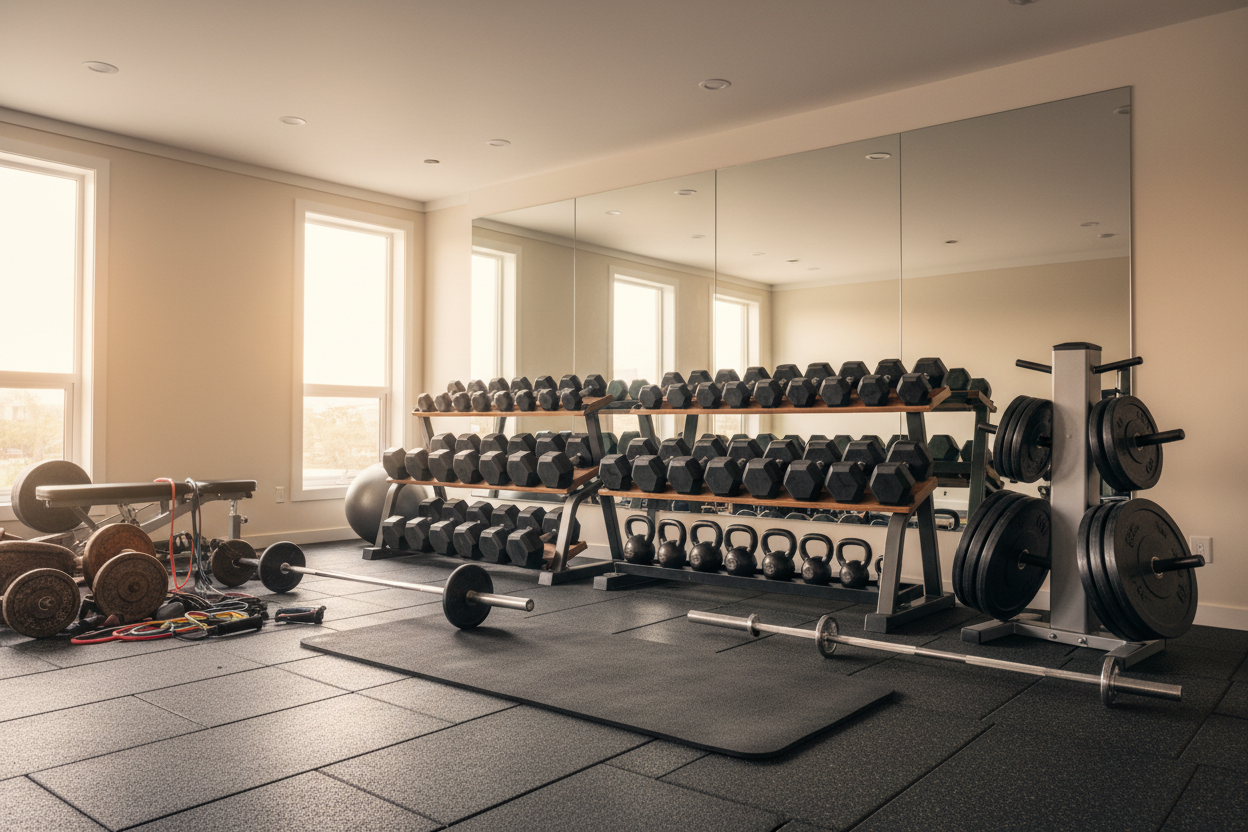
This is where specific equipment choices come into play. A compact design like the weider 3-tier dumbbell rack offers a balance between footprint and capacity. Unlike wide, horizontal commercial racks that require six feet of wall space, a tiered A-frame or compact horizontal design tucks neatly into a corner. This efficiency allows you to expand your weight set without feeling like the walls are closing in on you.
My Battle with the Garage Gym Chaos
I learned the value of a good rack the hard way. For the first two years of training at home, I lined my dumbbells up against the wall. It seemed fine until I started doing drop sets. In the heat of the moment, I would drop a pair of 40s, grab the 30s, and by the end of the session, the weights were scattered in a semi-circle around my bench. One morning, groggy and pre-coffee, I walked into the garage and stubbed my toe so hard on a 50-pound hex dumbbell that I couldn't wear a shoe for a week. That was the breaking point.
I needed something that forced me to be organized. Buying a rack wasn't just about storage; it was about changing my behavior. Once I installed a proper tiered system, re-racking the weights became part of the ritual. It signaled that the set was done. My workouts actually got faster because I wasn't hunting for a matching pair of 15s that had rolled under the treadmill. The psychological benefit of walking into a tidy room cannot be overstated; it invites you to train rather than repelling you with mess.
Structural Integrity and Design Considerations
Not all racks handle the same load. Plastic or lightweight tubular aluminum might hold neoprene aerobic weights, but if you are lifting heavy iron, you need steel. The gauge of the steel determines how much weight the structure can support without bowing or becoming unstable. A triangular or A-frame structure is inherently stable due to its low center of gravity, provided you load it correctly.
The weider three tier dumbbell rack is designed with this specific utility in mind. The three levels allow for a logical separation of weight classes. You typically place your heaviest dumbbells on the bottom tier to anchor the unit, mid-range weights in the center, and lighter weights on top. This arrangement prevents the rack from becoming top-heavy and tipping over. Furthermore, the angled tiers are crucial. Flat shelves can make it difficult to grab weights without pinching your fingers or twisting your wrist. An angled shelf presents the handle to you, allowing for a natural grip.
Optimizing Your Workout Flow
Organization directly impacts workout density. If you are performing supersets—alternating between two exercises with no rest—you need instant access to different weights. Imagine switching from heavy goblet squats to light lateral raises. With a tiered rack, you grab the heavy dumbbell from the bottom, perform your squats, re-rack it, and immediately grab the lighter pair from the top shelf for your raises. The transition is seamless.
This setup also helps with progressive overload tracking. When your weights are racked in ascending order, you have a visual representation of your progress. Moving from the second pair on the middle shelf to the third pair is a tangible milestone. It gamifies your training in a subtle way that a pile of weights on the floor never could.
Protecting Your Investment
Fitness equipment is expensive. Iron prices fluctuate, and shipping heavy weights costs a fortune. Taking care of what you have is financially prudent. Racks prevent dumbbells from clanging against each other, which chips the paint on cast iron or peels the rubber off hex weights. If you use adjustable dumbbells, a rack is even more critical, as the delicate selector mechanisms in those units can break if dropped or stored improperly.
When selecting a rack, check the width of the rails. Some racks are designed specifically for hex dumbbells and might not fit round pro-style bells, or vice versa. Ensure the gap between the rails is appropriate for the handle length of your specific weights. A universal design usually accommodates most standard sizes, but measuring your handle length before purchasing is always a smart move to avoid the frustration of returns.
Ultimately, the goal of a home gym is to remove barriers to exercise. If your space is messy, dangerous, or frustrating to use, you will find excuses to skip workouts. A solid storage system removes friction. It makes your gym safer, your equipment last longer, and your workouts more efficient. Whether you are lifting five pounds or fifty, respecting the iron means giving it a proper place to rest.
Common Questions About Gym Storage
How much weight can a standard 3-tier rack hold?
Most residential 3-tier racks are rated for between 300 to 1,000 pounds, depending on the steel gauge and construction quality. Always check the manufacturer's specific weight capacity rating before loading the rack, and ensure you distribute the weight evenly across the tiers.
Can I mix different types of dumbbells on the same rack?
Yes, you can generally mix hex, rubber-encased, and cast iron dumbbells on a tiered rail system. However, neoprene or vinyl-dipped aerobic weights are often too small to span the gap of standard rails and may require a rack with solid shelves instead.
What is the safest way to load a dumbbell rack?
Always load the heaviest weights on the bottom shelf and the lightest weights on the top shelf. This keeps the center of gravity low and prevents the rack from tipping over if you accidentally bump into it or during an earthquake.