Stop Tripping Over Your Weights: How to Choose the Perfect Storage for Your Home Gym
Leaving heavy weights scattered across the floor is the quickest way to turn a workout sanctuary into an obstacle course. If you have ever stubbed your toe on a 20-pound hex weight in the middle of the night or spent five minutes hunting for the matching partner to your 35-pounder, you already know the problem. The solution is straightforward: getting your equipment off the ground. A proper storage solution does more than just tidy up the room; it protects your flooring, prevents injuries, and actually makes your workouts more efficient by keeping everything within arm's reach.
Organizing a workout space requires more thought than simply stacking weights in a corner. The right dumbbell rack for home use depends entirely on the type of weights you own, the space available, and how much you plan to expand your collection in the future. Ignoring the logistics of storage usually leads to damaged equipment or, worse, a cluttered space that kills your motivation to train.
Why Your Floor Needs a Break
I spent the first few years of my lifting journey convinced that leaving weights on the floor was fine. My garage gym was raw and gritty, and I thought organization was for commercial facilities. That mindset shifted the day I tripped backward over a stray 50-pound dumbbell while spotting a friend. It was a near-miss that could have resulted in a serious injury. Beyond safety, I realized that my "system" of lining weights up against the wall was eating up valuable floor space. Once I installed a sturdy home dumbbell rack, the room immediately felt twice as large. The psychological effect of walking into a clean, organized space made it significantly easier to start a workout.
Floor damage is another silent killer of home gym deposits and property value. Dropping weights, even gently, over the same spot repeatedly compresses carpet and cracks tile. A rack distributes that load safely and keeps the heavy iron off delicate surfaces.
Matching the Rack to the Weight
Not all weights fit on all racks. This is the most common mistake buyers make. If you own rubber-encased hex dumbbells, they are generally bulky. A rack with narrow saddles might not accommodate them side-by-side. Conversely, round pro-style dumbbells can roll if placed on a flat shelf without a lip or individual cradles.
When looking for a dumbbell rack home gym setup, you need to measure the handle length of your weights. Some compact racks have tiers that are too wide, causing smaller weights (like 5lb or 8lb pairs) to fall right through the rails. For those lighter, vinyl, or neoprene weights often used for aerobics or high-repetition work, a standard heavy-duty rail system might be overkill and functionally poor. In this case, a specific hand weight rack for home gym use, often styled as a vertical tree with specific slots, is the superior choice. These vertical trees have a tiny footprint, making them perfect for apartment corners or living rooms where space is at a premium.
The A-Frame vs. The Tiered Shelf
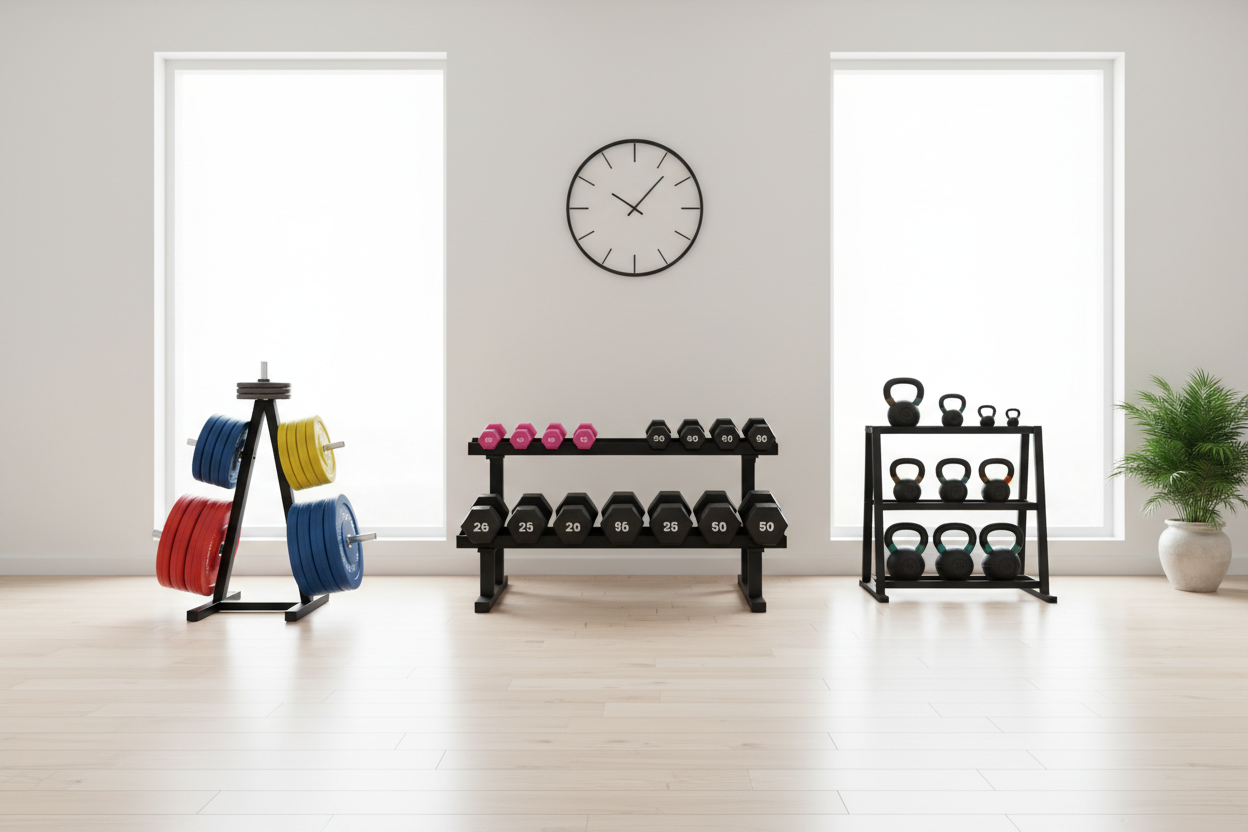
Space constraints usually dictate the design you should choose. The A-frame rack is a favorite for tight spaces. It stores weights vertically in a pyramid shape, maximizing vertical space while minimizing the footprint. These are excellent for sets ranging from 5 to 30 pounds. However, removing weights from the lower rungs of an A-frame can be awkward, sometimes requiring you to squat down and pull the weight out at a strange angle.
Horizontal tiered shelves are the standard for a reason. They allow for easy racking and unracking without compromising your lower back. If you have a wall to place it against, a 2-tier or 3-tier horizontal rack is generally the most ergonomic option. When browsing dumbbell racks for home gym layouts, look for angled shelves. An angled shelf presents the handle to you, meaning you don't have to bend your wrist awkwardly to grab the weight. This subtle design feature saves your wrists from unnecessary strain over time.
Navigating Budget and Quality
Everyone wants to save money, but storage equipment is one area where going too cheap can be dangerous. You might be tempted to search for a dumbbell rack cheap and buy the first twenty-dollar option that pops up. Proceed with caution. Extremely low-cost racks often use thin-gauge steel and plastic connectors rather than welded joints. A rack collapsing under 300 pounds of iron is a recipe for disaster.
You do not need to buy commercial-grade equipment meant for a public gym, but you should look for specific build indicators. Check the weight capacity listed by the manufacturer and cut it by 20% to be safe. If a rack claims it can hold 500 pounds, assume it is stable at 400. Look for powder-coated finishes which resist scratching and chipping better than standard paint. If the rack uses bolts, ensure they are heavy-duty and that the unit includes washers to prevent loosening over time.
Installation and Placement Strategy
Once you have selected your rack, placement is critical. Never place a rack in a pathway or directly behind a lifting platform where you might step back. The ideal spot is close to where you perform your accessory work but out of the "fail zone" of your main lifts.
If you are using a horizontal rack, keep it a few inches away from the wall. You need clearance for the larger plates on the dumbbells so they do not scrape the drywall every time you put them away. For those with rubber flooring, ensure the feet of the rack have protective caps. Heavy racks can cut right through cheap foam mats if the weight is concentrated on sharp metal legs.
Protecting Your Investment
Maintenance on a rack is minimal, but necessary. Sweat drips. Over time, moisture can pool in the crevices of the rack or where the dumbbell sits, leading to rust on both the rack and the knurling of your weights. Wipe down the saddles or rails occasionally. If you have a rack with metal-on-metal contact, consider adding strips of thin rubber or heavy-duty tape to the rails. This reduces the clanging noise when racking weights—a huge benefit if you train early in the morning while the rest of the house is asleep—and keeps the finish on your dumbbells looking new.
Investing in organization changes the tone of your workouts. It shifts the environment from a messy spare room to a dedicated training space. Whether you need a massive 3-tier shelf for a full set of heavy iron or a compact vertical tree for lighter bells, the right storage makes the process of getting strong safer and more enjoyable.
Frequently Asked Questions
Can I use a bookshelf or standard shelving unit to store my dumbbells?
No, this is highly unsafe. Standard household shelving is designed for books and decor, not the dense, concentrated weight of iron dumbbells. The shelves will likely bow or collapse, potentially causing injury or damaging your floor.
How much clearance do I need around a dumbbell rack?
You should aim for at least two to three feet of clear space in front of the rack to safely unrack weights without hitting anything. If the rack is against a wall, leave about three to four inches behind it to prevent the weights from scraping the wall when you set them down.
Do A-frame racks damage dumbbells?
Generally, no, but it depends on the fit. If the cradles on the A-frame are made of bare metal with sharp edges, they can scratch the handles or coating of your weights. Look for racks with plastic or rubber inserts in the cradles to protect your equipment.