Stop Tripping Over Weights: Why a Quality Rack is the Backbone of Your Home Gym
Building a workout space in your garage or basement usually starts with a burst of enthusiasm. You buy a bar, some plates, and maybe a bench. But the moment you try to squat heavy without a support system, reality hits hard. You aren't just lifting weight; you are managing risk. The centerpiece of any serious lifting setup isn't the barbell itself, but the station that holds it. A proper rack allows you to push your limits safely, organizes your equipment, and turns a pile of iron into a functional training facility.
If you are wondering if you really need one, the answer is an absolute yes. Trying to clean a heavy barbell from the floor just to perform a set of front squats is inefficient and limits your progression. A rack provides a stable starting point for your lifts and, more importantly, a safety mechanism to catch the weight if you fail a rep.
The Day I Almost Crushed My Garage Floor (And Myself)
I learned the value of sturdy equipment the hard way. Early in my lifting journey, I tried to save money by using independent squat stands that weren't connected to each other. They were wobbly, lightweight, and frankly, terrifying. One afternoon, I was attempting a personal best on the back squat. As I re-racked the weight, I missed the left cup by an inch. The independent stand tipped over, the bar crashed down, and I barely jumped out of the way in time. The resulting hole in the drywall was a permanent reminder of my mistake.
That weekend, I scrapped the cheap stands and invested in a full power cage. The difference was night and day. The stability gave me the confidence to add more weight to the bar because I knew the equipment could handle it even if I couldn't. That peace of mind is the single biggest performance enhancer you can buy.
Safety Is Not Optional
When you train alone, you don't have a spotter to grab the bar if your muscles give out. This is where your equipment has to step in. A reliable home gym barbell rack acts as a mechanical spotter. Features like safety pins, spotter arms, or straps are designed to catch the barbell before it crushes you during a bench press or squat.
Many lifters overlook the importance of adjustable safety heights. If you are bench pressing, you need the safeties set just below your chest height. This allows you to touch the bar to your chest for a full range of motion, but if you can't push it back up, you can slightly deflate your chest arch and let the rack take the load. Without this feature, you are gambling with your ribcage every time you go for a heavy single.
Choosing the Right Setup for Your Space
Not everyone has a three-car garage to dedicate to iron. Fortunately, the market has evolved to offer solutions for tight spaces. Understanding the footprint is crucial before you pull out your credit card.
The Power Cage
This is the gold standard. It consists of four upright posts connected by crossmembers. You stand inside the cage to lift. It offers the highest level of safety because the bar is contained within the structure. If you have the space and the budget, this is usually the best choice for heavy training.
The Half Rack
A half rack takes up less floor space and usually feels more open. You lift in front of the uprights rather than inside them. While excellent for space saving, you must ensure the unit is heavy enough or bolted down so it doesn't tip during heavy racking.
Wall-Mounted Folding Racks
For those parking a car in their gym during the night, folding racks are ingenious. They bolt to the wall and swing outward when you need to train, then fold flat against the wall when you are done. They are surprisingly sturdy and allow for a fully functional gym in a single parking stall.
Storage and Organization
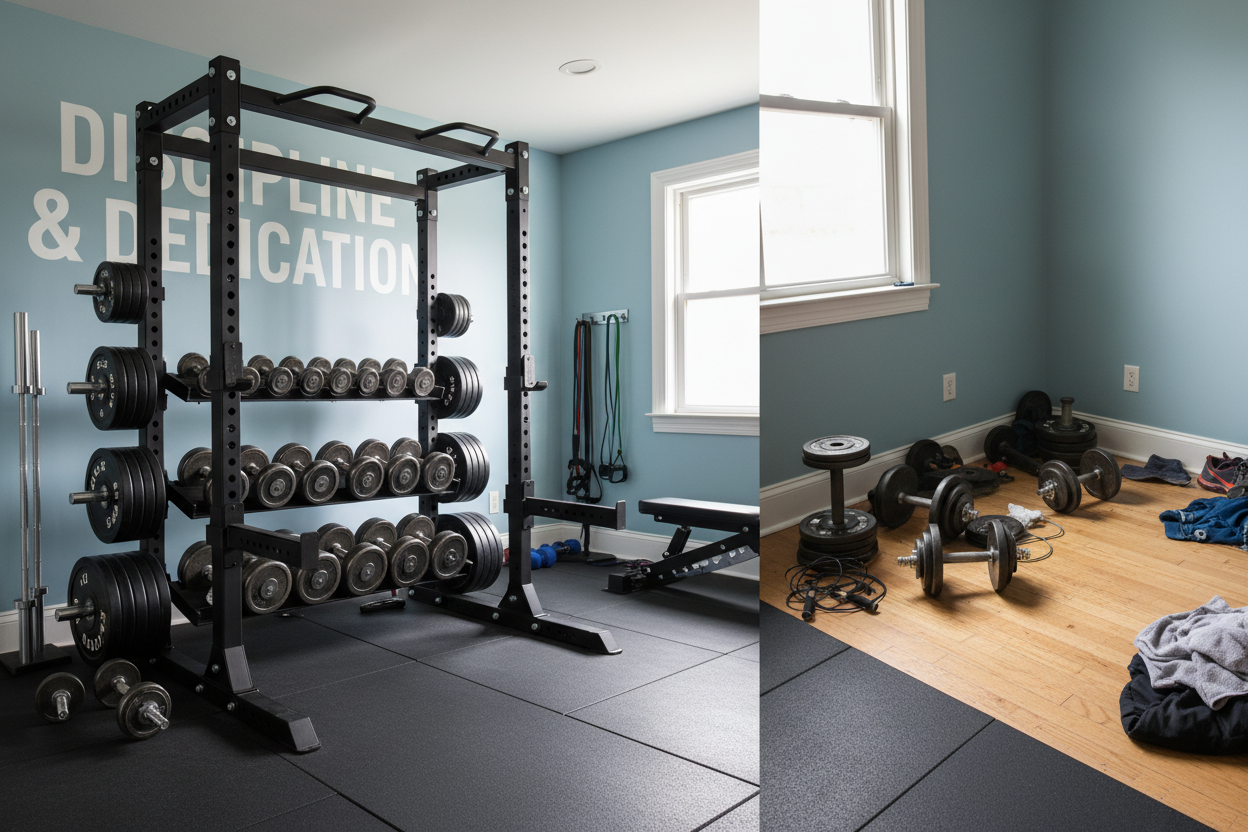
Beyond the actual lifting, you have to consider where everything goes when you are done. A messy gym is a dangerous gym. Tripping over a 45-pound plate can end your training cycle just as quickly as a torn muscle. Many power racks come with weight plate storage pegs attached to the back uprights. This adds stability to the unit by weighing it down and keeps your plates off the floor.
However, if you are using a smaller squat stand or a folding rig, you might need a dedicated home barbell rack for storage. These can be vertical holders that sit in the corner or wall-mounted gun racks that hold multiple bars horizontally. Keeping your barbells off the ground protects the knurling (the rough grip pattern) from getting damaged by concrete and prevents moisture from causing rust.
Construction Quality Matters
You will see terms like "11-gauge steel" or "2x3 tubing" thrown around. Here is what that means for you: the lower the gauge number, the thicker the steel. Commercial gyms typically use 7 or 11-gauge steel. For a home setup, 11-gauge is the sweet spot. It is incredibly durable and will last a lifetime.
Be wary of cheap racks found at general department stores. These often use 14-gauge steel or thinner, which might be rated for 300 pounds but will feel shaky long before you reach that weight. Look for hardware size as well—1-inch or 5/8-inch bolts are standard for high-quality rigs. The finish also plays a role; a high-quality powder coat prevents chipping and rust, keeping your investment looking new for years.
The Versatility Factor
A good rack is more than just a place to squat. It is the skeleton of your entire gym. With the right attachments, it becomes a dip station, a pull-up rig, and a pulley system. J-cups (the hooks that hold the bar) should be lined with plastic to protect your barbell. If you buy a bare steel hook, it will grind down the knurling on your expensive bar every time you rack it.
When selecting a home gym barbell rack, check the hole spacing. "Westside" spacing is a popular feature where the holes are spaced only 1 inch apart in the bench press zone. This allows for precise adjustments so you aren't stuck choosing between a hook that is too low (wasting energy un-racking) or too high (risking shoulder injury).
Making the Investment
Buying quality gear hurts the wallet once, but buying cheap gear hurts every time you use it. Your rack is the one piece of equipment you should not skimp on. You can get away with ugly iron plates or a second-hand bench, but your rack needs to be rock solid. It anchors your training, protects your body, and organizes your space.
Whether you choose a folding wall mount or a massive four-post cage, ensure it fits your specific lifting style. If you do Olympic lifting, you might just need a simple squat stand and plenty of floor space. If you are a powerlifter, a heavy-duty cage is non-negotiable. Assess your needs, measure your floor twice, and build your sanctuary on a solid foundation.
Frequently Asked Questions
Do I need to bolt my rack to the floor?
It depends on the type of rack and how heavy you lift. Full power cages are generally stable on their own, especially if weighed down by plate storage, but bolting them down offers maximum rigidity. However, half racks and squat stands should almost always be bolted or weighted down to prevent tipping during aggressive re-racking.
What is the difference between a squat stand and a power rack?
A squat stand usually consists of two uprights connected at the base, offering a small footprint but less safety for solo lifting. A power rack (or cage) has four or six uprights connected at the top and bottom, allowing you to lift inside the structure with safety bars on all sides to catch a failed lift.
Can I use a rack for exercises other than squats and bench press?
Absolutely. With the right attachments, a standard rack can support pull-ups, dips, landmine rows, and band work. Many modern racks are modular, allowing you to add cable pulley systems or lat pulldown attachments later as your budget allows.