Stop Treating Resistance Band Workout Equipment Like a Toy
I remember the first time a cheap band snapped and whipped me across the chest. I was trying to do heavy face pulls in my garage, using a kit I bought for twenty bucks on a whim. It left a welt that stayed for a week and a deep-seated distrust of anything made of latex.
The problem isn't the physics of elastic tension; it's that most resistance band workout equipment is marketed as a gimmick for people who don't actually want to sweat. If you treat these like a toy, they’ll act like one. But if you treat them like a serious strength tool, they can add pounds of lean tissue to your frame.
Quick Takeaways
- Layered latex beats molded rubber every single time for durability.
- Your anchor point is the most dangerous part of the setup—don't cheap out on it.
- Bands offer 'accommodating resistance,' meaning the move gets harder as you reach full extension.
- Stop stepping on your bands with dirty boots if you want them to last more than a month.
Why Most People Think Bands Are Useless for Real Muscle
Most lifters view resistance bands gym equipment as a warm-up tool, something you do for thirty seconds to 'wake up' your glutes before getting under a real barbell. I get it. When you see those flimsy, neon-colored tubes at big-box stores, it’s hard to imagine building a chest like Arnold with them.
The myth that bands can't build muscle comes from a lack of intensity. People pick up a band with ten pounds of tension, do twenty mindless reps, and wonder why they don't look like a bodybuilder. Real fitness equipment resistance bands need to be heavy enough to push you close to failure in the 8-12 rep range, just like iron. If you aren't fighting for that last inch of the rep, you're just playing with a giant rubber band.
The Difference Between Cheap Rubber and Actual Hardware
If you want to spot trash resistance exercise equipment before buying, look at the handles first. If they feel like hollow PVC pipe wrapped in cheap foam, put them back. High-end resistance band exercise equipment uses heavy-duty nylon webbing and steel carabiners that won't bend when you're pulling 100+ lbs of tension.
Then there's the material. Cheap bands are molded, meaning they are poured into a shape. These are prone to snapping because one tiny nick becomes a structural failure. Premium resistance bands are 'layered,' which looks like the rings of a tree. If a layered band gets a small tear, it won't explode instantly, giving you a chance to replace it before it takes an eye out. Whether you're using a loop band or a resistance cable system, the density of the rubber matters more than the color.
How to Anchor Your Band Exercise System Without Wrecking Your Door
The weakest link in any band exercise system is the anchor. Most people shove a flimsy foam stopper into a door frame and hope for the best. I've seen door frames splinter and hinges fly off because someone tried to do heavy lat pulldowns on a door that wasn't meant to hold 200 lbs of lateral force.
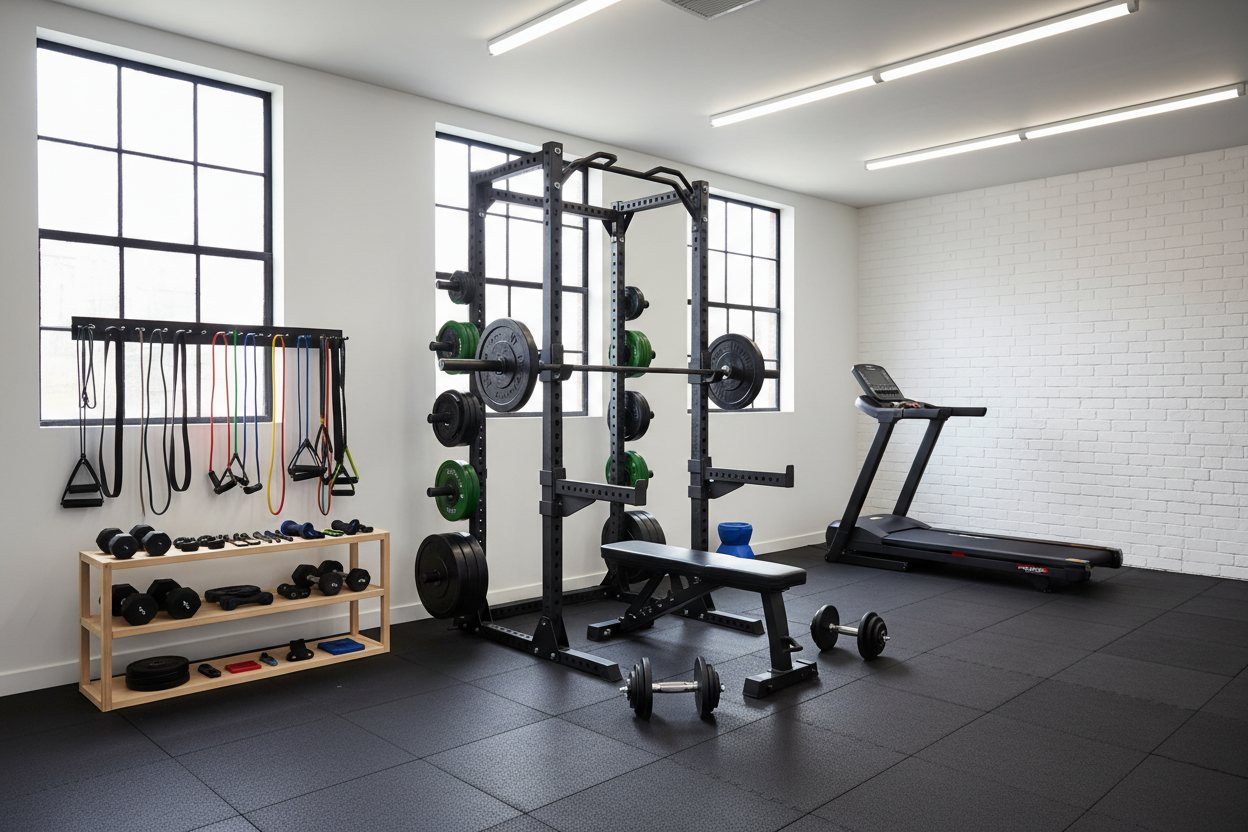
If you're serious, you need a dedicated band for gym use that anchors to something structural. I prefer using hitch pins on a power rack or a wall-mounted steel rail. This allows you to change the angle of resistance, which is vital for matching the strength curve of your muscles. For a deeper look at how to program these movements, check out this resistance exercise equipment the definitive strength guide.
Protecting Your Premium Resistance Bands (And Your Face)
Friction is the silent killer of rubber band gym equipment. If you loop a band around a textured pull-up bar or step on it while wearing boots with sharp treads, you're creating micro-tears. I always tell people to use a 6x8ft exercise mat yoga mat gym flooring to create a smooth surface between the band and the ground.
Also, stop leaving your bands in the garage during the summer. UV rays and extreme heat turn high-quality latex into brittle junk in a matter of weeks. Treat your resistance kits like any other investment. Keep them clean, keep them out of the sun, and inspect them for 'nicks' every single time you train.
Is a Rubber Band Workout System Actually Cheaper Long-Term?
A solid resistance band workout kit will run you $100 to $200 for a full set of heavy-duty loops and handles. Compare that to a set of adjustable dumbbells that can cost $400 to $600. On paper, the bands win. However, you have to realize that bands are a consumable. Even the best ones need replacing every 2-3 years if you're training hard.
If you're looking for home gym equipment deals, bands are the best entry point for a small space. Just don't expect them to be a one-time purchase for the next twenty years like a cast iron plate. They are a high-performance tool with a shelf life.
Personal Experience: The Band-Only Month
Last year, I moved houses and my rack was stuck in a shipping container for four weeks. I had nothing but a set of heavy loop bands and a door anchor. I thought I’d lose all my strength. Instead, I focused on high-tension slow eccentrics. When I finally got back to my barbell, my pull-up numbers had actually gone up. The constant tension of the bands forced my stabilizers to work in ways a static weight doesn't. My only mistake was doing high-volume rows in a tank top; the latex friction left me with a nasty 'burn' on my inner arms. Now I always wear a long-sleeve tech shirt for band days.
FAQ
Can you actually build muscle with just bands?
Yes, provided you apply progressive overload. You have to move to thicker bands or add more bands to the handle as you get stronger. Muscle doesn't know if the tension comes from a plate or a band.
How do I know when to throw a band away?
Run your thumb and forefinger along the entire length of the band. If you feel any 'nicks,' 'pitting,' or if the color looks faded and chalky, it's done. Don't risk the snap.
Are tube bands or loop bands better?
Loop bands are more versatile for lower body and powerlifting movements. Tube bands with handles are better for replicating cable machine exercises like flyes and rows. I own both.