Stop Squatting for a Second: Why Step Downs Are the Glute Builder Your Knees Will Love
Everyone loves a heavy squat or a walking lunge until their knees start to complain, or worse, they realize their quads are stealing the show while their glutes remain underdeveloped. If you have been hunting for a movement that isolates the posterior chain while simultaneously bulletproofing your knees, the step down exercise for glutes is likely the missing link in your program. Unlike the traditional step-up, which often turns into a momentum-fueled calf raise for the back leg, the step down forces you to control your body weight entirely through the working hip.
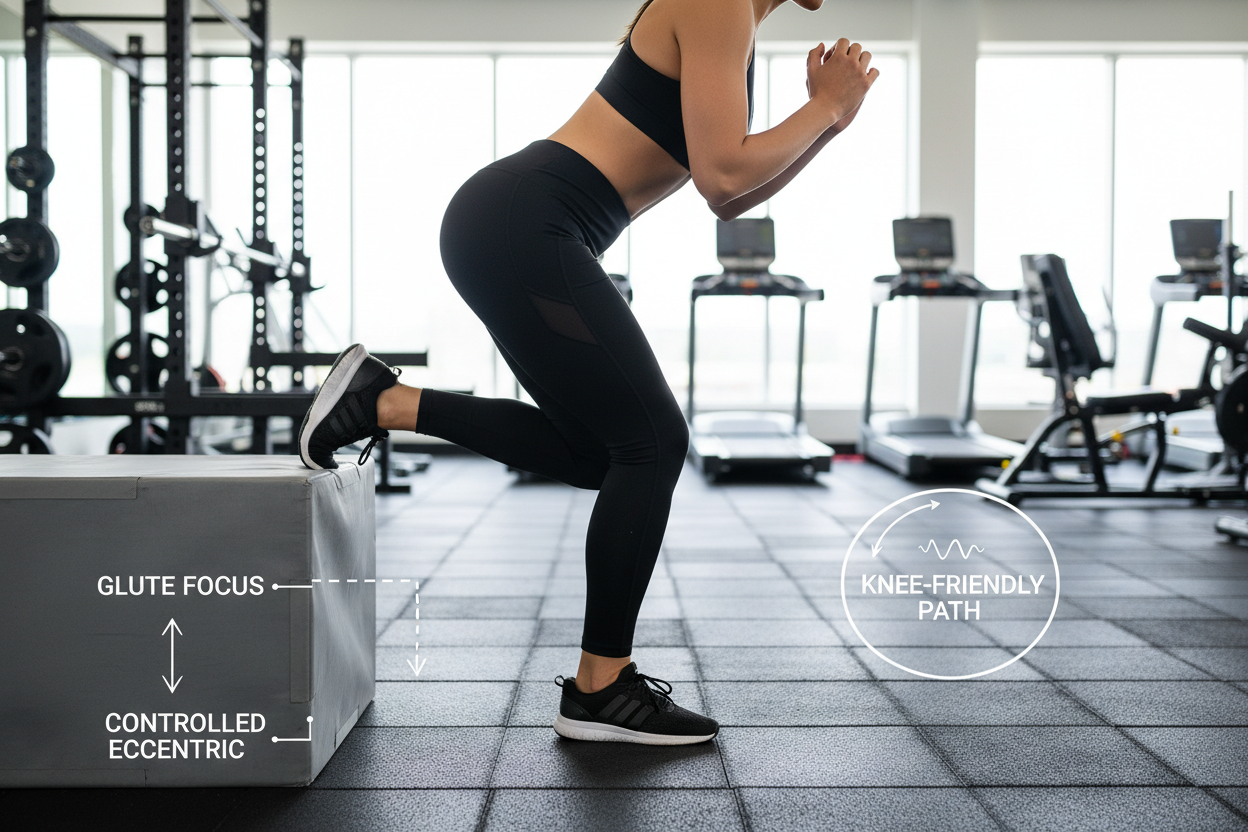
This movement is technically a unilateral squat pattern, but the mechanics are distinct. You start at the top of the box and lower yourself. By removing the push-off from the bottom leg, you eliminate cheating. The focus shifts entirely to eccentric control—slowing gravity down—which is a massive driver for hypertrophy and strength. If you want to fix muscle imbalances and build a shelf on your glutes without loading your spine with hundreds of pounds, this is where you start.
Why My Heavy Squats Didn't Fix My Glutes
I learned the value of this movement the hard way. A few years ago, despite moving decent weight on the barbell back squat, I developed a nagging pain in my left patellar tendon. My tracking was off. Every time I hit the bottom of a squat, my knee caved inward slightly—a classic sign of weak glute medius stability. I was strong, but I wasn't stable.
My physical therapist stripped the weight off the bar and pointed me toward a 6-inch box. He told me to perform step downs for glutes, focusing strictly on the tempo. It was humbling. My leg shook violently on the way down, and I couldn't keep my hips level. That shake was weakness leaving the body, or more accurately, my stabilizers finally waking up. After six weeks of prioritizing step downs, not only did the knee pain vanish, but my squat numbers went up because I wasn't leaking energy through unstable hips anymore.
The Mechanics: Step Down vs. Step Up
Confusion often arises between these two movements. In a step-up, you start on the floor and concentric force (shortening the muscle) drives you up. The problem is that most people push off the back foot, using their calves to assist the lift. It becomes a cardio move rather than a muscle builder.
The glute step down flips the script. You start standing on the box or bench. The primary challenge is the eccentric phase (lowering). You have to hinge at the hips to tap your non-working heel to the floor before driving back up. Because the non-working leg never fully rests or loads on the ground, it cannot help you. Your working glute has to handle 100% of the load during the change of direction. This isolation is incredibly difficult to replicate with bilateral exercises like squats or deadlifts.
Executing the Perfect Glute Step Down
Proper form is non-negotiable here. If you just bend your knee and drop, you will load the quads and stress the knee joint, missing the point entirely. To target the glutes, you must master the hip hinge.
Start with a low box or a stack of bumper plates, roughly 6 to 12 inches high. Stand on the edge with one foot hovering off the side or front. Before you move, engage your core. As you begin the descent, push your hips back as if you are trying to close a car door with your glutes. Your torso will naturally lean forward slightly to counterbalance hips moving backward.
Keep the weight in the heel of the foot that is on the box. Lower yourself slowly—think three seconds down. The goal is to lightly tap the heel of the free leg on the floor. Do not rest your weight on the floor. Imagine the floor is made of glass; you want to touch it without breaking it. Drive through the heel on the box to return to the starting position, squeezing the glute at the top.
Common Mistakes to Avoid
Watching people in the gym, the most frequent error is turning this into a knee-dominant movement. If your knee shoots forward over your toes and your heel lifts off the box, you are doing a quad exercise. While that isn't inherently bad, it isn't a step down exercise for glutes. Keep the shin relatively vertical and the heel glued down.
Another issue is the hip drop. Watch yourself in a mirror. As you lower down, your pelvis should remain level. If the hip of the free leg drops significantly lower than the working side, your glute medius isn't doing its job. Reduce the height of the box until you can maintain a level pelvis throughout the rep.
Programming Step Downs for Glutes
Since this exercise requires significant balance and neural drive, it works best placed early in your workout, perhaps after your main compound lift or even as a primer before squatting. You don't need massive weights to feel this. Bodyweight is often sufficient for beginners.
Aim for 3 to 4 sets of 8 to 12 reps per leg. If you can easily do 12 reps with perfect control, add resistance. Hold a dumbbell in the hand opposite the working leg (contralateral loading). This forces the glute to work even harder to stabilize the pelvis against the offset weight. Alternatively, holding a goblet squat position works well for keeping the chest up and the core engaged.
Progression and Variations
Once you have mastered the standard variation, you can tweak the angle to hit different fibers. A lateral step down (lowering the leg off the side of the box) tends to hit the glute medius a bit harder, which creates that "shelf" look and aids in lateral stability. The forward step down (lowering the heel off the front) requires immense control and demands serious hip mobility.
If you lack a box, you can perform step downs for glutes using a staircase or even a sturdy chair, provided it is stable. The key is simply finding a surface that allows for a deep enough range of motion without compromising your hip hinge mechanics.
Incorporating the glute step down into your routine does more than just build muscle. It exposes asymmetries. Most of us have one leg that is stronger or more coordinated than the other. Bilateral movements hide this; step downs highlight it. By dedicating time to bring up the lagging side, you reduce your risk of injury in everything from running to heavy deadlifting.
Final Thoughts on Knee Health
Many lifters avoid leg training when their knees act up, leading to atrophy that only worsens the problem. Because the step down keeps the shin vertical and relies on the posterior chain, it places significantly less shear force on the knee joint compared to a forward lunge or a leg extension. It strengthens the muscles that support the knee without grinding the joint itself. If you want longevity in your training career, master this movement.
Frequently Asked Questions
How high should the box be for glute step downs?
Start conservatively with a 6-inch box or step. The height should be low enough that you can control the descent without your hips shifting or your knee collapsing inward. As your strength and mobility improve, you can increase the height, but form always dictates the depth.
Can step downs replace squats?
While they are an incredible accessory movement, they generally shouldn't replace squats entirely if your goal is maximal absolute strength. However, for hypertrophy and correcting imbalances, they can serve as a primary leg movement, especially for those with back or knee limitations that prevent heavy squatting.
Why do I feel this in my quads instead of my glutes?
This usually happens because you are bending at the knee before hinging at the hips. Initiate the movement by pushing your hips back first, and ensure your weight is in the heel of the working foot. A slight forward lean of the torso helps shift the tension to the posterior chain.