Stop Skipping Leg Day: How to Build Massive Legs with Just Dumbbells and a Bench
You absolutely do not need a squat rack, a leg press machine, or a gym membership costing hundreds of dollars a month to build strong, muscular legs. If you have access to a flat bench and a pair of heavy dumbbells, you have everything required to trigger hypertrophy and strength gains. In fact, relying on free weights and stability work often corrects muscle imbalances that machines ignore, leading to a more functional and resilient lower body.
Many lifters mistakenly believe that without a barbell across their back, they cannot generate enough intensity. This is false. By manipulating leverage, utilizing unilateral movements, and controlling tempo, leg workouts with dumbbells and bench setups can leave you just as exhausted—and sore—as a heavy barbell session. The key lies in exercise selection and intent.
My Real-World Experience with Limited Gear
A few years ago, I moved to a rural area where the nearest commercial gym was a forty-minute drive away. I had a garage, a rusty adjustable bench, and a set of dumbbells going up to 80 pounds. Initially, I panicked, thinking my leg development would stall. I was used to loading up plates on the leg press and squatting heavy.
I was wrong. I was forced to switch to high-volume single-leg movements. Within three months, not only did my quads look more defined, but a nagging hip imbalance I had ignored for years finally disappeared. The stability required to balance on a bench while holding heavy iron forced my stabilizers to wake up. That period taught me that intensity isn't just about total weight moved; it's about how you apply tension to the muscle.
Why This Combination Works
Combining free weights with an elevated surface changes the biomechanics of standard leg movements. The bench allows for a greater range of motion and enables you to isolate one leg at a time. Unilateral training (working one side at a time) prevents your dominant side from taking over, ensuring symmetrical growth.
When you perform leg exercises with dumbbells and bench support, you also engage your core significantly more than you would on a machine. Your body has to fight to stay upright and aligned, turning a simple leg movement into a full-body stability challenge. This carries over to athletic performance and daily activities far better than sitting in a fixed machine.
The Essential Movements
To get the most out of your equipment, focus on compound movements that recruit the quads, hamstrings, and glutes simultaneously. Here are the most effective lifts to include in your rotation.
The Bulgarian Split Squat
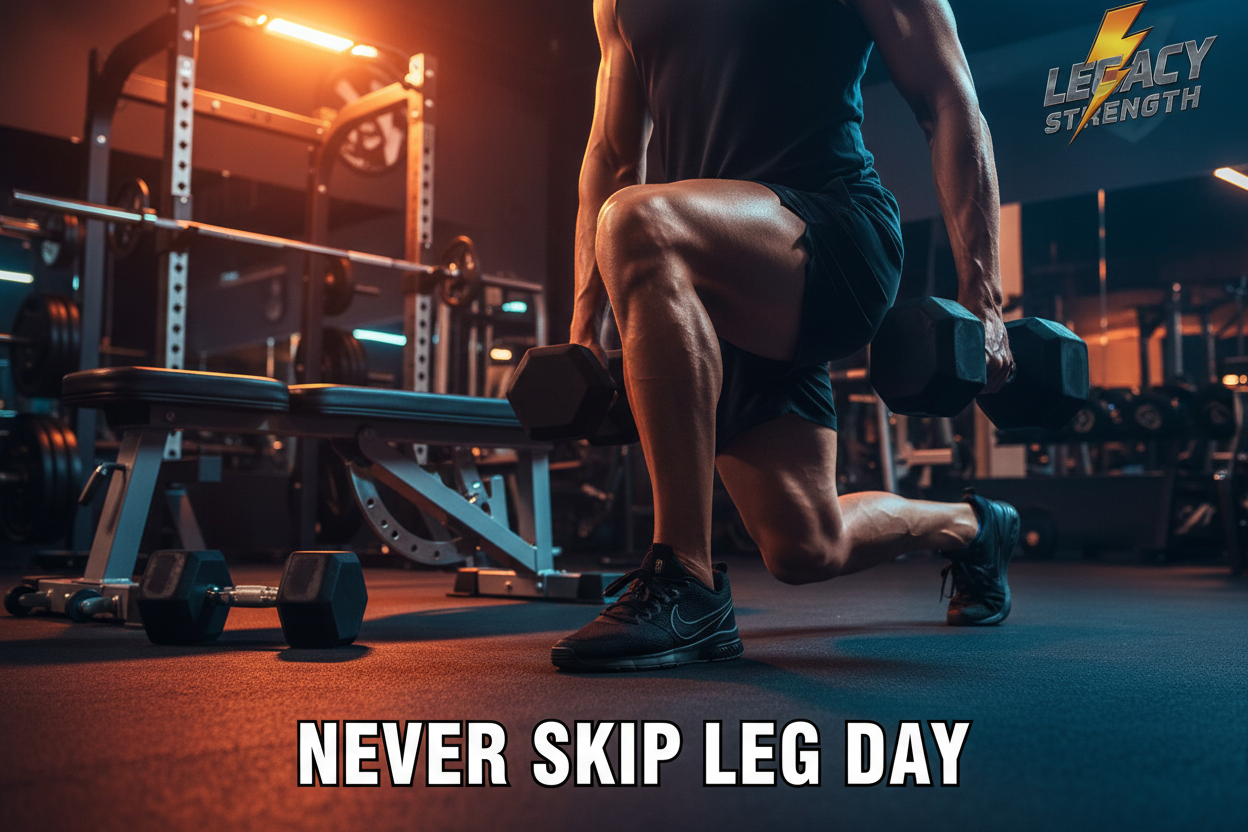
This is arguably the king of lower body exercises, often more effective for hypertrophy than a standard back squat because it takes the lower back out of the equation. Place the top of your rear foot on the bench behind you. Hold a dumbbell in each hand (or one heavy one at your chest like a goblet). Lower your hips until your back knee almost touches the floor, keeping your front heel planted.
The stretch you get in the rear hip flexor combined with the load on the front quad creates massive tension. If you lean your torso slightly forward, you target the glutes; keep your torso upright to hammer the quads.
Dumbbell Hip Thrusts
The bench is non-negotiable here. Sit on the floor with your upper back resting against the edge of the bench. Roll a heavy dumbbell over your hips. Drive through your heels to lift your hips toward the ceiling, squeezing your glutes hard at the top. Your shins should be vertical at the peak of the movement.
This movement isolates the glutes better than almost any other exercise. It develops the posterior chain power necessary for sprinting and jumping, without compressing the spine.
Step-Ups with Controlled Eccentric
Most people do step-ups wrong by pushing off the bottom foot. To make this effective, plant one foot on the bench. Drive down through that heel to lift your body up, ensuring the trailing leg is dead weight. The magic happens on the way down. Lower yourself slowly—taking 3 to 4 seconds—until your trailing toe gently touches the floor.
This slow lowering phase causes significant muscle fiber damage (the good kind) which signals growth. It requires immense focus but delivers impressive results for the quads.
Single-Leg Romanian Deadlift (RDL)
While you can do these standing on the floor, using the bench for support can help if your balance is poor. Place one hand on the bench backrest for stability while holding a dumbbell in the other hand. Hinge at the hips, lifting one leg behind you while lowering the weight toward the ground. You should feel a deep stretch in the hamstring of the planted leg.
Removing the balance constraint allows you to go heavier and focus purely on the hamstring stretch and contraction.
Structuring Your Routine
You shouldn't just throw these exercises together randomly. A structured leg workout with dumbbells and bench should follow a logical flow, starting with the most demanding movements and finishing with isolation or burnout work.
Try this sequence for your next session:
- Bulgarian Split Squats: 3 sets of 8-10 reps per leg. (Rest 90 seconds between sets).
- Dumbbell Hip Thrusts: 4 sets of 12-15 reps. (Focus on a hard squeeze at the top).
- Step-Ups: 3 sets of 10 reps per leg. (Focus on the slow descent).
- Goblet Squats to Bench: 3 sets of 15-20 reps. (Use the bench as a depth gauge—tap your butt to the bench and explode up).
- Dumbbell RDLs: 3 sets of 12 reps.
Progressive Overload Without More Weight
A common issue with home workouts is maxing out your dumbbell weight. Once you can easily perform the prescribed reps with your heaviest dumbbells, you need other ways to make the workout harder.
Manipulating tempo is the easiest method. Instead of a standard 1-second up, 1-second down cadence, try lowering the weight for 4 seconds and pausing for 2 seconds at the bottom of a squat or lunge. This increases "time under tension." Alternatively, decrease your rest periods. If you usually rest 90 seconds, cut it to 45. Your muscles will fatigue faster, maintaining the stimulus even if the weight stays the same.
Consistency remains the primary driver of results. Whether you are in a high-end health club or a garage, the effort you apply to these movements determines your progress. The bench and dumbbells are merely tools; your intensity is the catalyst.
Frequently Asked Questions
Can I really build big legs without a barbell squat?
Yes, absolutely. Your muscles do not know if resistance is coming from a barbell, a machine, or a dumbbell; they only recognize tension. By using unilateral movements like split squats, you can place immense load on the legs comparable to a back squat, often with less risk of lower back injury.
How often should I do this workout?
For most natural lifters, training legs twice a week allows for optimal protein synthesis and recovery. You might perform this specific routine on Monday and Thursday, giving your muscles 48 to 72 hours to repair and grow between sessions.
What if I struggle with balance on Bulgarian Split Squats?
This is common for beginners. You can place your bench near a wall or a sturdy object and use one hand to lightly touch it for stability. As your core and hip stabilizers get stronger over a few weeks, try to rely on the wall less until you can perform the movement freely.