Stop Sitting on Your Potential: The Real Science Behind Building Powerful Glutes
Most people treat glute training as purely aesthetic, chasing a certain look for swimsuit season. While a well-developed posterior is a nice bonus, the real value of strong glutes lies in performance and pain prevention. Your glutes are the engine of your body. They dictate how fast you run, how heavy you lift, and whether your lower back aches after a long day of sitting. If you want to move better and lift heavier, you need to prioritize glutes strength exercises that target all three heads of the muscle group.
Modern lifestyles are the enemy of glute function. Spending eight hours in a chair puts the hips in a shortened position, leading to tight hip flexors and inactive glutes, a phenomenon often called "gluteal amnesia." To wake these muscles up, you can't just rely on walking or random bodyweight squats. You need a strategic approach involving resistance and progressive overload. Let's break down how to build a backside that actually performs.
Understanding the Engine: It’s Not Just One Muscle
Before jumping under a barbell, you need to understand what you are training. The gluteal complex consists of the Maximus, Medius, and Minimus. The Gluteus Maximus is the powerhouse responsible for hip extension—think sprinting or standing up from a chair. The Medius and Minimus are smaller, located on the side of the hip, and they handle abduction and rotation. If you neglect these smaller stabilizers, your knees might cave inward during squats, leading to injury.
Effective strength exercises for glutes must address all these functions. A routine consisting solely of squats will leave gaps in your development because squats are primarily knee-dominant. To truly isolate and grow the glutes, you need movements that challenge the hips through extension, abduction, and rotation under load.
My Wake-Up Call With Glute Training
I learned the hard way that compound lifts aren't always enough. For years, I relied strictly on heavy back squats and conventional deadlifts, assuming my legs were getting equal work. I developed decent quads, but my lower back was constantly tight, and my numbers on the deadlift stalled completely. It wasn't until I visited a physical therapist that I realized my glutes were essentially dormant. My lower back was taking over the load that my hips should have been moving. Once I shifted my focus to specific workouts to strengthen glutes—incorporating direct hip thrusts and unilateral work—my back pain vanished within weeks, and my deadlift PR shot up by 30 pounds. It was a humbling lesson in biomechanics: you are only as strong as your weakest link.
The Heavy Hitters: Compound Movements
To build raw power, you have to move weight. The foundation of strength training glutes lies in heavy, compound extension movements. These should form the start of your workout when your energy levels are highest.
The Barbell Hip Thrust
This is arguably the king of glute development. Unlike a squat, where tension on the glutes varies throughout the movement, the hip thrust keeps the glutes under constant tension, specifically at the peak contraction. By bending the knees, you take the hamstrings largely out of the equation, forcing the glutes to do the heavy lifting.
Set up with your upper back against a bench and a barbell across your hips (use a pad). Drive through your heels, keeping your chin tucked and ribs down. Squeeze hard at the top. If you feel this in your lower back, you are likely hyperextending rather than using your hips.
The Romanian Deadlift (RDL)
While the hip thrust challenges the muscle in the shortened position (the squeeze), the RDL challenges the glutes in the lengthened position (the stretch). This exercise is crucial for hypertrophy. Keep a slight bend in your knees and push your hips back as far as possible, imagining you are trying to close a car door with your butt. The movement ends when your hips stop moving back, not when the bar hits the floor. The deep stretch you feel here creates significant muscle damage, which is a key driver for growth.
Unilateral Work: Fixing Imbalances
Bilateral movements hide weaknesses. If your right side is stronger, it will compensate for the left during a heavy squat. To build a bulletproof lower body, you must include exercises for stronger glutes that force each leg to work independently.
Bulgarian Split Squats
Often dreaded for their difficulty, these are non-negotiable for serious strength. Place one foot on a bench behind you and lower your hips. To bias the glutes rather than the quads, lean your torso forward slightly and position your front foot further out. This increases the degree of hip flexion. You will feel a deep stretch in the glute of the working leg. This movement also heavily recruits the Gluteus Medius to stabilize the pelvis.
Step-Ups
The step-up is deceptive. It looks easy, but when done correctly, it requires immense stability. Use a box that is roughly knee height. The key is to avoid pushing off with the back leg. Lean forward, drive through the heel of the foot on the box, and control the descent. Slowing down the eccentric (lowering) phase will light up your glutes more than simply bouncing up and down.
Accessory Work and Metabolic Stress
Once the heavy lifting is done, you can finish with higher-repetition isolation work. These exercises are less about moving maximum weight and more about metabolic stress and the "pump." This is where you target the smaller muscles like the Gluteus Medius.
Cable kickbacks and seated abduction machine work fit well here. For kickbacks, keep your torso stable and kick slightly outward at a 45-degree angle rather than straight back. This hits the upper shelf of the glutes. High-rep banded walks are also excellent finishers to ensure you have fully exhausted the muscle fibers.
Structuring Your Routine
You don't need to train glutes every single day. In fact, doing so can hinder recovery and growth. A frequency of two to three times per week is optimal for most lifters. A solid approach is to have one day focused on heavy tension (lower reps, heavier weight) using hip thrusts and squats, and another day focused on metabolic stress and range of motion (higher reps, lighter weight) using lunges and RDLs.
Remember that progressive overload applies to workouts to strengthen glutes just as it does to chest or back training. You must do more over time—whether that is adding weight to the bar, doing more reps, or slowing down your tempo to increase time under tension. Randomly selecting exercises without tracking your progress will lead to random results.
The Role of Nutrition and Recovery
All the hip thrusts in the world won't result in muscle growth if you aren't fueling the process. Building muscle requires a caloric surplus or at least maintenance calories with high protein intake. Aim for roughly 0.7 to 1 gram of protein per pound of body weight to support tissue repair. Sleep is equally critical; growth hormone is released during deep sleep cycles, repairing the micro-tears created during your session.
Building a powerful posterior chain takes patience. It requires a mental shift from simply "working out" to training with intent. Connect with the muscle, control the weight, and prioritize form over ego. Your lower back, knees, and athletic performance will thank you.
Frequently Asked Questions
Can I build glutes without heavy weights?
Yes, but only to a point. Beginners can see results with bodyweight exercises, but to continue building significant mass and power, you eventually need external resistance (weights or strong bands) to provide the necessary stimulus for the muscle fibers to grow.
Why do I feel my hamstrings taking over during glute bridges?
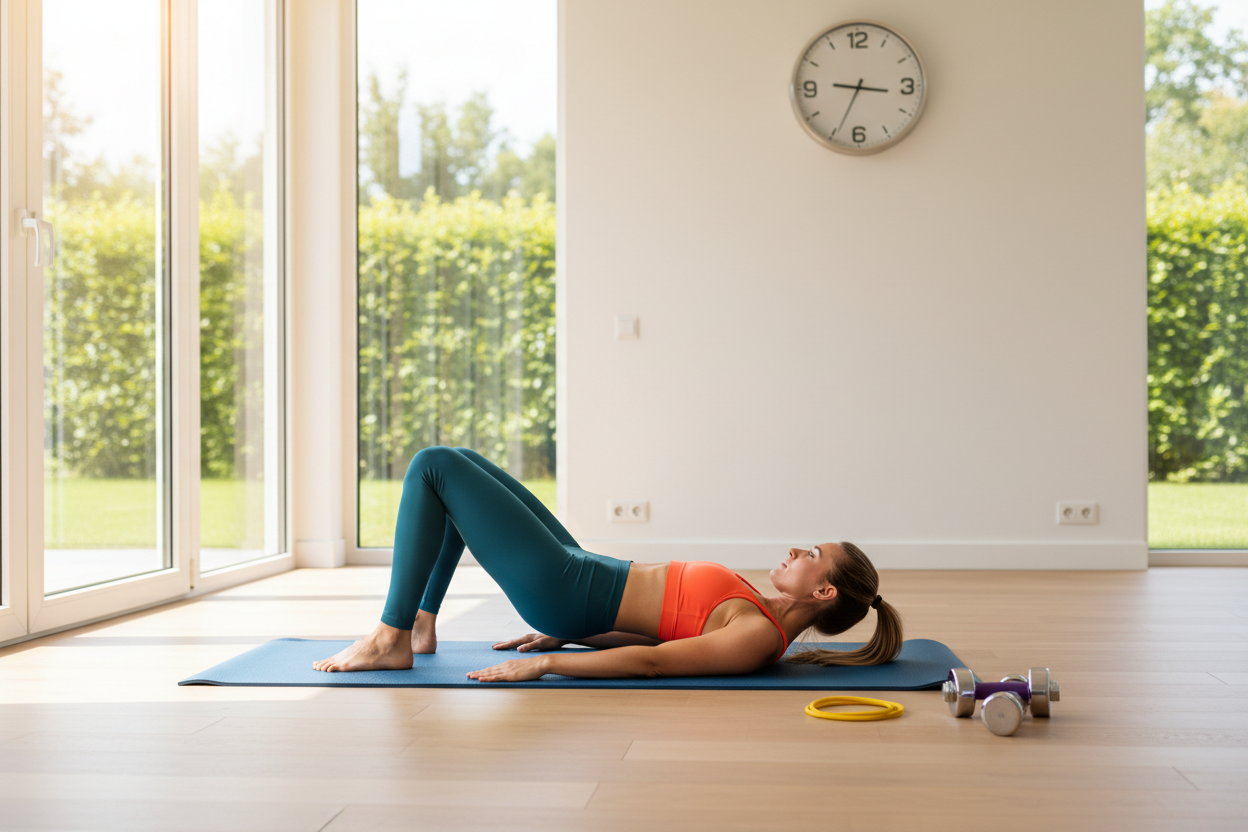
This usually happens if your feet are placed too far away from your body. Try bringing your heels closer to your glutes. Additionally, focus on driving through your heels and mentally cueing the glute squeeze before you even lift your hips off the ground.
How long does it take to see results from glute training?
With consistent training 2-3 times a week and proper nutrition, you can expect to feel strength improvements within 4-6 weeks. Visible muscle growth (hypertrophy) is a slower process and typically becomes noticeable after 3-4 months of progressive overload.