Stop Sitting on Your Potential: How to Wake Up and Strengthen Weak Glutes
Most people realize they have a problem when the lower back starts aching after a long drive or their knees wobble during a hike. We spend the vast majority of our lives sitting—at desks, in cars, and on sofas—which causes our posterior chain to effectively go to sleep. If you are wondering how to strengthen your glutes, the answer isn't just about doing endless squats. It requires a targeted approach that first wakes up the muscle connection and then applies progressive load. To truly fix the issue, you must move beyond generic leg workouts and focus on isolation and activation before building raw power.
Why Your Glutes Are Weak (And Why It Matters)
I learned this lesson the hard way a few years ago. Despite squatting heavy weights regularly, I developed nagging hip pain that wouldn't go away. A physical therapist eventually told me that while my quads were strong, my glutes were practically dormant. I was using my lower back and hamstrings to compensate for inactive gluteal muscles. This phenomenon, often called "gluteal amnesia," means your brain has essentially forgotten how to activate those fibers properly. Once I shifted my focus to specific exercises for weak glutes that prioritized muscle engagement over heavy weight, the pain vanished, and my lifts actually improved.
When you look for exercises to strengthen gluteus muscles, you are doing more than just aesthetic work. The glutes are the engine of your body. They stabilize the pelvis, support the lower back, and drive movement. If you have weak glutes, your body is forced to rely on smaller, less capable muscles to do the heavy lifting, leading to injury and chronic pain. Learning how to strengthen weak glutes is often the missing link in resolving posture issues and athletic plateaus.
The Activation Phase: Waking Up the Muscle
Before you grab a barbell, you need to establish a mind-muscle connection. If you jump straight into heavy compound movements with dormant glutes, your hamstrings and lower back will take over. Here are the best weak glute exercises to start your routine.
The Glute Bridge
This is arguably the most fundamental exercise to strengthen buttock muscles. It removes the quads from the equation and forces the hips to do the work.
- Lie on your back with knees bent and feet flat on the floor.
- Press your heels into the ground and lift your hips until your body forms a straight line from shoulders to knees.
- Squeeze your glutes hard at the top for two seconds.
- Lower slowly.
Clamshells
If you want to know how to strengthen glute muscles specifically in the lateral (side) region, clamshells are non-negotiable. They target the gluteus medius, which is crucial for hip stability.
- Lie on your side with legs stacked and knees bent at a 45-degree angle.
- Keeping your feet touching, open your top knee as high as possible without rolling your hips backward.
- Pause at the top and return to the start.
Building Strength: The Best Compound Movements
Once you feel your glutes firing during the warm-up, it is time to load them. When people ask which exercise best strengthens the glutes, the scientific consensus and practical application point to the hip thrust. However, a balanced routine includes a variety of movement patterns.
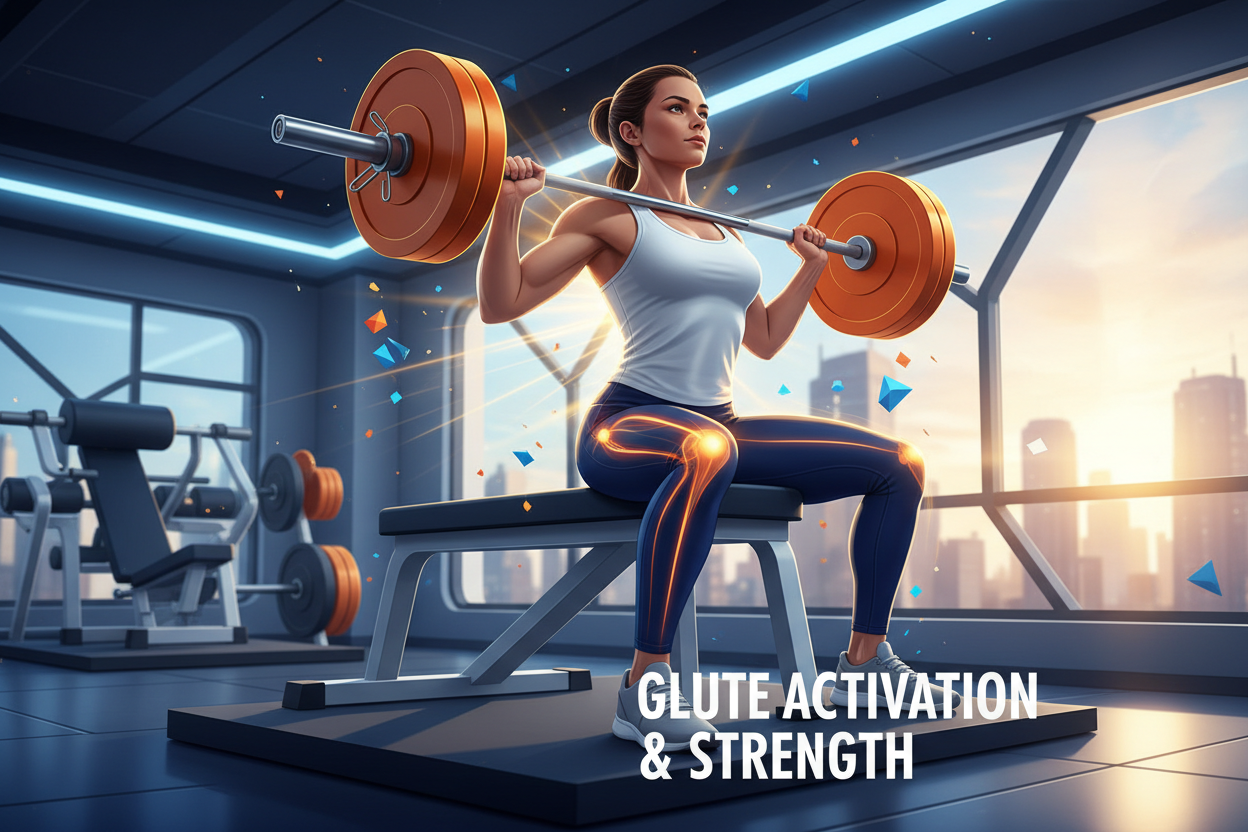
The Barbell Hip Thrust
This movement provides the highest level of glute activation because the tension is highest when the muscle is fully shortened. It is the gold standard when looking for exercises to strengthen your glutes.
Sit with your upper back against a bench and a barbell across your hips (use a pad for comfort). Drive through your heels to lift your hips until fully extended. Your shins should be vertical at the top. Lower the weight with control. If you are wondering how to strengthen buttocks effectively for size and power, this is your primary lift.
Bulgarian Split Squats
Unilateral (single-leg) training is essential to fix imbalances. This is a challenging exercise for strengthening glutes that also improves balance.
Stand a few feet in front of a bench. Place one foot behind you on the bench. Lower your hips until your back knee almost touches the floor. To bias the glutes, lean your torso slightly forward rather than staying perfectly upright. Drive back up through the front heel.
Romanian Deadlifts (RDL)
While the hip thrust works the glute in a shortened position, the RDL strengthens gluteal muscles in a lengthened position. Holding a barbell or dumbbells, hinge at the hips with a slight bend in the knees. Push your hips back as far as possible until you feel a deep stretch in your hamstrings and glutes. Squeeze your glutes to pull your hips forward and return to standing.
How Long Does It Take to See Results?
A common frustration is the timeline. You might ask, how long to strengthen weak glutes? The answer depends on your consistency. Neurological adaptations happen quickly. Within two to three weeks of consistent activation work, you will feel a difference in how your muscles fire while walking or climbing stairs.
For actual structural changes and muscle growth, you are looking at six to eight weeks. The key is frequency. Because the glutes are large, resilient muscles, they respond well to high frequency. You can perform buttock strengthening exercises like bridges and clamshells daily, while heavier lifts like hip thrusts should be done 2-3 times a week to allow for recovery.
Creating Your Routine
If you are unsure how do you strengthen your glutes without spending hours in the gym, structure your workout by prioritizing the posterior chain twice a week. Start every leg workout with 5-10 minutes of isolation work. This acts as a primer. If you suffer from severe "sleepy glutes," doing a set of bodyweight glute bridges immediately after waking up or after long periods of sitting can be a game-changer.
Remember that form dictates function. If you are swinging the weight or arching your lower back, you aren't doing exercises to strengthen glutes; you are just stressing your spine. Slow down the tempo. Focus on the squeeze. When you learn how to strengthen my glutes properly, you stop chasing numbers and start chasing tension.
Fixing the Lifestyle Factors
You cannot train away a bad lifestyle. If you sit for 10 hours a day and train for one, your hips will remain tight and your glutes weak. To truly fix weak glutes, you must interrupt the sitting cycle. Stand up every 30 minutes. Squeeze your glutes while standing in line at the grocery store. Walk uphill. Incorporating these micro-habits determines how to strengthen your glutes permanently rather than just temporarily.
Ultimately, the journey to strengthen buttock muscles is about intentionality. It is about reconnecting your brain to your body. Whether you choose the hip thrust, the lunge, or the humble bridge, the exercise that best strengthens the glutes is the one you perform with perfect intent and consistency.
Frequently Asked Questions
Can walking help strengthen my glutes?
Walking on flat ground provides minimal glute stimulation, but walking uphill or on an incline treadmill is excellent for glute engagement. To maximize the benefit, focus on pushing through your heel with every step and consciously squeezing the glute as you extend your leg behind you.
Why do I feel glute exercises in my hamstrings?
This usually indicates that your glutes are inactive, causing your hamstrings to compensate (synergistic dominance). To fix this, reduce the weight and spend more time on activation movements like clamshells or glute bridges before attempting compound lifts, and focus on mentally engaging the glute first.
Can I strengthen my glutes at home without weights?
Yes, you can build significant strength at home using high-repetition bodyweight exercises. Movements like single-leg glute bridges, step-ups on a sturdy chair, and bodyweight squats are highly effective if you perform them with high volume and slow, controlled tempos.