Stop Sabotaging Your Gains: The Best Arm and Shoulder Workouts Guide
You walk into the gym, head straight for the dumbbell rack, and start curling. It’s a standard routine, but it is also the reason your physique hasn't changed in six months. If you want 3D delts and sleeves that feel tight, you need to stop training these muscle groups as afterthoughts.
The best arm and shoulder workouts aren't about how much weight you can swing; they are about mechanical tension and anatomical precision. To build a complete upper body, you have to understand how the deltoids, biceps, and triceps function together and where most lifters fail. Let’s strip away the bro-science and look at what actually builds mass.
Quick Summary: The Upper Body Blueprint
- Prioritize Overhead Stability: The standing Overhead Press is the non-negotiable foundation for shoulder mass and tricep stability.
- Target the Lateral Head: You cannot build wide shoulders without isolating the side delts using high reps and controlled eccentrics.
- Stretch the Long Head: For arms, tricep overhead extensions are superior to pushdowns for mass because they train the muscle in a stretched position.
- Volume Management: Arms and shoulders recover quickly; frequency (2-3x per week) usually beats singular "annihilation" days.
- Compound First, Isolate Second: Always start with heavy presses before moving to isolation movements to maximize energy expenditure.
The Anatomy of the "3D" Look
Before we touch a weight, you need to visualize what we are targeting. The "capped" shoulder look comes from the medial (side) deltoid, while the thickness comes from the front and rear delts. However, many lifters overdevelop their front delts (from too much bench pressing) and neglect the rear delts and side heads.
Similarly, the tricep makes up two-thirds of your arm mass. If you are obsessing over curls but ignoring heavy extensions, your arms will effectively look small regardless of how hard you work. The best shoulder and arm exercises address the tricep long head and the rear deltoid specifically.
The Compound Foundation
The Standing Overhead Press (OHP)
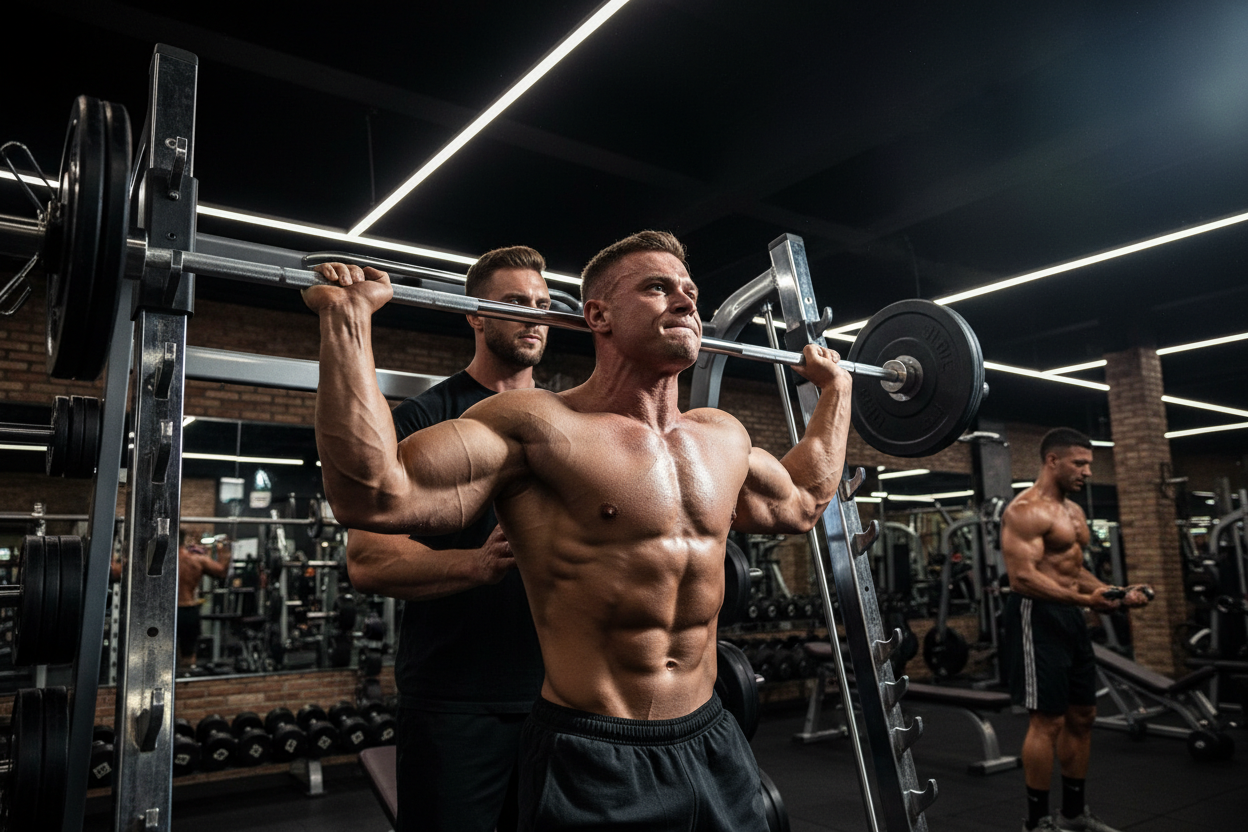
This is the king of upper body movements. It integrates the entire shoulder girdle and places a massive load on the triceps. Unlike seated variations, the standing press forces your core to stabilize, allowing for a more natural scapular rhythm.
Keep your glutes squeezed and your elbows slightly in front of the bar. Press in a straight line, moving your head through the "window" at the top. This isn't just a shoulder move; it is the primary mass builder for the triceps as well.
Isolation Mechanics for Width and Peak
Lateral Raises (The Right Way)
Most people butcher this exercise by going too heavy. If you are swinging your torso, your traps are doing the work, not your shoulders. To execute the best workout for arms and shoulders, drop the ego.
Lean slightly forward. Visualize pushing your hands out toward the walls rather than up toward the ceiling. This mental cue disengages the traps and places the tension squarely on the medial delt.
Incline Dumbbell Curls
Standing curls are fine, but incline curls are superior for the long head of the bicep. By sitting back on an incline bench, you place your arms behind your torso. This stretches the long head of the bicep at the shoulder joint. A stretched muscle under load has a higher potential for hypertrophy (growth).
Overhead Tricep Extensions
Tricep pushdowns are popular, but they don't fully stretch the long head of the tricep. To get that thick, hanging look to the back of the arm, you must extend the arm overhead. You can use a dumbbell, a cable rope, or an EZ bar. Focus on a deep stretch at the bottom of the movement.
My Training Log: Real Talk
I want to be transparent about my own journey with the best arm and shoulder workouts. For years, I thought heavy dumbbell shoulder presses were the answer. I was pushing 80lb dumbbells, but my shoulders looked flat. Why? Because my form was trash and my triceps were taking over.
The game changer for me wasn't lifting heavier; it was the "cable burn." I remember specifically switching from dumbbell lateral raises to cable lateral raises. The difference in sensation was immediate and uncomfortable. With dumbbells, there is zero tension at the bottom of the movement. With cables, the weight stack is trying to rip your arm across your body even when your hand is at your thigh.
I recall the specific, gritty feeling of the cable cuff digging into my wrist hair and that deep, nauseating burn in the side delt that hits around rep 12. It’s not the sharp pain of an injury; it’s a dull, accumulating heat that makes you want to drop your arms. That specific discomfort—where the muscle feels like it's full of battery acid—is exactly where the growth happens. Once I fell in love with that ugly feeling, my width finally popped.
Conclusion
Building impressive appendages doesn't require a complex matrix of exercises. It requires executing the basics with surgical precision. Focus on the overhead press for strength, and use strict isolation movements to carve out the details. Remember, if you can't feel the muscle working, you are just moving weight. Control the eccentric, pause at the bottom, and force growth through tension.
Frequently Asked Questions
Can I train arms and shoulders on the same day?
Absolutely. In fact, they are synergistic. Since pressing movements for shoulders heavily involve the triceps, it makes sense to finish the triceps off in the same session. This is often more efficient than splitting them up.
What is the best rep range for shoulders?
Shoulders, particularly the side and rear delts, respond best to metabolic stress. While your heavy presses should be in the 6-10 rep range, your lateral raises and face pulls often see better results in the 12-20 rep range to maximize blood flow and pump.
How do I stop my traps from taking over on lateral raises?
This is a common issue. Try doing lateral raises while seated to eliminate body momentum. Also, focus on depressing your scapula (pulling your shoulder blades down) before you initiate the lift. If you shrug, the trap takes over.