Stop Rushing Rehabilitation for Rotator Cuff Tear: The Safe Path
Waking up at 3 AM because you accidentally rolled onto your shoulder is a specific kind of misery. Whether you hurt yourself lifting heavy, playing tennis, or simply from years of wear and tear, the road to recovery can feel incredibly slow. Many people try to push through the pain, assuming that "no pain, no gain" applies here. It doesn't.
Successful rehabilitation for rotator cuff tear requires a shift in mindset. You aren't just building muscle; you are convincing a stubborn, low-blood-flow tendon to knit itself back together while maintaining range of motion. It is a balancing act between protection and mobilization.
Key Takeaways: The Recovery Roadmap
- Respect the Inflammation: The first phase isn't about strength; it's about reducing inflammation and protecting the tissue.
- Scapular Stability First: You cannot fix the rotator cuff if your shoulder blade (scapula) isn't moving correctly.
- Passive before Active: Movement must be re-introduced passively (gravity or assistance) before using your own muscles.
- Patience is Physiology: Tendons heal slower than muscles due to limited blood supply; rushing leads to setbacks.
The Science of Rotator Cuff Injury Rehabilitation
To fix the shoulder, you have to understand why it failed. The rotator cuff is a group of four small muscles that act as a suction cup, holding the ball of your arm bone (humerus) in the shallow socket of your shoulder blade.
When you have a tear, that suction seal is broken. If you immediately start doing heavy overhead presses, you are grinding the bone against the acromion (the roof of the shoulder), causing impingement. Effective rotator cuff injury rehabilitation focuses on depressing the humeral head to clear that space.
Phase 1: Protection and Passive Motion
In the early stages, stiffness is actually your enemy. However, active movement can widen the tear. The solution is passive range of motion.
We use exercises like the "Pendulum." This involves leaning over a table and letting your arm hang dead weight, using your body's momentum to swing the arm gently. This pumps synovial fluid into the joint without stressing the torn tendon.
The Critical Role of the Scapula
Most failed rehab programs ignore the shoulder blade. Think of the scapula as the launchpad for a rocket (your arm). If the launchpad is on unstable ground, the rocket crashes.
During the rehabilitation of rotator cuff injury, we must engage the lower trapezius and serratus anterior. If your shoulder rounds forward (posture issues), you are mechanically closing off the space the rotator cuff needs to move. Retraction and depression of the shoulder blade are non-negotiable prerequisites before you ever pick up a dumbbell.
Common Pitfalls in Rehabilitation
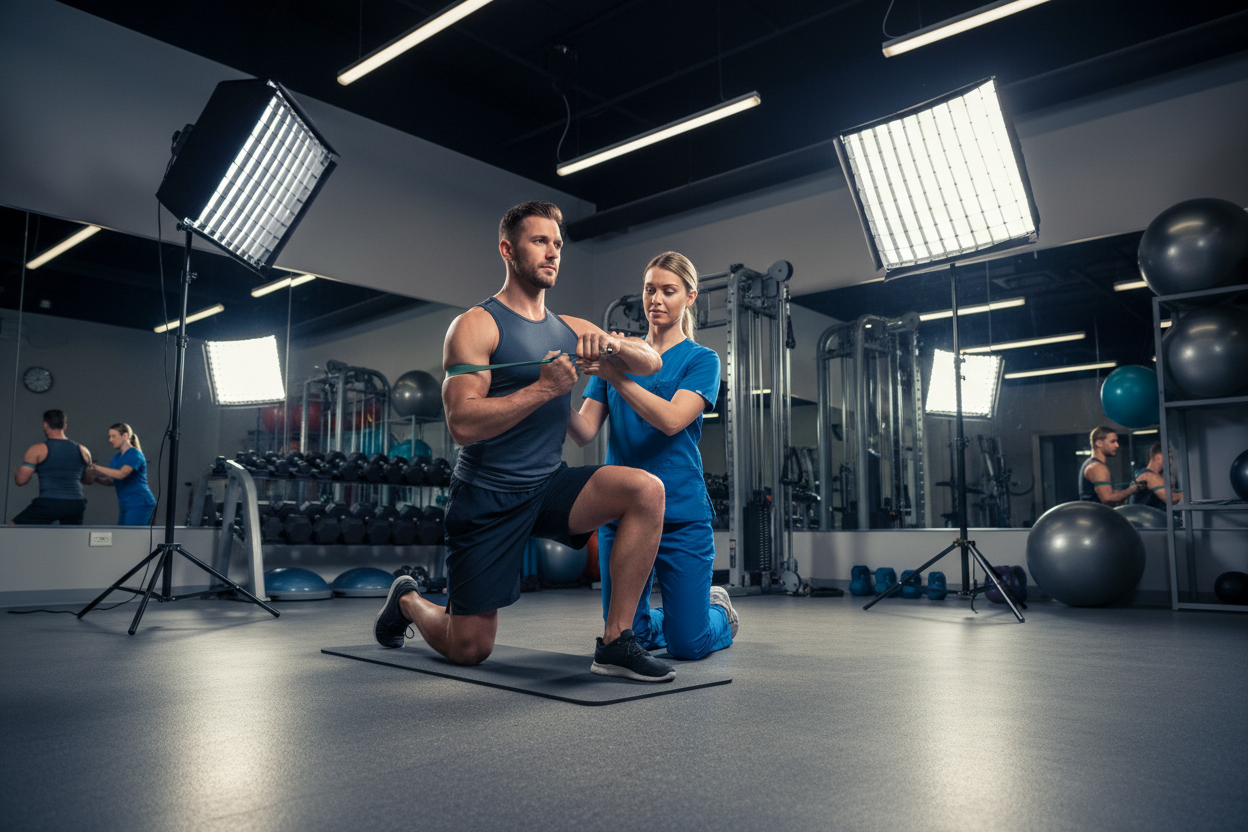
The biggest mistake I see is patients graduating themselves to resistance bands too early. They feel a "good burn" and think they are healing. Often, that burn is the upper trap taking over because the rotator cuff is still inhibited.
Another error is ignoring the eccentric phase. The rotator cuff works hardest as a brake, slowing your arm down after a throw or a reach. Your rehab must eventually include slow, controlled lowering movements to mimic this function.
My Personal Experience with Rehabilitation for Rotator Cuff Tear
I want to be real about what this process actually feels like, beyond the clinical textbooks. A few years ago, I dealt with a partial supraspinatus tear. The hardest part wasn't the exercises; it was the psychological frustration of the "yellow band."
I remember standing in my living room, doing external rotations with that flimsy yellow resistance band. It felt like I was doing absolutely nothing. There was no pump, no sweat. My ego wanted to grab the 20lb dumbbell. But whenever I tried to cheat the progression, I'd get this specific, dull ache deep inside the front of the shoulder—not a muscle soreness, but a sickening "toothache" feeling in the joint that lingered for hours.
The breakthrough happened when I stopped trying to "lift" the weight and started focusing entirely on keeping my shoulder blade tucked into my back pocket. The moment I isolated that movement, the clicking sound in my shoulder—that annoying pop I heard every time I reached for a seatbelt—finally stopped.
Conclusion
Healing a shoulder is a marathon, not a sprint. The biology of tendon repair cannot be rushed, no matter how hard you work. By focusing on scapular stability and adhering to a strict progression from passive to active movement, you can return to full function.
Trust the process, respect the timeline, and listen to the feedback your body gives you.