Stop Overcomplicating Leg Day: A Simple Routine That Actually Grows Your Thighs
You do not need twelve different machines, drop sets, supersets, or two hours of free time to build strong legs. In fact, most people see better results when they strip away the noise and focus on a simple leg workout built around fundamental movement patterns. The best routine is the one you can recover from and stick to consistently.
If you want to know how to do leg day effectively, the answer lies in intensity and form, not variety. A basic leg workout should hit the quadriceps, hamstrings, glutes, and calves using compound movements. By focusing on just three or four key exercises, you can pour more energy into the lifts that actually matter, driving growth and strength without spending your entire evening at the gym.
The Philosophy of a Simple Leg Day
Complexity is the enemy of execution. When I first started lifting, I fell into the trap of volume over value. I remember walking into the gym with a notebook full of eight different exercises. I would start with extensions, move to curls, then the leg press, then squats, and finish with lunges. By the time I got to the heavy compound lifts—the ones that actually drive hormone response and muscle growth—I was already exhausted. My form broke down, and my progress stalled for months.
I eventually scrapped everything and switched to a simple leg day workout consisting of just three movements. Within six weeks, my squat numbers went up, and my pants started fitting tighter in the thighs. The lesson was clear: doing a few things with high intensity is infinitely better than doing many things with mediocre effort.
The Core Components of a Leg Workout
To build a comprehensive workout routine for thighs and glutes, you only need to cover three main mechanical functions. If you hit these, you have hit everything.
The first is the squat pattern. This is knee-dominant and primarily targets the quadriceps and glutes. The second is the hinge pattern. This involves bending at the hips with a slight knee bend, heavily recruiting the hamstrings and lower back. The third is the unilateral movement, or single-leg work. This fixes imbalances and improves stability.
Exercise 1: The Squat Variation (3 sets of 6-10 reps)
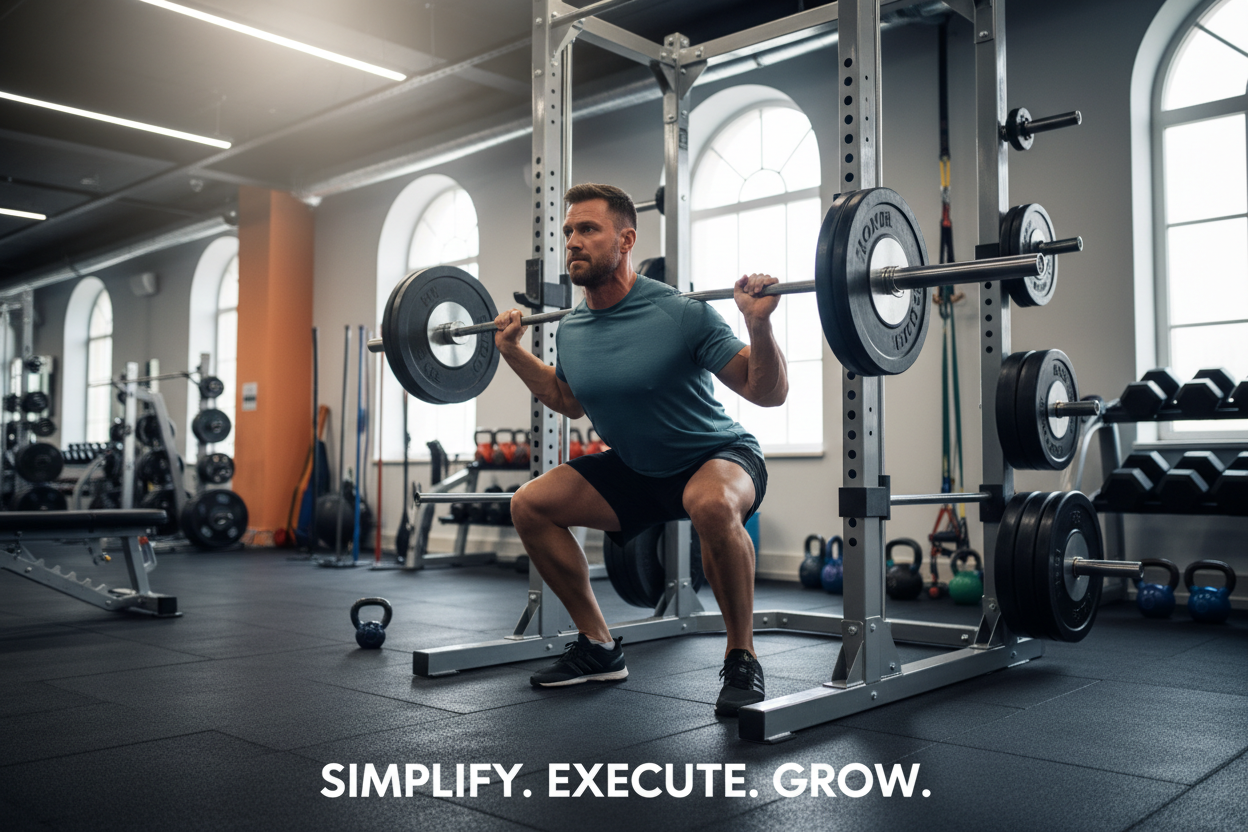
The centerpiece of any simple leg day is the squat. You don't necessarily have to put a barbell on your back if you aren't comfortable with it yet. Goblet squats (holding a dumbbell at chest height) are fantastic for beginners because the weight acts as a counterbalance, helping you keep your torso upright.
Focus on depth. Lower your hips until your thighs are at least parallel to the floor. Drive back up through your mid-foot. This movement recruits the most muscle mass and triggers the greatest growth response. If you are advanced, stick to the barbell back squat. If you have back issues, try a front squat or a leg press, but treat it with the same intensity as a free-weight movement.
Exercise 2: The Hinge / Romanian Deadlift (3 sets of 8-12 reps)
While squats handle the front of the legs, you need a heavy hitter for the back of the legs. The Romanian Deadlift (RDL) is superior to the lying leg curl machine because it integrates your lower back and glutes in a way that machines cannot replicate.
To perform this, hold a barbell or dumbbells at hip height. Keep your knees slightly bent but rigid—they shouldn't bend further as you lower the weight. Push your hips backward as if you are trying to close a car door with your butt. Lower the weight only until you feel a deep stretch in your hamstrings, usually just below the knees, then squeeze your glutes to return to standing. This is essential for a balanced basic leg workout.
Exercise 3: Walking Lunges or Split Squats (3 sets of 10-12 reps per leg)
Bilateral movements (using both legs) are great for raw strength, but they can hide weaknesses. If your right leg is stronger than your left, it will take over during a squat. Unilateral work exposes these imbalances.
Lunges are a perfect finisher. They torch the quads and glutes and require significant core stability. Grab a pair of dumbbells and take long strides to emphasize the glutes, or shorter strides to hammer the quads. If space is an issue, Bulgarian Split Squats (rear foot elevated on a bench) are a grueling but effective alternative.
Optional: Calf Raises (3 sets of 15-20 reps)
If you have the time and energy, throw in some standing or seated calf raises. High reps work best here. Pause at the bottom for a full second to eliminate the elastic energy in the tendon, ensuring the muscle does the work.
How to Progress: The Key to Growth
A simple leg workout only works if you apply progressive overload. Since you aren't confusing your muscles with new exercises every week, you must challenge them by increasing the difficulty of the standard movements.
Track your numbers. If you squatted 135 lbs for 8 reps last week, try for 9 reps this week. Once you hit the top of your rep range (e.g., 10 or 12 reps), increase the weight by 5 or 10 lbs and start back at the bottom of the rep range. This systematic approach guarantees that your simple leg day workout continues to produce results year after year.
Warm-Up and Safety
Never jump straight into your working sets. A proper warm-up lubricates the joints and prepares the nervous system. Start with 5 minutes of light cardio to get the body temperature up. Follow this with dynamic stretching: leg swings, bodyweight squats, and hip openers.
Before you load the bar for your squats or RDLs, do two or three "ramp-up" sets with lighter weights. This helps groove the movement pattern and prepares your mind for the heavy lifting to come. Neglecting this step is the fastest way to turn a productive session into an injury.
Frequency: How Often Should You Train Legs?
For most people, training legs once a week is the bare minimum to maintain mass, but twice a week is optimal for growth. Because this routine is low in complexity and volume (total number of sets), you can likely recover from it faster than a high-volume "bodybuilder" style workout. Consider running this routine on Monday and Thursday, allowing plenty of recovery time in between.
Simplifying your training doesn't mean you are being lazy. It means you are being efficient. By focusing on the squat, hinge, and lunge patterns, you cover every muscle fiber in the lower body. Master these movements, add weight over time, and you will build an impressive set of wheels without living in the gym.
Frequently Asked Questions
Can I do this leg workout at home with just dumbbells?
Yes, absolutely. You can perform goblet squats, dumbbell RDLs, and lunges effectively with just a pair of dumbbells. The only limitation is if the dumbbells become too light for your strength level, at which point you will need to increase reps or slow down the tempo to keep it challenging.
What should I do if I feel pain in my lower back during RDLs?
Lower back pain during RDLs usually means you are rounding your spine or lowering the weight too far. Focus on pushing your hips back rather than reaching down with the weights, and stop the movement as soon as your hips stop moving backward, even if the weights are only at knee height.
Is this routine enough to build big legs?
Yes, muscle growth comes from mechanical tension and progressive overload, not from doing ten different exercises. As long as you are pushing close to failure and gradually increasing the weight or reps over time, this focused routine is sufficient for significant hypertrophy.