
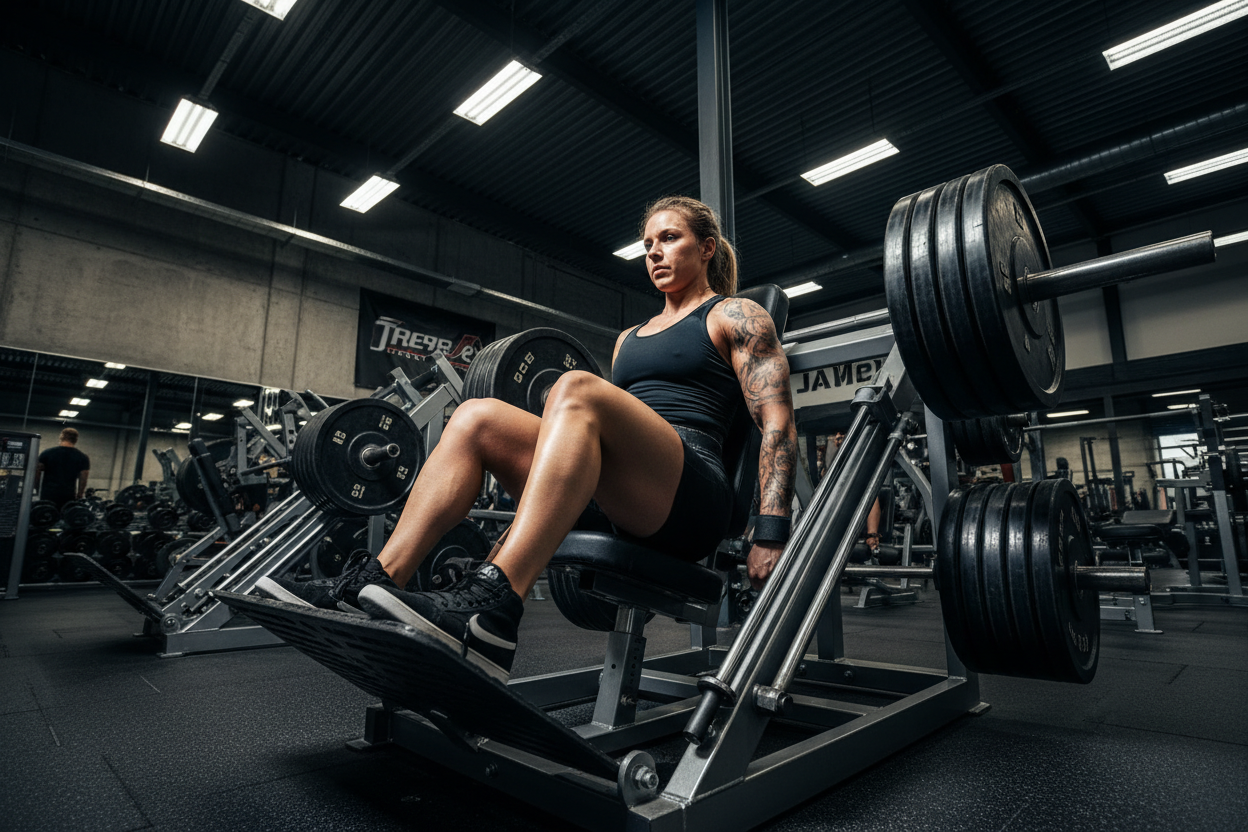
Stop Ignoring Machines: The Secret to a Bigger Powerlifting Total
You walk into a dedicated strength gym, and it usually looks the same: monolithic combo racks, calibrated plates, and clouds of chalk dust. In this environment, mentioning a powerlifting machine might get you a few dirty looks from the purists who believe the barbell is the only tool that matters.
But holding onto that dogma is a mistake that will stall your progress. While the competition lifts—squat, bench, and deadlift—must be practiced with free weights, machines offer a unique advantage for hypertrophy and injury prevention that a barbell simply cannot match. If you want to move more weight, you need more muscle, and sometimes the best way to build that muscle is by stepping away from the rack.
Key Takeaways
- Hypertrophy without Fatigue: Machines allow you to add muscle mass (volume) without taxing your Central Nervous System (CNS) or lower back.
- Isolation is Key: Weak points like triceps or hamstrings are often hard to target specifically with compound movements alone.
- Injury Management: Machines like the Belt Squat allow you to train heavy legs even with a lower back injury.
- Programming Placement: Always prioritize machines as accessory work after your main barbell lifts are complete.
Why Powerlifters Need Machines
Powerlifting is a sport of specificity. To get better at squatting, you have to squat. However, it is also a sport of physics: a larger muscle cross-section has a higher potential for force production.
The problem with doing strictly barbell movements is systemic fatigue. Doing 5 sets of 10 on a low-bar back squat will fry your lower back and CNS long before your quads reach true muscular failure. This is where machines shine. They stabilize the load for you, removing the need for balance and core bracing, which allows you to take the target muscle to absolute failure safely.
The Best Machines for the Big Three
Squat Builders: The Hack Squat
If your squat is failing because you fold forward in the hole, your quads are likely the weak link. The Hack Squat is arguably the single best accessory for a raw powerlifter.
Because your back is supported against a pad, you eliminate the shear force on the lumbar spine. You can load this heavy and focus entirely on knee flexion. This builds the massive vastus medialis (teardrop muscle) needed to drive out of the bottom of a heavy squat.
Bench Press Accessories: Cable Stacks & Hammer Strength
A big bench press is built on the back of strong triceps. While close-grip benching is great, it still beats up the shoulder joints. Using a cable stack for tricep pushdowns allows for constant tension throughout the range of motion, something gravity-based free weights can't provide.
Additionally, plate-loaded chest presses (like Hammer Strength) allow you to overload the lockout portion of the press without needing a spotter to save your life if you fail.
Deadlift Assistance: Seated Hamstring Curls
Many lifters default to the lying leg curl, but the seated version is often superior for powerlifting. Biomechanically, the seated position places the hamstring in a lengthened position at the hip.
Training a muscle at long muscle lengths has been shown to induce greater hypertrophy. Stronger hamstrings mean a stronger lockout on the deadlift and better stability in the squat.
Common Mistakes When Using Machines
The biggest error powerlifters make is treating machine work like competition work. Do not try to hit a "1 Rep Max" on a leg press. It serves no purpose and spikes your injury risk.
Machine work is for volume. Keep your rep ranges between 8 and 20. Focus on the tempo. Control the eccentric (lowering) phase and get a hard contraction at the top. If you are jerking the weight or using momentum, you are wasting your time.
My Training Log: Real Talk
I used to be a barbell purist. If it wasn't a barbell, I didn't touch it. That changed about three years ago when I tweaked my L5 disc pulling conventional. I couldn't put a bar on my back for six weeks, but I had a meet coming up.
I started using the Belt Squat (Pit Shark) exclusively for my lower body volume. I remember the first session vividly—not because of the pump, but because of the distinct, sharp pinch of the dip belt digging into my hip flexors. It left a bruise that looked like a seatbelt injury for days. But the relief on my spine was instant.
I could load four plates on each side and squat until my legs shook, without feeling a single ounce of pressure in my lower back. When I finally got back under a straight bar six weeks later, my squat hadn't just maintained; it had gone up by 15 pounds because my quads were finally doing their share of the work.
Conclusion
A powerlifting machine isn't a replacement for the barbell; it's a force multiplier. It allows you to train around injuries, hammer weak points, and add the necessary muscle mass to move heavier weights. Stop looking down on the machines in your gym. Use them intelligently, and watch your total climb.
Frequently Asked Questions
Can I train for powerlifting using only machines?
No. Powerlifting requires specific neuromuscular coordination with a barbell. Machines stabilize the weight for you, so if you only use machines, you will lack the stabilizer strength and technique required to perform a competition squat, bench, or deadlift safely.
Is the Smith Machine good for powerlifting?
It depends. The Smith Machine is generally poor for squats because it forces a fixed bar path that doesn't match the natural movement of a human body. However, it can be excellent for accessory movements like JM Presses or seated overhead presses where stability is less of a concern.
When should I do my machine work?
Always perform machine work after your primary compound lifts (Squat, Bench, Deadlift) and secondary barbell movements (like RDLs or Pause Squats). Machines are for hypertrophy and exhaustion; you don't want to pre-exhaust your muscles before attempting a heavy free-weight lift.


