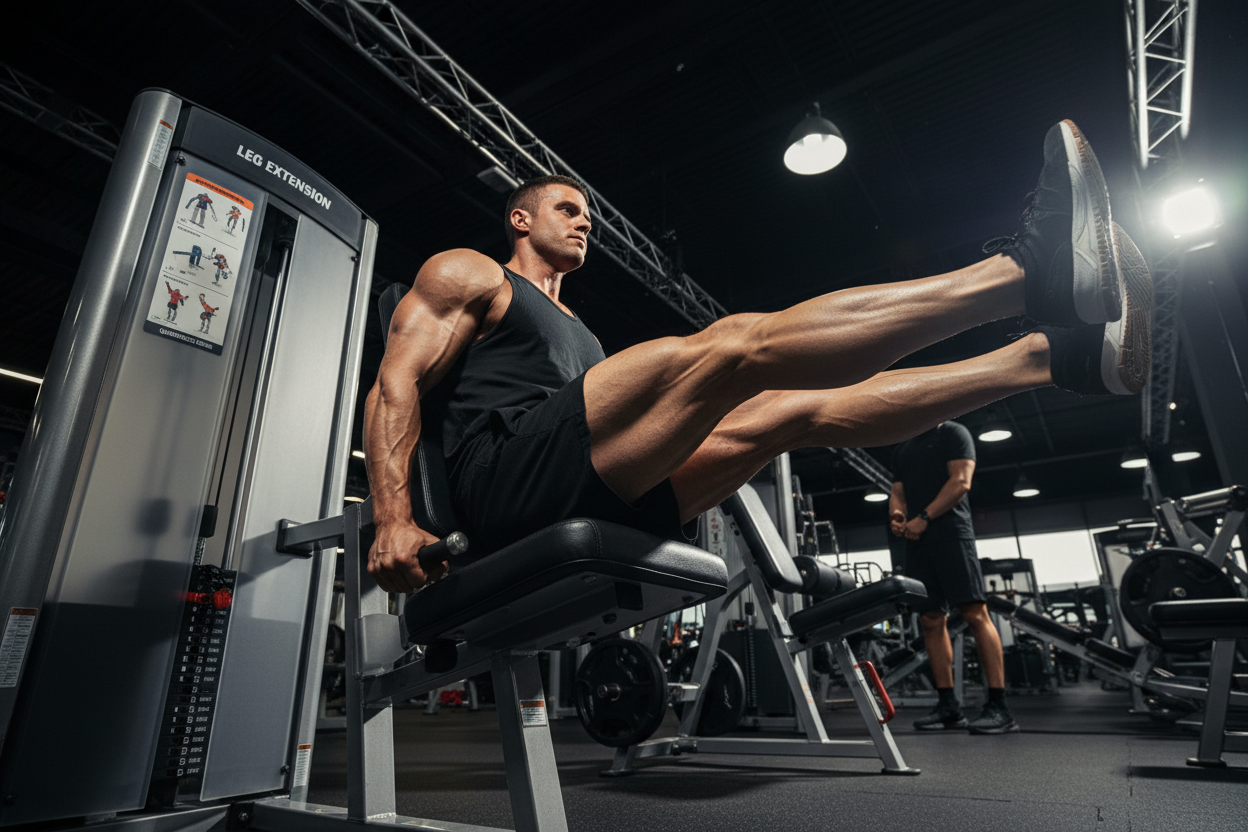
Stop Ignoring Legs: Fixing a Strong Upper Body Weak Legs Imbalance
You walk into the gym, hit the bench press, and feel powerful. Your chest fills out shirts, and your shoulders are broad. But when you look in the mirror below the waist, the proportions don't add up. You are dealing with a strong upper body weak legs imbalance.
In the fitness world, this is often jokingly referred to as the "Johnny Bravo" syndrome, but functionally, it is a significant issue. It creates a high center of gravity, reduces athletic stability, and limits your total force production. If your foundation is shaky, the house eventually stops getting taller.
This guide cuts through the noise. We aren't just talking about doing more squats; we are looking at the physiological and programming shifts required to bring your lower half up to speed.
Key Takeaways: Fixing the Imbalance
- Frequency is King: You cannot fix lagging legs by training them once a week. You need 2-3 sessions weekly.
- Neuromuscular Efficiency: Weak legs often aren't lacking muscle fiber as much as they lack the neural drive to fire correctly.
- The "Fresh" Principle: Always train your weakest body part first in the week or first in the session.
- Volume Management: To grow legs, you may need to temporarily maintain (not build) your upper body to manage systemic fatigue.
The Science: Why This Imbalance Happens
Before we fix the problem, we have to understand the cause. It is rarely just laziness.
1. Androgen Receptor Density
For many men, the upper body (specifically the traps and deltoids) has a higher density of androgen receptors. This means those muscles respond faster to training stimuli than the quadriceps or calves. You might be putting in equal effort, yet still end up with a weak upper body relative to your legs, or vice versa, depending on your genetic makeup.
2. The "Everyday Use" Fallacy
Because you walk on your legs all day, they possess a higher endurance threshold. They are stubborn. A few sets of 10 reps might smoke your pecs, but your legs barely register that as a stressor. They require higher intensity and volume to trigger a growth response.
The Protocol: How to Balance Your Physique
If you have a massive chest but stick legs, your standard "Bro Split" (Chest on Monday, Back on Tuesday, etc.) is dead. You need a specialization block.
Prioritize the Lower Body
Move your leg sessions to Monday and Thursday. Training legs when you are mentally fresh and fully fueled makes a massive difference in output. If you train legs on Friday afternoon after a long work week, you will subconsciously sandbag the workout.
Pre-Exhaustion Techniques
If your lower back gives out before your quads do, you won't stimulate growth. Try isolation movements like leg extensions before your heavy squats. This ensures your legs are the limiting factor, not your systemic fatigue.
The Flip Side: Strong Legs, Weak Arms
While the "chicken leg" issue is common, I often see the reverse, particularly in female athletes, cyclists, or soccer players. You might have strong legs weak arms.
If you feel like i have no upper body strength, the solution is the inverse of the above. You must stop treating upper body training as an afterthought. Many women specifically struggle with no upper body strength female stereotypes, but this is usually a programming error, not a biological limit.
If this is you, shift your heavy compound presses (Overhead Press, Bench Press) to the start of the week. Do not rely solely on cardio-based upper body movements (like rowing machines); you need mechanical tension to build strength.
Common Mistakes to Avoid
1. Junk Volume
Doing 20 sets of squats with poor form won't fix a strong lower body weak upper body or the reverse. It just creates inflammation. Focus on 6-8 hard sets where you control the eccentric (lowering) portion of the lift.
2. Ignoring Unilateral Work
Bilateral movements (squats) hide imbalances. If you have a weak upper body or weak legs, incorporate single-limb movements. Bulgarian Split Squats and Single-Arm Dumbbell Presses expose weakness immediately.
My Training Log: Real Talk
I spent the first three years of my lifting career ignoring my legs. I told myself, "I run, so my legs are fine." They weren't.
When I finally decided to fix my strong upper body weak legs issue, I switched to a high-frequency squat program. The hardest part wasn't the weight—it was the stairs.
I specifically remember the feeling of walking out of the gym to my car. My quads were so flooded with lactate that when I tried to push the clutch pedal down to start the engine, my left leg started trembling uncontrollably. It wasn't painful, just a weird, jelly-like instability. That specific "wobble" is the signal that you've actually hit the motor units deep in the muscle belly. If you walk out of a leg specialization workout walking perfectly normally, you probably didn't go hard enough.
Conclusion
Fixing an imbalance takes ego removal. You might have to squat less weight than you bench press for a while to learn proper form. That is okay. whether you are struggling with why is my upper body so weak or you need to bring up your quads, the answer lies in prioritization and frequency. Stop skipping the hard stuff.
Frequently Asked Questions
Why is my upper body so weak compared to my legs?
This is often due to lifestyle or previous sports background. If you played soccer, ran track, or cycled, your lower body is conditioned, but your upper body lacks neuromuscular development. You need to focus on progressive overload on pushing and pulling movements.
Can genetics cause skinny legs?
Yes, high muscle insertions (where the muscle belly ends higher up the bone) can make legs look smaller, particularly the calves. However, genetics rarely prevent strength gains; they just dictate the shape of the muscle.
How long does it take to fix a muscle imbalance?
If you switch to a specialization routine (training the weak part 2-3 times a week), you can expect to see visual changes in 8-12 weeks, though correcting a severe strength disparity may take 6 months of consistent training.