
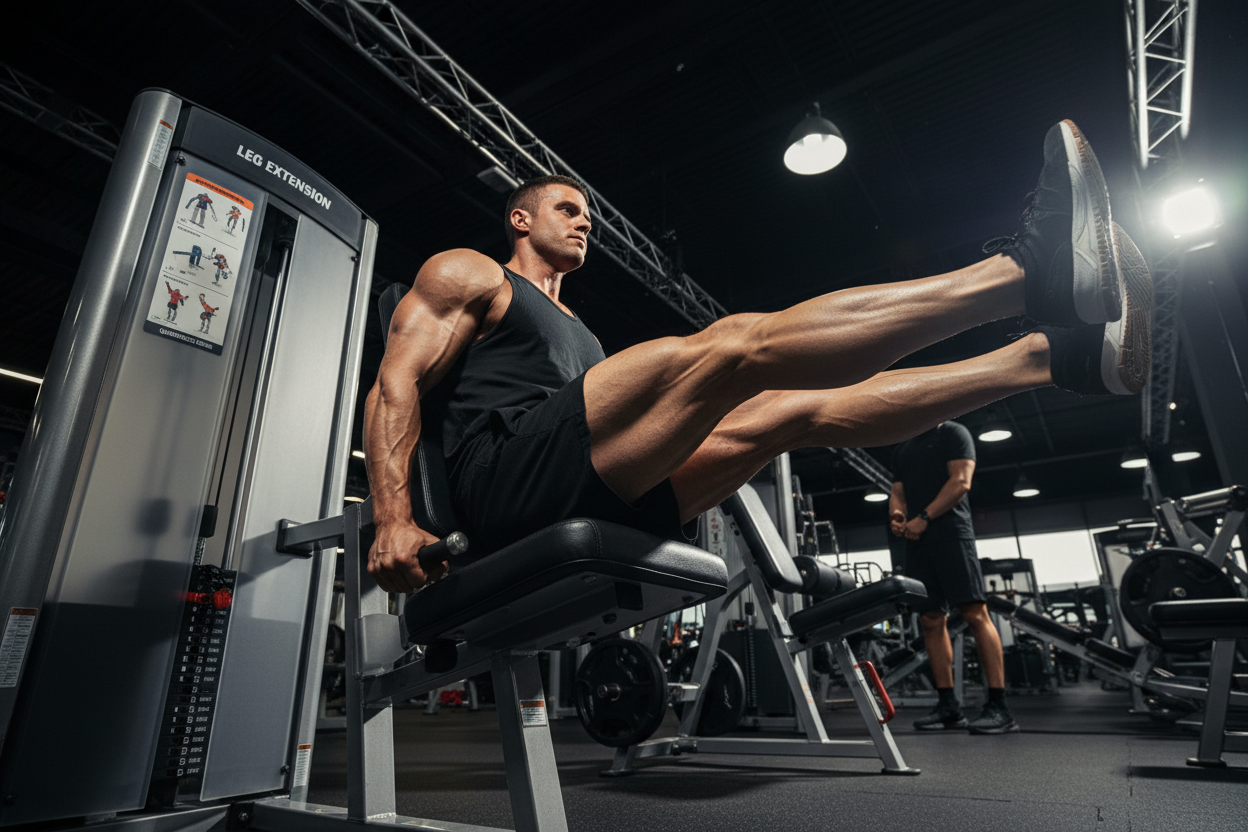
Leg Extensions Machine: The Definitive Guide for Bigger Quads
Walk into any commercial facility, and you will see a line for the squat rack. Meanwhile, the leg extensions machine often sits empty, or worse, is being used as a phone-scrolling station. There is a prevailing myth in the fitness community that this piece of equipment is a "knee destroyer."
That reputation is unfair. While compound movements like squats and lunges are foundational, they cannot fully isolate the quadriceps—specifically the rectus femoris—like an extension machine can. If you want that deep separation in your thighs and stability in your knees, you need to understand how to use this tool without wrecking your joints.
Key Takeaways: Mastering the Extension
- Isolation King: It is one of the few movements that loads the quadriceps in the fully shortened position.
- Pivot Alignment: The axis of rotation on the machine must align perfectly with your knee joint to prevent shear force.
- Control is Key: Momentum is the enemy here; swinging the weight increases injury risk significantly.
- Seat Position: Your hips must remain glued to the pad; if they rise, you are using leverage, not muscle.
Why the Quadriceps Machine is Non-Negotiable
You might ask, "Why not just squat?" Squats are fantastic, but they are a compound movement involving the glutes, hamstrings, and lower back. When your goal is pure hypertrophy (muscle growth) of the front thigh, the quadriceps machine offers something free weights cannot: constant tension.
The leg extension targets the rectus femoris, the only quad muscle that crosses the hip joint. During a squat, this muscle doesn't get fully shortened. On a thigh extension machine, you can contract this muscle fully at the top of the movement, creating a stimulus that is hard to replicate with barbells.
Setting Up the Gym Leg Extension Machine Correctly
Most injuries associated with leg extension machines come from user error, not the equipment itself. The setup is critical. If your mechanics are off, you are grinding your knee cap against the femur.
1. The Pivot Point Rule
Look at the side of the machine. There is usually a cam or a bolt that acts as the axis of rotation. This must form a straight line with your knee joint. If your knee is too far forward or backward, you introduce dangerous shear forces to the patellar tendon.
2. The Shin Pad Placement
Adjust the lower pad so it rests comfortably on your lower shin, just above the ankle. If it is too high (on the shin bone), you lose leverage. If it is too low (on the foot), you risk straining the ankle.
3. The Back Pad
Adjust the backrest forward enough so that your knee aligns with that pivot point while your lower back is firmly supported. You should not be slouching.
Execution: How to Use the Extension Machine Gym Setup
Sit down and grab the handles located by the seat. These aren't decoration. By pulling up on the handles, you drive your hips down into the seat. This creates a stable brace.
Extend your legs smoothly. Do not kick the weight up. Pause for a distinct one-second count at the top to maximize the peak contraction. Lower the weight slowly. The eccentric (lowering) phase should take two to three seconds. If the weight stack slams down, you are going too fast.
Common Mistakes with Leg Extension Gym Equipment
We see it all the time with leg extension workout machine users: ego lifting. They load the whole stack and swing their torso to get the weight up.
When you use momentum, your butt lifts off the seat. This shifts the tension from your quads to your lower back and hip flexors. If you cannot keep your glutes on the seat, the weight is too heavy. Drop the weight, fix your form, and focus on the burn.
My Training Log: Real Talk
I have a vivid memory of using an old, rusty leg extension gym equipment piece in a basement gym back in 2014. It was plate-loaded, not a selectorized stack. I thought I was strong enough to load four 45lb plates on it.
I didn't check the seat depth. On my third rep, the mismatched pivot point caused the shin pad to roll up my leg mid-rep. It scraped the hair right off my shins and slammed into the top of my foot. Worse, because I wasn't holding the handles, my butt shot up so high I nearly slid out of the machine. The pain wasn't in my quads; it was a sharp, grinding pinch behind my kneecap that lingered for three weeks. That was the day I learned that on this machine, 100lbs with perfect form feels heavier—and works better—than 200lbs with body English.
Conclusion
The leg extension machine gym station is a tool, and like any tool, it works best when handled with precision. Don't let fear mongering keep you away from it. Align your knee, control the tempo, and leave your ego at the door. Your quads will thank you for the isolation, even if they hate you during the burn.
Frequently Asked Questions
Is the leg extension machine bad for your knees?
Not inherently. It becomes dangerous when used with excessive weight, explosive momentum, or improper alignment of the knee with the machine's pivot point. For healthy individuals, it strengthens the tendons surrounding the knee.
Should I do leg extensions before or after squats?
It depends on your goal. Doing them first (pre-exhaustion) warms up the knees and makes lighter squats feel heavier. Doing them last ensures you can fully fatigue the quads without worrying about stabilizing a heavy barbell.
What is the best rep range for this machine?
Since this is an isolation movement, heavy low reps (1-5) are generally not recommended due to joint stress. Stick to the 10-20 rep range to maximize metabolic stress and blood flow to the muscle.


