Stop Ignoring External Rotation Strengthening Exercises (Read This)
If you spend your days hunched over a keyboard or your gym sessions chasing a bigger bench press, your shoulders are likely ticking time bombs. We obsess over the mirror muscles—the pecs and front delts—but often neglect the invisible stabilizers that keep the joint functioning. I'm talking about external rotation strengthening exercises.
Ignoring these movements doesn't just lead to bad posture; it invites impingement and rotator cuff tears. The shoulder is the most mobile joint in the body, but that mobility comes at a cost: stability. Without specific work to counterbalance all that internal rotation (typing, driving, pressing), you are setting yourself up for a painful injury.
Key Takeaways: Quick Summary
- The Root Cause: Most shoulder pain stems from an imbalance between strong internal rotators (pecs/lats) and weak external rotators.
- The Solution: Low-load, high-repetition isolation movements targeting the infraspinatus and teres minor.
- Key Movements: Face pulls, side-lying dumbbell rotations, and band pull-aparts are non-negotiable staples.
- Frequency: These muscles recover quickly; aim for 2-3 sessions per week, preferably as a warm-up or finisher.
Why Your Rotator Cuff is Failing You
To understand why you need these exercises, you have to look at the anatomy. The rotator cuff consists of four muscles. Two of them—the infraspinatus and teres minor—are responsible for rotating your arm outward.
Modern life forces us into internal rotation. When you sit at a desk, your shoulders roll forward. When you bench press, you are internally rotating the humerus under load. Over time, the internal rotators become tight and overactive, while the external rotators lengthen and weaken.
This imbalance pulls the head of the humerus forward, reducing the space in the shoulder joint. The result? The dreaded "clicking" sound and eventual impingement.
Essential Shoulder Lateral Rotation Exercises
You don't need heavy weights here. In fact, if you go too heavy, your larger deltoid muscles will take over, defeating the purpose. We want to isolate the deep cuff muscles.
1. The Side-Lying Dumbbell Wiper
This is the gold standard for isolation. Lie on your side with a small towel roll tucked between your elbow and your ribs. This towel is crucial—it prevents you from cheating by using your deltoids.
Keep your elbow bent at 90 degrees and rotate the dumbbell upward toward the ceiling. Control the descent. If you feel this in the front of your shoulder, check your form. The burn should be deep in the back of the shoulder blade.
2. Face Pulls with External Rotation Bias
Most people do face pulls wrong. They just yank the rope to their nose. To turn this into one of the best shoulder lateral rotation exercises, you need to focus on the finish.
Pull the rope toward your forehead, but as you near the end of the movement, actively try to pull your hands apart and rotate your thumbs backward. You should finish in a "double bicep" pose. Hold that squeeze for a full second.
3. Banded W-Raises
Attach a light resistance band at chest height. Hold the band with palms facing up, elbows tucked into your sides. Rotate your hands out while keeping elbows pinned, forming a "W" shape with your arms and torso. This hits the lower traps and the external rotators simultaneously.
Integrating Shoulder Extension Rotation
While lateral rotation is key, you also need to consider shoulder extension rotation. This involves extending the arm behind the body while maintaining rotation.
This is often neglected but vital for athletes who throw or swim. A great way to train this is the "Prone Swimmer." Lie on your stomach, lift your hands off the floor, and move them from your lower back to behind your head, rotating your palms as you move through the range of motion. It looks simple, but it will humble even the strongest lifter.
Common Mistakes That Kill Progress
Ego Lifting: I cannot stress this enough. If you grab the 25lb dumbbell for external rotations, you are wasting your time. These are small muscles. Use 5lbs, maybe 10lbs max. If you have to use momentum, the wrong muscle is working.
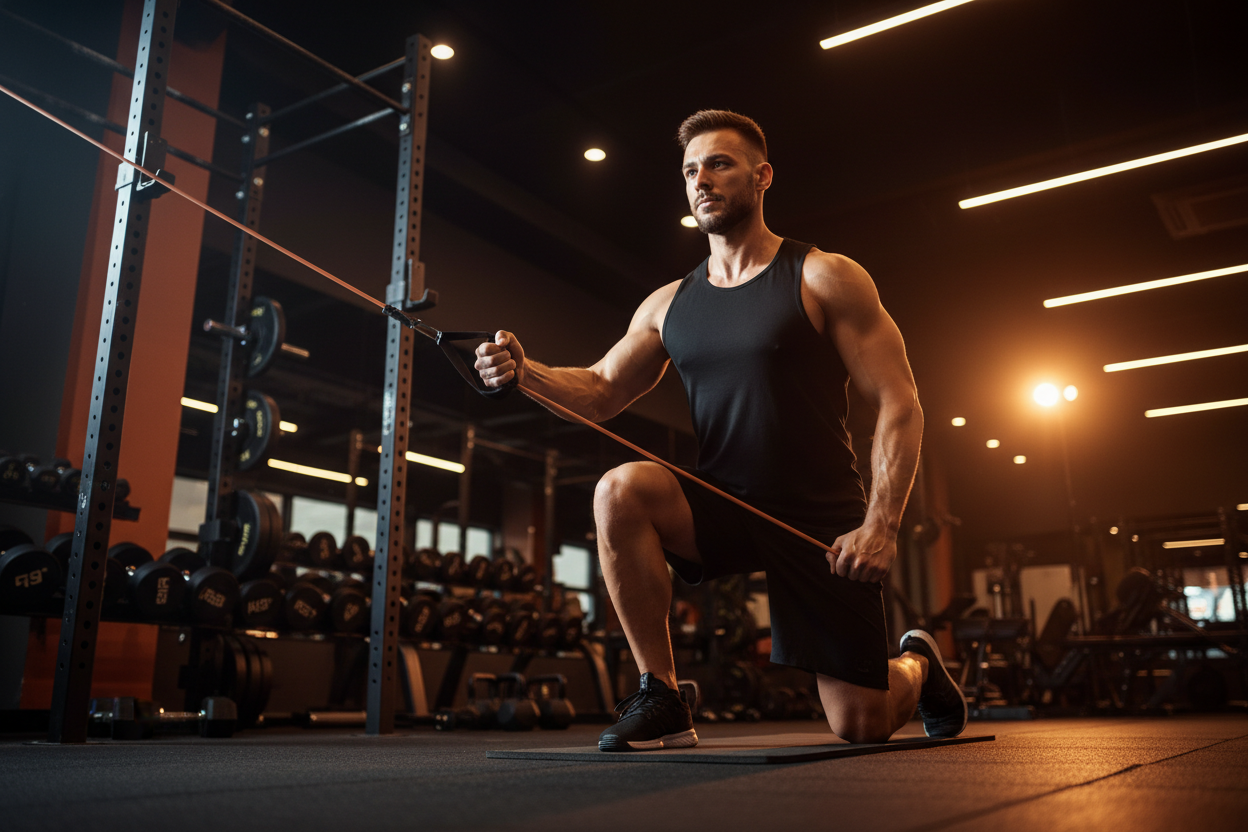
Elbow Drift: During cable or band rotations, your elbow must act like a hinge. If it drifts away from your body, your deltoid takes the load. Keep that towel tucked under your arm if you struggle with this.
My Personal Experience with External Rotation Strengthening Exercises
I learned this the hard way. A few years ago, my bench press stalled at 225lbs, not because my chest was weak, but because my right shoulder felt like someone was stabbing it with an ice pick every time I lowered the bar.
I started doing cable external rotations, but I made a classic mistake: I didn't use a towel roll under my arm. I thought I was getting stronger because I was moving more weight, but I was actually just leveraging my side delts. It wasn't until I dropped the weight to a humiliating 5lbs and pinned a rolled-up gym towel against my ribs that I felt the difference.
There’s a very specific, nasty burn that happens when you truly isolate the infraspinatus. It doesn't feel like a pumped bicep; it feels like a cramp deep inside the shoulder blade, almost like a toothache in your back. The first time I felt that specific "crampy" shake in my arm, I knew I had finally found the weak link. Three weeks of chasing that specific sensation, and the ice pick pain in my bench press vanished.
Conclusion
Shoulder health isn't sexy until you lose it. Incorporating external rotation strengthening exercises is the insurance policy your upper body needs. It doesn't require a lot of time—just 10 minutes of focused work twice a week can reverse years of poor posture and heavy pressing. Start light, focus on the squeeze, and protect your rotation.
Frequently Asked Questions
How often should I do external rotation exercises?
Because these muscles are stabilizers and endurance-based, they recover quickly. You can train them 2-4 times per week. However, keep the volume moderate—2 to 3 sets of 15-20 repetitions is usually the sweet spot.
Should I do these before or after my workout?
Ideally, do them as part of your warm-up to "wake up" the cuff before heavy pressing. However, do not train them to failure before a heavy bench press, as you don't want to fatigue your stabilizers before they are needed to protect the joint. Save the failure sets for the end of the workout.
Can resistance bands replace dumbbells for these exercises?
Absolutely. In fact, resistance bands are often better for rotator cuff work because they provide ascending resistance—the tension increases as you move further into the range of motion, which matches the strength curve of the muscle well.