Stop Guessing: The Ultimate Guide to Choosing Between a Power Rack, Half Rack, and Squat Stand
Walking into a gym equipment store or browsing online catalogs can feel like trying to learn a new language. You see steel beams, holes, pins, and varying price tags, all promising to help you get strong. The terminology is often used interchangeably, which creates a massive headache for anyone trying to build a home gym or understand commercial equipment. The most common confusion stems from the terms themselves. To answer the most pressing question right away: a power rack and a power cage are exactly the same thing. There is no difference. They are synonymous terms for a four-post (or six-post) enclosed steel box designed for maximum safety. However, the differences between a cage, a half rack, and a squat stand are significant and will dictate what you can and cannot do during your workouts.
Understanding the Power Cage (Full Rack)
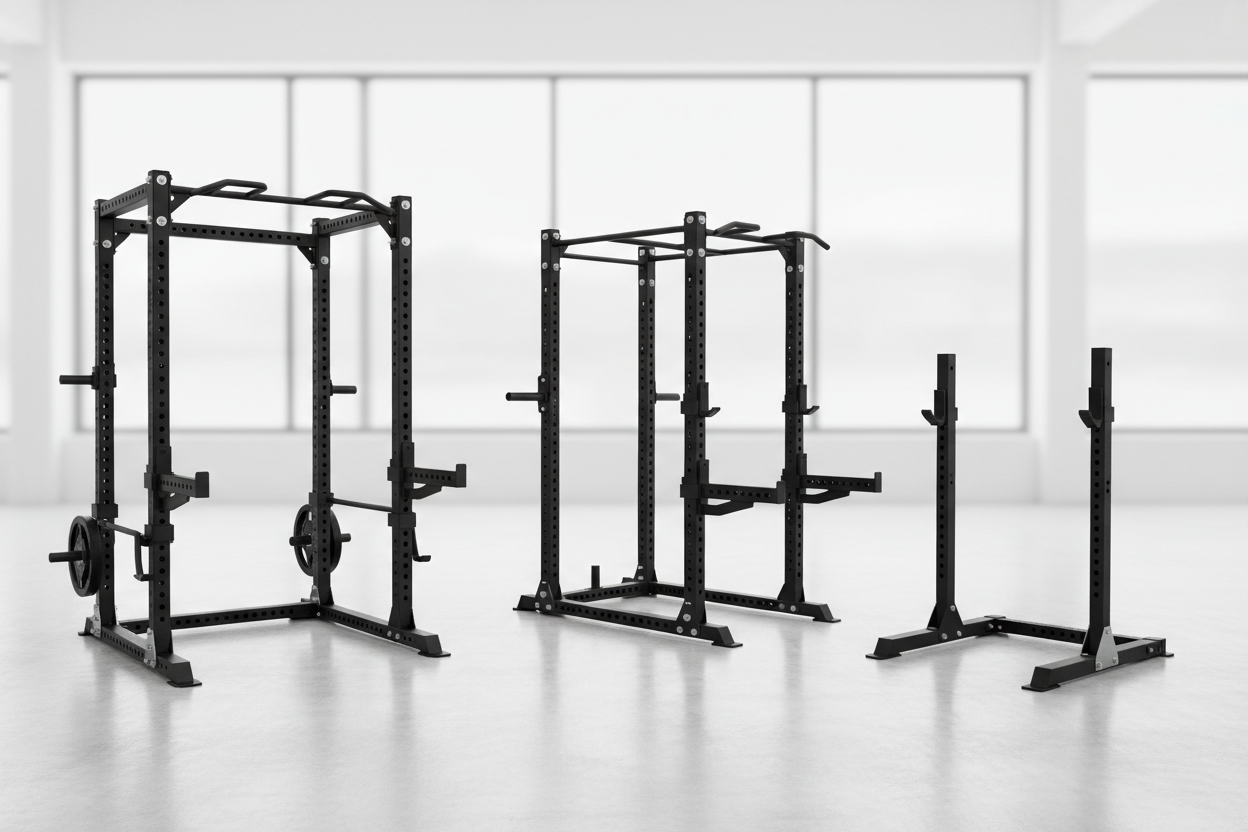
If safety is your absolute priority, especially if you train alone, the discussion of power rack vs power cage is moot because they are the singular gold standard. So, what is a power cage? It is a box-like structure usually consisting of four vertical uprights connected by horizontal crossmembers at the top and bottom. You stand inside the cage to lift.
The defining feature of a full rack is the safety system. You have horizontal safety pins or straps that run between the front and back uprights. If you fail a squat or drop a bench press, the bar lands on these safeties rather than on you. When comparing a squat rack vs power cage, the cage wins on safety every time because the bar is contained within the structure. You cannot fall backward out of the lift, and the structure is incredibly stable because of its large footprint.
The Half Rack Hybrid
Space is often a luxury, which brings us to the next contender. What is a half rack? Picture a full power cage, then slice the front half off. A half rack typically has two main uprights where the barbell rests, and often two shorter posts in the back for weight plate storage. Unlike the cage, you perform your lifts in front of the rack, not inside it.
The half rack vs power cage debate usually comes down to floor space and comfort. Some lifters feel claustrophobic inside a four-post cage and prefer the open air of a half rack. However, because you are lifting outside the uprights, you rely on spotter arms that attach to the front of the rack. These are safe, but they don't offer the total enclosure of a full rack. In the half rack vs power rack comparison, the full rack is generally more stable without being bolted down, whereas many half racks need to be anchored to the floor to prevent tipping during heavy re-racks.
Squat Stands and Basic Racks
At the most minimalist end of the spectrum, we find the squat stand. When analyzing a squat stand vs power rack, you are trading versatility and safety for portability and cost savings. A squat stand usually consists of two independent vertical posts or two posts connected by a single base bar. There is no "cage" and often no pull-up bar.
The squat stand vs squat rack terminology can be tricky. Generally, a "squat rack" implies a more connected, stable unit, sometimes with a fixed pull-up bar, while "stands" can be two separate pieces of metal. If you are comparing a squat stand vs rack of any other kind, the stand is the least stable. It is great for Olympic weightlifters who dump the bar on the floor, but terrible for powerlifters who need to bench press alone without a spotter.
Direct Comparisons for Your Gym Needs
Let's break down the specific matchups you are likely wrestling with. The full rack vs half rack decision often hinges on depth. A full rack requires significant depth to allow you to walk the bar out and squat inside the posts. A half rack saves that depth, making it a better choice for shallow garages. However, in a half rack vs full rack gym scenario, the full rack allows for more attachments, like band pegs and cable systems, because it has more structural points to bolt things onto.
When looking at a squat cage vs rack (implying a generic open rack), consider your confidence under heavy loads. If you plan to test your one-rep max on the bench press alone, an open squat rack vs cage is a risky gamble. In a cage, you set the pins, and you are safe. In an open rack with small spotter arms, if you mis-groove the bar, you might miss the safety catch entirely.
The squat rack vs half rack distinction is subtle but important. A generic squat rack might just be two posts with a fixed height. A half rack is a more engineered piece of equipment, usually featuring adjustable J-cups, safety arms, and plate storage. If you are debating a half rack vs squat rack, the half rack is almost always the superior, albeit more expensive, option due to its expandability.
Personal Experience: The Stability Factor
I learned the difference between these pieces of equipment the hard way. Years ago, I started with independent squat stands because they were cheap and I could shove them into the corner of my apartment. They worked fine for 135 lbs. But one evening, I was re-racking a heavy set of squats. I was tired, my form broke down, and I hit the left upright a little harder than the right. The entire stand shifted and nearly tipped over. It was a terrifying moment that could have ended with a barbell through my drywall or on my foot.
I sold them the next day and bought a full power rack. The difference in confidence was immediate. Knowing that I could fail a rep and the squat rack vs power rack safety mechanisms would catch the weight allowed me to push harder. I stopped worrying about the equipment and focused on the lift. If you are on the fence in the squat stand vs rack debate, take it from me: stability is not just about safety; it's about the mental freedom to lift heavy.
Making the Final Choice
If you have the space and the budget, the squat rack vs power rack winner is the power rack (or cage). It offers the highest safety rating, the most versatility for attachments (like dip bars, lat pulldowns, and jammer arms), and the best resale value. It is the centerpiece of a serious gym.
If you are tight on space, the half rack vs power cage compromise is excellent. You get 90% of the functionality of a cage but with a smaller visual and physical footprint. Just ensure you buy a high-quality unit with long spotter arms to keep you safe during bench pressing.
The squat stand should be reserved for those with extreme space limitations or specific training styles (like Olympic lifting) where bailing the weight onto the floor is part of the sport. In the battle of squat rack vs half rack or squat rack vs cage, the stand is the entry-level option that most serious lifters eventually upgrade from.
Frequently Asked Questions
Can I bench press safely in a squat stand?
It is difficult to bench press safely in a basic squat stand unless you have a spotter. Most basic stands do not come with safety arms long enough or strong enough to catch a failed bench press, making a power rack or half rack a much safer option for solo training.
Do I need to bolt a power rack to the floor?
While many high-quality, heavy power racks are stable enough to stand on their own, bolting them down is always recommended for maximum safety. This is especially true for half racks or if you plan on using suspension trainers or performing kipping pull-ups, which can shift the center of gravity.
What is the main height requirement difference between a half rack and a full rack?
Both rack types typically come in standard heights around 80 to 90 inches, so ceiling height requirements are similar. However, because you perform pull-ups inside a full rack and often outside or on the front of a half rack, you need to ensure your head won't hit the ceiling or a garage door opener during the movement regardless of the rack type.