Stop Doing Seated Machine Leg Extensions Like This (Read First)
You walk into the gym, legs feeling heavy from squats, and head over to the isolation station. It looks simple enough. You sit down, pin the weight, and start kicking. But if you aren't careful, the seated machine leg extension can go from a premier quad-builder to a knee-wrecker in a single set.
This isn't just an accessory movement to toss in at the end of a workout. When executed with precision, it is one of the only ways to fully shorten the quadriceps, specifically the rectus femoris. However, most lifters get the biomechanics wrong, placing shear force on the knee joint rather than tension on the muscle belly.
Let’s fix your setup and execution to build massive quads without the joint pain.
Key Takeaways: Quick Summary
- Align the Pivot: The machine's axis of rotation (usually a red dot or bolt) must align perfectly with your knee joint to prevent shear stress.
- Control the Eccentric: Never let the weight stack drop. Lower the weight over 2–3 seconds to maximize muscle fiber tearing.
- Seat Position Matters: Your knees should hang off the edge of the seat comfortably; if the seat is too far forward, you lose leverage.
- Use the Handles: Pulling yourself into the seat prevents your hips from rising, keeping the tension on the quads.
Why You Need the Leg Extension Exercise Machine
Compound movements like squats and lunges are kings for overall mass, but they have a limitation: they don't fully shorten the rectus femoris (the muscle running down the middle of your thigh). Because this muscle crosses both the hip and the knee, it struggles to contract fully during simultaneous hip and knee flexion.
The leg extension exercise machine solves this. By fixing the hips in a seated position and focusing solely on knee extension, you isolate the quads in a way free weights simply cannot replicate. This creates that deep, burning separation in the lower thigh that bodybuilders chase.
Mastering the Setup: It’s All About Angles
The biggest mistake happens before you move a single pound. If your body isn't aligned with the machine mechanics, you are fighting physics.
1. The Axis of Rotation
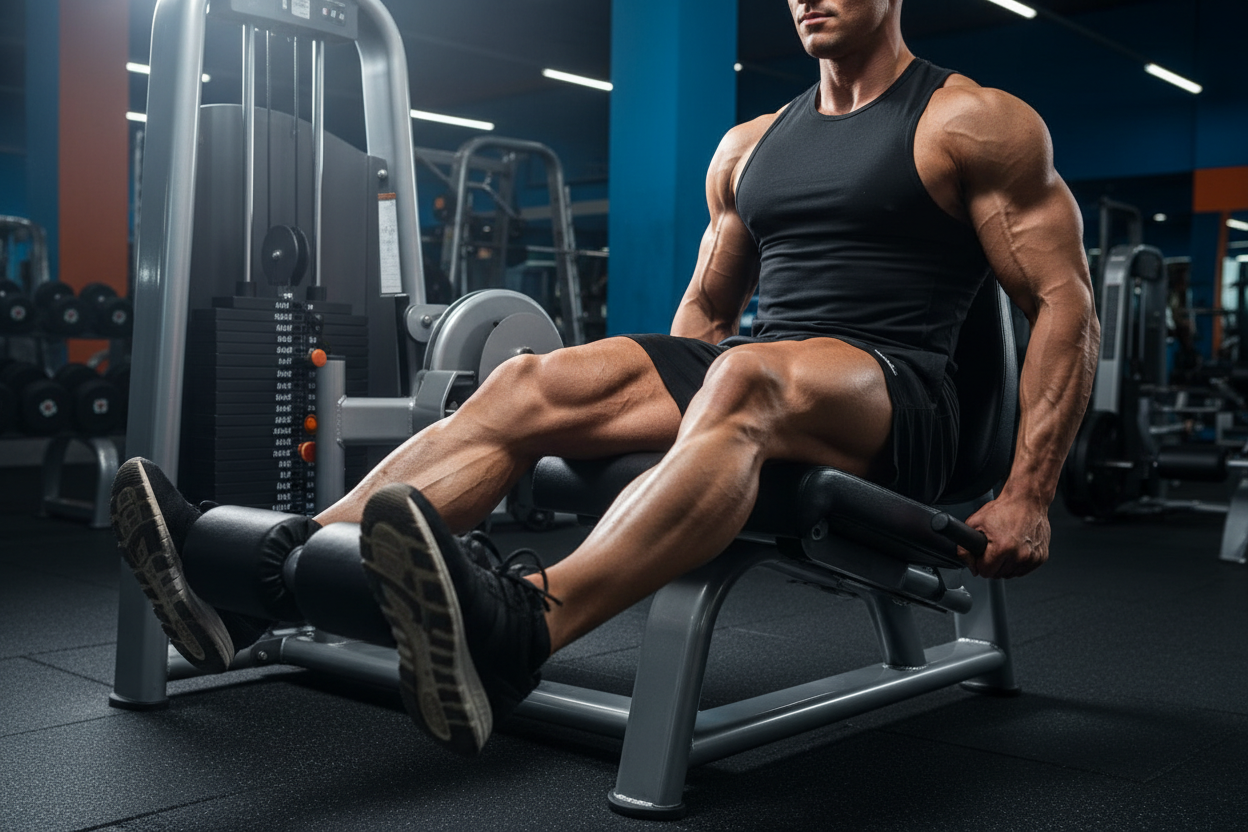
Look at the side of the machine seated leg extension unit. There is usually a pivot point where the arm swings. This needs to be strictly in line with your own knee joint. If your knee is behind it, you put stress on the patellar tendon. If your knee is in front of it, you limit your range of motion.
2. The Pad Placement
Adjust the ankle pad so it rests just above your shoe, on the lower shin. If it's too high (on the shin bone), the leverage is poor. If it's on the foot, you risk ankle strain. You want the force applied directly against the distal end of the tibia.
3. The Backrest
Adjust the back pad so that when you sit back, your knees align with that pivot point mentioned earlier. Your glutes should be firmly against the back of the seat, not floating.
Execution: Grind, Don’t Kick
Many gym-goers treat this like a penalty kick in soccer. Momentum is the enemy here. To get the most out of the seated leg raise machine (a common misnomer, as we are extending, not raising), you need strict tempo.
The Concentric (Up)
Extend your legs smoothly. Avoid 'jerking' the weight up. As you reach the top, lock your knees out—unless you have pre-existing knee issues—and hold for a distinct one-second pause. This peak contraction is where the magic happens.
The Eccentric (Down)
This is where growth occurs. Lower the weight slowly. Fight the gravity. If you hear the weight stack 'clank' between reps, you are going too fast. Keep tension on the muscle the entire time.
My Training Log: Real Talk
I’ve had a love-hate relationship with this machine for years. I remember using an old, rusty plate-loaded extension unit in a garage gym back in 2015. The padding was worn thin, almost down to the metal.
Here is the gritty reality no textbook tells you: if you don't pull yourself down into the seat using the side handles, your butt will lift off the pad as the weight gets heavy. I learned this the hard way. I was trying to push a PR, and my hips shot up, shifting the load entirely to my lower back and knees. I felt a sharp 'click' that sidelined me for a week.
Now, I actually wear a weightlifting belt not for back support, but to physically strap myself to the seat if the machine doesn't have a thigh restraint. That sensation of being glued to the chair allows me to drive 100% of the effort into my quads. Also, beware the 'shin groove'—if you go too heavy with cheap pads, you'll walk away with a horizontal bruise across your ankles that looks like you were shackled. It’s a badge of honor, but it hurts like hell in the shower.
Conclusion
The seated machine leg extension is a tool, not a toy. When used with intention, proper alignment, and controlled tempo, it is arguably the best isolation exercise for quad development. Stop kicking the weight and start contracting the muscle. Your knees (and your leg gains) will thank you.
Frequently Asked Questions
Is the seated machine leg extension bad for your knees?
Not inherently. It becomes dangerous when people use too much weight, use momentum (kicking), or fail to align their knee joint with the machine's pivot point. Correct form actually strengthens the connective tissue around the knee.
Should I point my toes in or out?
For general development, keep your toes neutral (pointing straight up). Pointing toes out can bias the vastus medialis (teardrop), while pointing them in can target the vastus lateralis (outer sweep), but extreme angles can twist the knee joint. Stick to neutral until you are advanced.
Can I replace squats with leg extensions?
No. Squats are a compound movement working the glutes, hamstrings, and core. The leg extension is an isolation movement. They should be used together for a complete leg day, not as substitutes for one another.