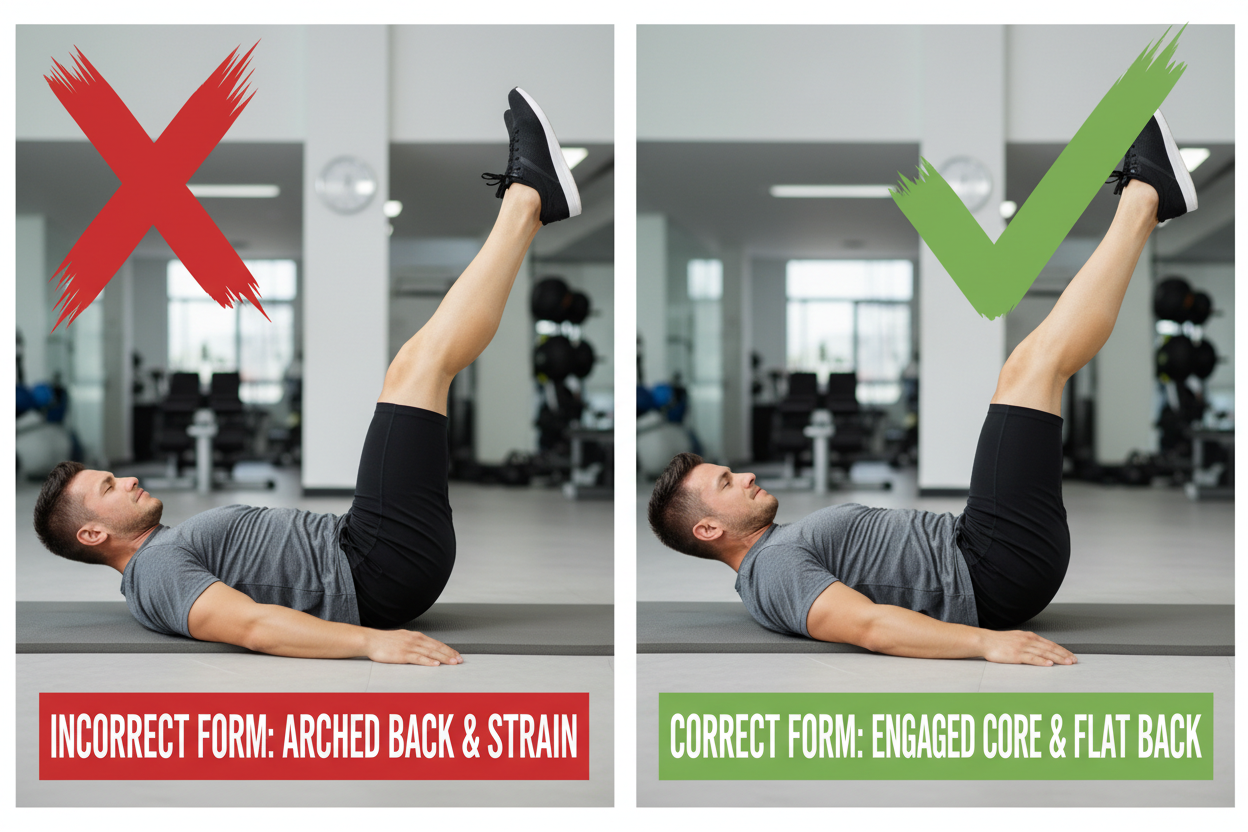
Stop Doing Raised Leg Lifts Like This (Read This First)
Most people think core training is just about cranking out crunches until their stomach burns. But if you want functional strength and a lower midsection that actually pops, raised leg lifts are the superior choice. However, there is a catch. This move is notorious for causing lower back pain if your form is even slightly off.
You might know them as the leg raise exercise, leg ups, or simply leg lifts. Regardless of the name, the mechanics remain the same. When executed poorly, you’re just straining your lumbar spine. When done right, they are one of the most effective tools for anterior chain development.
Key Takeaways
- Primary Target: They target the lower rectus abdominis and hip flexors (iliopsoas).
- Critical Form Cue: You must keep your lower back pressed firmly against the floor (posterior pelvic tilt) throughout the movement.
- Common Mistake: Using momentum or letting the back arch, which shifts tension from the abs to the spine.
- Regression: Beginners should start with supported leg raises (hands under glutes) or single leg raises.
What Are Raised Leg Lifts?
So, what is a leg lift exactly? In its purest form, it is a supine (lying face up) movement where you lift your legs from a horizontal position to a vertical one, hinging at the hips. While it looks simple, it requires significant core stability.
The terminology can get confusing. You might hear people ask, "what are leg raises?" or "what is leg raise?" In the context of a floor workout, raised leg lifts, leg raises, and leg lifts exercise are virtually interchangeable. They all refer to the action of lifting legs against gravity to engage the midline.
Leg Lifts Muscles Worked: The Science
Understanding the biomechanics helps you get more out of the rep. When we analyze leg raises muscles worked, we are looking at two main groups.
1. The Hip Flexors
Many people ask, "what muscles do leg raises work?" expecting the answer to be purely "abs." However, the primary movers are actually the iliopsoas and the rectus femoris (a quadriceps muscle). These are the muscles used to lift leg while lying down. They initiate the movement.
2. The Rectus Abdominis
Do leg lifts work the abs? Absolutely. Your abdominals act as stabilizers. Their job during a flat leg raise is to prevent your pelvis from tilting forward and your back from arching off the floor. This type of isometric contraction is incredibly intense for the lower abdominal region.
How to Do Leg Raises Properly
If you want to know how to do leg raises correctly without wrecking your back, follow this protocol. Proper leg lift form is non-negotiable.
Step 1: The Setup
Lie flat on your back. Place your arms by your sides, palms facing down. If you are learning how to do leg lift mechanics for the first time, you can wedge your hands slightly under your glutes. This is a "supported leg raise" and helps tilt the pelvis into a safer position.
Step 2: The Brace
Before you move, engage your core. Imagine someone is about to drop a medicine ball on your stomach. Press your lower back into the mat. There should be no gap between your spine and the floor.
Step 3: The Lift
Keeping your legs straight (or slightly bent if you have tight hamstrings), exhale and lift them toward the ceiling until your hips are at a 90-degree angle. This is the "leg up and down exercise" phase. Control is key; do not swing them.
Step 4: The Descent
Inhale as you lower your legs. Stop before your lower back starts to peel off the floor. If you feel your back arch, you've gone too low. The "leg raise workout" is effective only as long as tension remains on the abs, not the spine.
Variations for Every Level
Not everyone is ready for 20 leg raises with straight legs immediately. Adjust the intensity based on your strength.
Leg Lifts for Beginners
If you are wondering how to do leg raises for beginners, start with "single leg raises muscles worked" variations. Keep one leg bent with the foot on the floor while lifting the other. This stabilizes the pelvis. Alternatively, try the "knee tuck," where you bring knees to chest rather than straight legs.
Elevated and Extended Variations
Once you master the floor version, you can move to elevated leg lifts using a bench. This allows for a greater range of motion at the bottom. The "extended leg lift" involves holding the legs at the bottom (6 inches off the ground) for a static hold, drastically increasing time under tension.
My Training Log: Real Talk
I remember when I first added these to my routine. I thought I was strong because I could squat heavy, but raised leg lifts humbled me immediately.
The first thing I noticed wasn't the ab burn—it was the annoying "clicking" in my hip. It felt like a tendon snapping over the bone every time I lowered my legs. It wasn't painful, just uncomfortable and distracting. I realized I had tight hip flexors and a weak deep core.
I had to swallow my pride and put my hands under my butt (the supported variation) for a solid month. The other thing the textbooks don't tell you is the "leg shake." Around rep 12 of a set of 25 leg lifts, my quads would start trembling violently before my abs even felt tired. It took weeks to build the hip flexor endurance to let my abs actually do the work. If you feel that shake or hear that hip click, you aren't broken—you just need to regress the movement until your stabilizers catch up.
Conclusion
Are leg lifts a good exercise? Yes, but they are a double-edged sword. Performed with proper leg lifts mechanics, they build a bulletproof core and strong hip flexors. Performed lazily, they are a recipe for lumbar strain. Focus on the quality of the movement, keep that back glued down, and don't rush the progression.
Frequently Asked Questions
What do leg lifts work out primarily?
What do leg lifts target? They primarily target the hip flexors (iliopsoas) and the rectus abdominis, specifically the lower region. They also engage the obliques and quadriceps as secondary stabilizers.
How many leg raises should I do?
Quality beats quantity. Instead of aiming for 50 sloppy reps, aim for 20 leg raises with perfect form. If you can do 3 sets of 15-20 with a flat back, you are ready to add weight or move to a hanging bar variation.
Why does my back hurt when I do leg lifts?
This is usually due to weak abdominals failing to keep the pelvis neutral. When the abs fatigue, the pelvis tilts forward (anterior tilt), causing the lower back to arch and take the load. Switch to leg raises for beginners (knees bent) until your core is stronger.