Stop Doing Machine Squats Like Free Weights (Read This)
If you listen to the purists, they’ll tell you that anything other than a free-weight barbell squat is a waste of time. They are wrong. When performed correctly, machine squats are one of the most effective tools in your arsenal for isolating the quadriceps and building pure hypertrophy without the systemic fatigue of balancing a heavy bar.
However, the Smith machine is not a barbell. Treating it like one is the fastest way to wreck your knees and lower back. Because the bar travels on a fixed vertical plane, you cannot move your body the same way you would in a power rack. You need to adjust your mechanics to fit the machine, not the other way around.
Key Takeaways
- Foot Placement is Critical: Unlike free weights, your feet should be placed further forward in a Smith machine squat stance to allow for a vertical torso.
- Fixed Bar Path: The Smith machine back squat moves in a straight line. Do not try to curve your back or hips to create a natural arc; lean into the machine's stability.
- Safety First: Utilize the safety stops. This allows you to perform a Smith machine deep squat with confidence, knowing you won't get crushed.
- Target Muscle: This is primarily a quad-dominant movement. If you want to hit glutes, other variations are better suited.
Understanding the Smith Machine Squat
Many lifters ask, what is a machine squat? Generally, this refers to performing squats inside a Smith machine—a piece of equipment where the barbell is attached to rails, allowing only vertical movement. This setup removes the need for stabilization.
Because you don't have to balance the load, the Smith machine for squats allows you to push closer to failure safely. It turns a compound movement into something closer to an isolation exercise for the legs.
How to Properly Squat on Smith Machine
Learning how to use the Smith machine for squats requires unlearning some barbell habits. Here is the step-by-step breakdown of the proper squat form on Smith machine.
1. The Setup and Stance
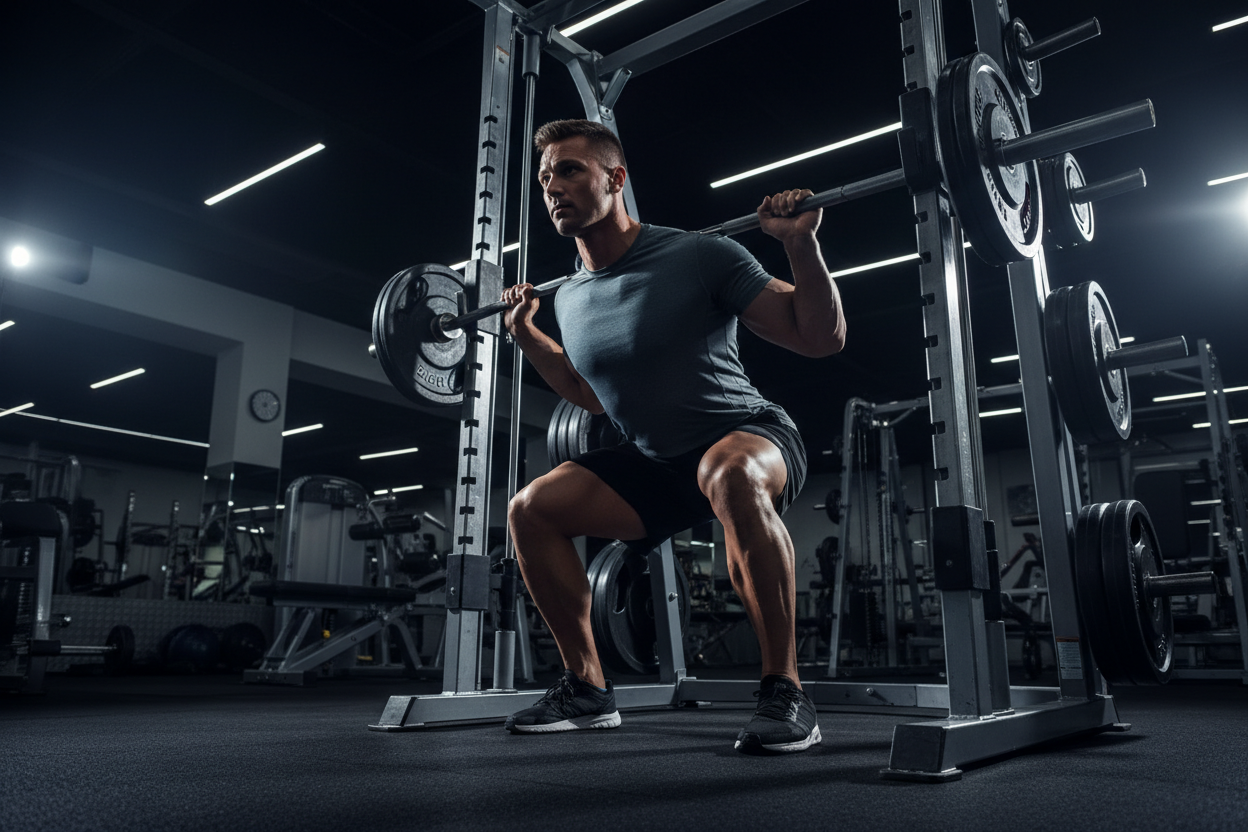
Step under the bar and rest it across your traps, just like a high-bar back squat. Unrack the weight by lifting and rotating your wrists back.
Here is the game-changer: Walk your feet forward. In a barbell machine squat, your feet should be about 6 to 12 inches in front of your hips. This Smith machine squat position allows you to keep your torso upright and sit "down" rather than "back," putting massive tension on the quads.
2. The Descent
Initiate the movement by bending at the knees. Because of your forward foot placement, you can drop into a Smith machine deep squat while keeping your heels flat. Keep your knees tracking over your toes. Do not let your hips shoot back excessively; let the guide rails support your balance.
3. The Drive
Drive through your mid-foot to return to the starting position. Do not lock out your knees aggressively at the top; keep tension on the muscles. This is how to do squats on a smith machine for maximum muscle growth.
Common Mistakes with Smith Machine Form
Even experienced lifters mess this up. Here is where the squat technique Smith machine usually falls apart.
Mimicking the Barbell Squat
If you stand directly under the bar with your feet close to the uprights (like a traditional squat), the fixed path will force your torso forward and put unnatural shear force on your spine and knees. The proper way to squat on Smith machine always involves leaning back against the bar.
Ignoring the Safety Stops
One of the biggest benefits of the squat bar machine is safety. Set the stops just below your lowest depth. If you fail a rep, you can simply sit the bar down. There is no excuse for getting stuck under a Smith press squat.
Variations: Front vs. Back Squat on Smith Machine
While the Smith machine back squat is the standard, you can also perform front squats. The Smith rack squat in a front position is incredibly effective for quads because the machine helps you keep the bar racked on your delts even if you lack the wrist mobility required for free weights.
My Training Log: Real Talk
I want to be honest about my relationship with the Smith squat. For years, I avoided it because I thought it wasn't "functional." Then I tore my meniscus.
Rehab forced me to use the Smith machine because I couldn't stabilize a free barbell without pain. The first thing I noticed wasn't the pump—it was the friction. If you use an older machine that hasn't been oiled, you can actually feel the grit in the rails fighting you on the eccentric (lowering) phase. It forces a slow, controlled tempo that you just don't get with free weights.
Another specific detail: the wrist turn. When you are grinding out that last rep of a Smith machine squat workout, your wrists are fatigued. I've had moments where I barely rotated the hooks enough to catch the rack. Now, I always set the safety catches high enough that if my wrists give out, the bar doesn't crush me. That mechanical "clank-clank" of the bar hitting the safeties is the sound of pushing to failure safely.
Conclusion
The Smith machine squat isn't a replacement for the barbell squat; it is a different tool entirely. It excels at hypertrophy and allows you to safely overload your legs. By mastering the machine squat form—specifically the foot placement and torso angle—you can build impressive lower body size without the injury risk associated with heavy free weights.
Frequently Asked Questions
Is the Smith machine squat bad for your knees?
No, not if performed correctly. Knee pain usually occurs when people try to use free-weight form on the machine. By using the proper squat form Smith machine requires—specifically placing your feet forward—you reduce shear force on the knees.
How much does the bar weigh on a Smith machine?
Unlike a standard 45lb barbell, a squat smith machine bar usually weighs between 15 to 25 lbs because it is counterbalanced by pulleys. Always check the manufacturer's label on the side of the machine to be sure.
Can I build muscle with just machine squats?
Absolutely. Weight machine squats allow for high stability, meaning you can focus entirely on muscle contraction rather than balance. This high-tension environment is ideal for hypertrophy (muscle growth).