Stop Doing External Rotation for Shoulder Like This (Read This)
If you have ever felt a sharp pinch when reaching for a seatbelt or noticed your bench press stalling despite heavy training, the culprit is often buried deep within the joint. Most lifters obsess over the mirror muscles—the pecs and front delts—while neglecting the mechanics that keep the arm bone centered in the socket.
Proper external rotation for shoulder health is not just about rehab; it is the prerequisite for heavy overhead pressing and long-term joint longevity. Yet, walk into any gym, and you will see people butchering these movements, turning a therapeutic exercise into a momentum-driven ego lift. Let’s fix your mechanics before you tear something.
Key Takeaways: Quick Summary
- Target Muscles: Primarily the Infraspinatus and Teres Minor (posterior rotator cuff).
- The Goal: To keep the humeral head centrated (centered) in the socket during arm movement.
- Common Error: Using heavy weights shifts the load to the rear deltoid, bypassing the rotator cuff entirely.
- Best Technique: Use a towel roll under the armpit during side-lying variations to prevent adduction compensation.
- Frequency: High frequency (3-4 times a week) with low load yields the best structural changes.
The Science: Why External Rotation Matters
To understand why this movement is critical, you have to look past the big deltoid muscles. The shoulder is a ball-and-socket joint, but the socket is shallow, like a golf ball sitting on a tee. The rotator cuff muscles are what keep the ball on the tee.
When you perform an external shoulder rotation, you are engaging the Infraspinatus and Teres Minor. These small muscles pull the head of the humerus down and back. Without this stabilization, the large deltoid muscle pulls the arm bone upward, crashing it into the acromion bone. This is the mechanism of impingement.
The "Centration" Effect
Think of external rotation as the anchor. When you bench press or military press, the prime movers push weight up. The external rotators work isometrically to keep the joint centered. If they are weak, the joint becomes unstable, and your nervous system will actually shut down power to your big muscles to protect you. Stronger external rotators of shoulder exercise routines often lead to instant strength gains in compound lifts.
Essential Exercises for External Rotation
Forget the heavy dumbbells. We are targeting small stabilizers here. If you can use more than 10-15 pounds, you are likely cheating.
1. Side-Lying Dumbbell Rotation (The Gold Standard)
This is the classic external rotation exercise, but most get it wrong. Gravity is strongest when the weight is parallel to the floor.
The Fix: Lie on your side. Place a rolled-up towel between your elbow and your ribs. Squeeze the towel lightly. This disengages the deltoid and isolates the cuff. Rotate the arm upward until your forearm is vertical, then control the descent for 3 seconds.
2. Face Pulls with External Rotation
This is a functional shoulder rotation workout staple. Don't just pull the rope to your face. Pull the rope apart and rotate your hands back so your knuckles face the wall behind you.
This hits the rear delts and the external rotators simultaneously, teaching the shoulder to stabilize while retracting the scapula.
3. 90/90 Cable External Rotation
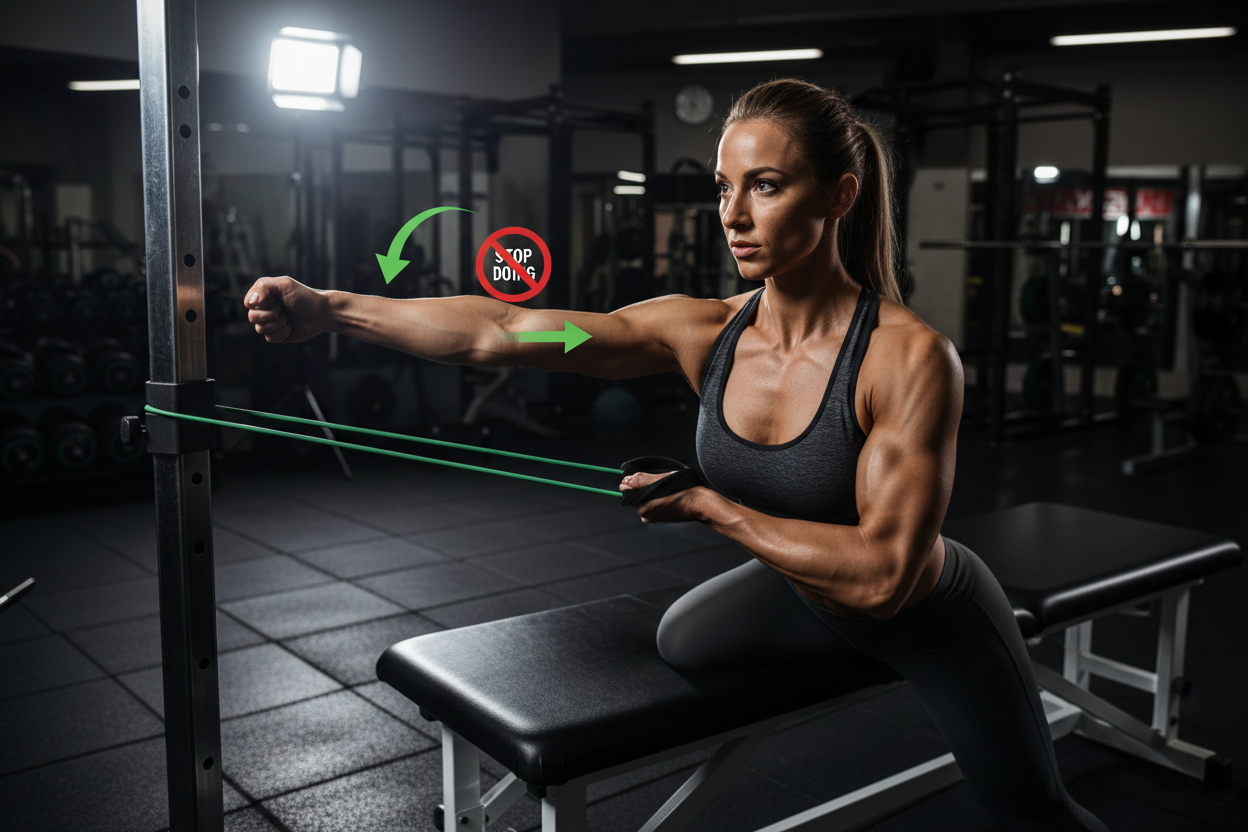
This external rotation workout mimics the throwing motion. Stand with your arm abducted (out to the side) at 90 degrees, elbow bent at 90 degrees. Rotate the forearm back.
This is crucial for athletes because it trains the cuff in the position where it is most vulnerable. Keep the elbow pinned in space; imagine there is a rod running through your elbow joint.
Common Mistakes That Kill Progress
You cannot brute-force these movements. The moment you use momentum, the rotator cuff checks out.
The "Rear Delt Takeover"
If you use a weight that is too heavy during shoulder external rotation muscles exercises, your body will recruit the rear deltoid and latissimus dorsi to move the load. You might feel a burn, but it’s in the wrong place. The burn should feel deep inside the joint, not on the surface of the back.
Poor Scapular Positioning
If your shoulder blade is rolled forward (anterior tilt) while you try to rotate the arm back, you are grinding the joint. Always set the scapula—pull it slightly back and down—before initiating any arm rotation exercises.
My Training Log: Real Talk
I learned the hard way that ego has no place in rotator cuff training. A few years ago, I was dealing with a nagging click in my right shoulder every time I bench pressed. I thought I was being proactive by adding shoulder er exercises to my warm-up.
I grabbed the 20lb dumbbells and started cranking out side-lying rotations. I felt strong. I felt the burn in my rear shoulder. But the clicking didn't stop.
It wasn't until a physical therapist watched me and literally laughed. He handed me a pink 3lb dumbbell and shoved a folded gym towel into my armpit. He told me, "If the towel drops, the set doesn't count."
The difference was humbling. By rep 8 with just 3lbs, I felt a distinct, almost nauseating ache deep inside the shoulder capsule that I had never felt before. It wasn't the surface-level muscle pump I was used to; it was the stabilizer fatigue. That specific, deep ache is the only indicator I trust now. If I don't feel that isolated fatigue, I know I'm compensating.
Conclusion
Integrating external rotator strengthening into your routine isn't about building massive muscles; it's about building a bulletproof foundation. Whether you are using cables, bands, or dumbbells, the focus must be on precision and control.
Start with the towel drill. Drop the weight. Master the mechanics. Your bench press numbers—and your joint health—will thank you for it.
Frequently Asked Questions
How often should I perform external rotation exercises?
Because the rotator cuff muscles are endurance-based stabilizers, they respond well to high frequency. You can perform shoulder rotation movements 3 to 4 times a week. However, keep the volume moderate (2-3 sets of 15-20 reps) to avoid over-fatiguing them before heavy lifting.
Should I do these before or after my workout?
It depends on intensity. Light external rotation arm exercise drills with bands are excellent for warm-ups to activate the cuff (priming the nervous system). However, do not train them to failure before a heavy press, as a fatigued stabilizer can increase injury risk. Save the exhaustive sets for the end of the session.
Can I use resistance bands instead of dumbbells?
Absolutely. In fact, bands are often superior for external rotation example exercises because they provide accommodating resistance—the tension increases as you move into the peak contraction. This matches the strength curve of the muscle better than gravity-based free weights in standing positions.