Stop Doing Clamshells: 4 Glute Exercises Runners Actually Need
I remember the first time I got IT band syndrome. I spent six weeks on the living room floor doing 100 clamshells a night with a thin latex band, convinced I was 'activating' my way back to health. It didn't work. Most glute exercises runners do are just endurance tests for small muscles that are already tired. They don't build the actual horsepower needed to stabilize your hips when you're hitting the pavement at three times your body weight.
Quick Takeaways
- Stop confusing muscle activation with strength training; bands are for warm-ups, weights are for gains.
- The gluteus maximus is your engine, while the medius is your stabilizer—you need to train both under load.
- Unilateral (single-leg) movements are non-negotiable because running is just a series of single-leg hops.
- Lift heavy on your hard run days to keep your recovery days dedicated to actual rest.
Why Your Pre-Run Band Routine Isn't Cutting It
I see it at every local trailhead: runners leaning against their bumpers, looping a $5 mini-band around their ankles, and doing a few side-steps. They think they're doing the heavy lifting. The reality? 50 reps of unweighted side-lying leg raises is just cardio for your hips. It feels like it's 'burning,' but that burn is just metabolic stress, not an adaptation that will bulletproof your knees against the impact forces of a 10-mile run.
Running is a high-impact, plyometric activity. Every time your foot strikes the ground, your posterior chain has to absorb and redirect massive forces. If you want to stop the 'runner's knee' cycle, you have to Fix Glute Amnesia: 3 Activation Exercises for Glutes That Actually Work as a primer, but then you have to move to the rack. You wouldn't expect to win a drag race with a lawnmower engine; don't expect to run a PR with 'activated' but weak glutes.
The goal of strength training for runners isn't to get better at lifting weights; it's to increase the structural integrity of your joints. That requires mechanical tension. You need to pick up something heavy enough that you can only do it 8 to 10 times. If you can do 30 reps, you're just practicing being tired, and you already get enough of that on your long runs.
The Biomechanics of Running (And Why Your Backside Matters)
Your gluteus maximus is the largest muscle in your body for a reason. It's the primary driver of hip extension—the movement that pulls your leg back and propels you forward. If this muscle is weak, your lower back and hamstrings have to pick up the slack, which is why so many runners complain of 'tight' hamstrings that never seem to stretch out. They aren't tight; they're overworked.
Meanwhile, your gluteus medius sits on the side of your hip. Its job is to keep your pelvis level. When it fails, your hip drops, your knee caves inward, and your IT band starts rubbing against your femur like a hacksaw. Strengthening these muscles isn't about aesthetics; it's about maintaining a stable platform so your energy goes into forward motion rather than side-to-side wobbling.
The Core 4: Heavy Glute Exercises for Running Economy
Forget the high-rep 'toning' workouts. We're looking for running economy—the ability to run faster while using less oxygen. Research consistently shows that heavy resistance training improves this. I recommend focusing on these four movements, using weights that actually challenge your grip and your resolve. Leave the 2-lb pink dumbbells in the bin.
1. The Bulgarian Split Squat
This is arguably the most hated exercise in the gym, which usually means it's the most effective. The Bulgarian Split Squat is essentially a running stride under extreme duress. By elevating your back foot, you force the front glute to handle the entire load while also stretching the hip flexor of the trailing leg. It fixes imbalances you didn't even know you had.
I recommend using a Large Exercise Mat For Home Gym to protect your back knee. When you drop into the bottom of the movement, your back knee should just kiss the floor. If you're doing these on bare concrete or a thin yoga mat, you'll find yourself cutting the range of motion short to avoid the impact. Go deep, stay upright, and feel that front glute work to stabilize your entire torso.
2. Barbell or Heavy Dumbbell RDLs
Romanian Deadlifts (RDLs) are the gold standard for posterior chain health. Unlike a standard deadlift, the RDL focuses on the eccentric (lowering) phase. This is crucial for runners because it 'bulletproofs' the hamstrings and glutes for deceleration. Think about running downhill—that's all eccentric loading. If you don't train it in the gym, your tendons will pay for it on the trail.
Keep the bar close to your shins and hinge at the hips until you feel a massive stretch in your hamstrings. Don't worry about touching the floor; worry about keeping your back flat and your glutes engaged. If you're using dumbbells, I suggest something in the 35-lb to 50-lb range once you've mastered the form. Anything lighter is just a warm-up.
3. Single-Leg Glute Bridges
Standard glute bridges are too easy for most runners. To make them effective, you have to go single-leg and add weight. Place a heavy dumbbell or a sandbag across your hips. Driving through your heel, lift your hips until they are fully extended. The key here is to keep your hip bones level. If one side dips, your glute medius is checking out.
This move directly addresses 'hip drop,' a common gait flaw that leads to lower back pain. I like to hold the top position for two seconds to really emphasize the contraction. If you can't feel your glutes firing here, you're likely overcompensating with your lower back—tuck your ribs and squeeze your abs to fix it.
4. Heavy Step-Ups
Most people cheat on step-ups by pushing off with their bottom foot. To do these for running power, you need to eliminate that 'helper' leg. Lean your torso forward over the stepping leg and drive up using only that front glute. Don't let your knee cave inward. This builds the specific strength you need for hill climbing and late-race surges.
Use a box or a sturdy bench that puts your thigh roughly parallel to the floor. If the step is too high, your lower back will take over; if it's too low, it's just a staircase. Grab a pair of heavy dumbbells and keep your descent slow and controlled. The slower you go down, the more 'armored' your knees will become.
How to Fit Leg Day Into a High-Mileage Week
The biggest mistake runners make is trying to lift on their 'easy' days. If you run hard on Monday and lift hard on Tuesday, your legs never actually recover. Instead, follow the 'Keep Your Hard Days Hard' rule. Lift on the same day as your speed work or tempo run. Run in the morning, lift in the afternoon or evening. This leaves your rest days for actual recovery.
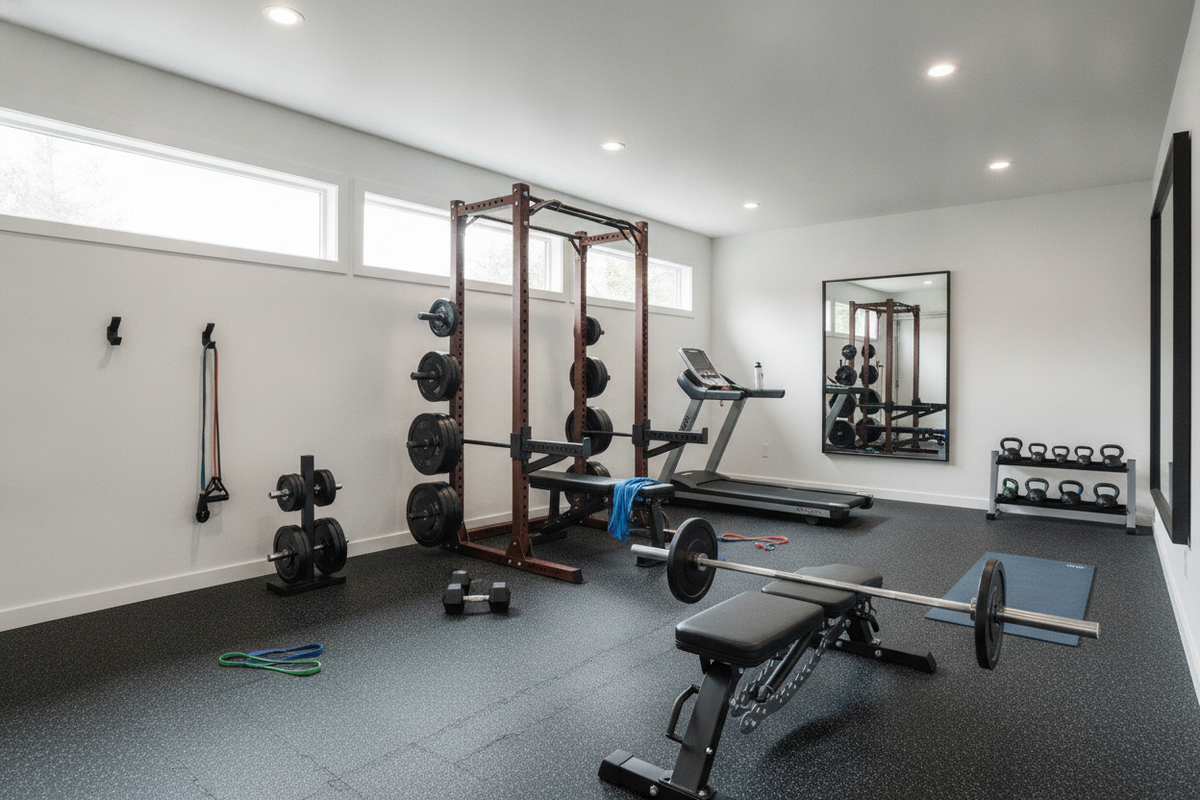
Setting up a dedicated space like a 6X8Ft Exercise Mat Yoga Mat Gym Flooring For Home Workout in your garage makes this transition seamless. You can finish your miles, walk straight into your home gym, and knock out your Core 4 in 30 minutes. No driving to a commercial gym, no waiting for a rack. Just efficient, heavy work that makes you a more durable athlete.
Personal Experience: My Biggest Mistake
I once spent an entire marathon build skipping leg day because I was afraid of 'heavy' legs. I thought the 50 miles a week I was running was enough 'leg work.' By mile 18 of the race, my glutes completely gave out, my form collapsed, and I finished with a PR in knee pain instead of time. Now, I never lift less than twice a week, even during peak mileage. The 'heavy' feeling goes away after about two weeks of consistency, replaced by a sense of stability that makes those final miles feel much shorter.
FAQ
Will lifting heavy make me too bulky for running?
No. To get 'bulky,' you need a massive caloric surplus and a specific high-volume bodybuilding program. For runners, lifting heavy (low reps, high weight) improves neuromuscular efficiency—it makes your muscles better at firing, not necessarily bigger.
How many times a week should I do these glute exercises?
Twice a week is the sweet spot. It's enough to build strength without causing so much fatigue that your running performance suffers. If you're in a heavy racing season, you can even drop down to once a week just to maintain your gains.
Can I do these exercises with just bodyweight?
You can start there to learn the form, but you won't stay there long. Running is a high-load activity. To see real changes in injury prevention and power, you eventually need to add external weight like dumbbells, kettlebells, or a barbell.