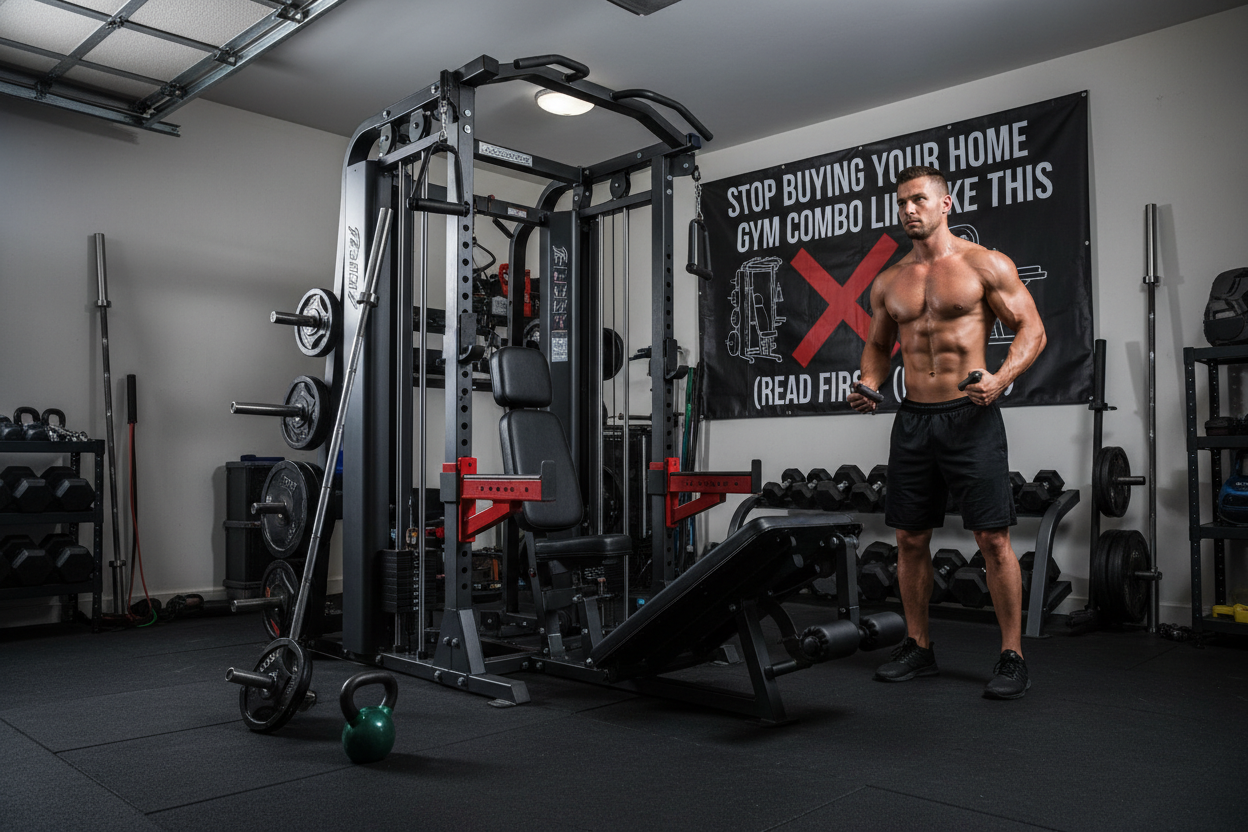
Stop Buying Your Home Gym Combo Like This (Read First)
You have limited square footage. You want maximum output. Naturally, the idea of a home gym combo sounds like the holy grail of garage training. It promises the functionality of a commercial facility packed into the footprint of a single closet.
But here is the hard truth: most all-in-one machines are expensive coat racks in the making. If you buy based on the number of exercises listed on the box rather than the biomechanics of the movement, you will end up with a machine that feels awkward, jerky, and unsafe.
Let’s break down how to select a unit that actually supports heavy training without eating up your entire living space.
Quick Summary: What Matters Most
- The Stability Ratio: If the machine weighs less than the total weight you plan to lift, it will wobble. Look for 11-gauge steel frames.
- Pulley Ratios: Understand the difference between 1:1 and 2:1 ratios. A 2:1 ratio is smoother for isolation work but effectively halves the resistance.
- Footprint vs. Working Space: A machine might be 4 feet deep, but you need an extra 2 feet of clearance for barbell movements or cable flyes.
- Linear Bearings: For any combo weight machine involving a Smith bar, linear bearings are non-negotiable for safety and smoothness.
The Evolution of Combo Gym Equipment
Ten years ago, buying a combo unit meant settling for a flimsy universal machine that used resistance rods or cheap plastic pulleys. The game has changed.
Modern combo gym equipment usually refers to a hybrid structure: a half-rack (for free weight squats/bench), a functional trainer (dual adjustable pulleys), and often a Smith machine integrated into one. This is the gold standard.
Why does this distinction matter? Because isolation exercises build muscle, but compound movements build strength. You need a setup that allows for heavy barbell work without compromising the ability to do high-rep cable finishers. If the unit prevents you from using a standard Olympic barbell, you are capping your strength potential.
Analyzing the "Combo Weight Machine" Mechanics
When you look at a combo weight machine, you need to look past the shiny chrome and inspect the pivot points. The biggest failure point in these units is the cable travel smoothness.
The Drag Factor
Cheap machines use plastic bushings on the weight stack guide rods. When you load the machine heavy, these bushings create friction. You aren't fighting the weight; you're fighting the drag.
This destroys the eccentric (lowering) phase of the lift, which is where the majority of muscle hypertrophy occurs. If the weight stack stutters on the way down, you are losing tension. Always look for machines that utilize sealed ball bearings or high-quality aluminum pulleys.
The 2:1 vs. 1:1 Ratio Trap
This is where marketing tricks you. A manufacturer might advertise a "200lb weight stack." However, if the machine uses a 2:1 pulley ratio (common in functional trainers to increase cable travel length), moving that pin to 200lbs means you are only lifting 100lbs of effective resistance.
If you are a heavy presser or plan on doing lat pulldowns, a 2:1 ratio stack might be too light for you within a year. For heavy pulling movements, a 1:1 ratio or a plate-loaded option is often superior.
My Training Log: Real Talk
I want to share a specific frustration I encountered while testing a mid-range all-in-one trainer last year. On paper, it looked perfect. It had a Smith machine, a rack, and cables.
But the first time I set up for a cable chest flye, I hit a wall—literally and figuratively. The manufacturer had placed the weight stacks too close to the center of the frame to save space. When I stepped forward to get a full stretch in my pecs, the cable ran out of travel length before my arms were fully extended behind me. The weight stack slammed into the top of the carriage mid-rep.
Furthermore, the knurling on the integrated chin-up bar was non-existent. It was a glossy, powder-coated finish. Within ten minutes, my sweat made it so slippery I had to use straps just to hang on. These are the "unpolished" details specs sheets don't tell you. It taught me that working space (cable travel) is just as important as the machine's physical footprint.
Conclusion
Building a home gym is an investment in your longevity. Don't try to save a few dollars on a home gym combo that uses thin steel or plastic pulleys. You want a piece of equipment that feels boringly consistent every time you use it. Focus on stability, cable travel, and standard barbell compatibility, and you will build a physique that rivals any commercial gym goer.
Frequently Asked Questions
1. How much space do I really need for a home gym combo?
While the footprint of the machine might be roughly 4ft x 6ft, you realistically need a 10ft x 10ft area. You must account for the barbell width (7ft) and the space required to step back for lunges or cable extensions.
2. Are combo machines effective for building muscle?
Absolutely, provided they allow for progressive overload. A unit that combines a squat rack with cables covers both mechanical tension (heavy lifting) and metabolic stress (constant tension cable work), the two main drivers of hypertrophy.
3. What maintenance does a combo weight machine require?
Dust the guide rods weekly and lubricate them with 100% silicone lubricant (not WD-40) every 3 to 6 months. Check cables for fraying annually, as a snapped cable under tension is a major safety hazard.