Stop Buying a Water Rower Foldable Until You Read This Guide
You want the hypnotic, meditative swoosh of water resistance, but you don't have a garage the size of an aircraft hangar. I get it. The standard rower footprint is massive. That is exactly why the water rower foldable has surged in popularity recently.
However, combining heavy water tanks with moving hinges creates a unique engineering challenge. If you buy the wrong model, you aren't just getting a workout machine; you're getting a squeaky, wobbly furniture piece that might leak on your hardwood floors. Let's look at the reality of these machines so you can train without regret.
Key Takeaways
- Vertical vs. Hinge: Most "foldable" water rowers actually store upright (vertically) rather than folding in half, preserving rail integrity.
- The Tank Factor: A water rowing machine foldable model requires a sealed tank design that prevents leaks when the orientation changes.
- Structural Trade-off: True folding rails (hinged) save horizontal space but often introduce a "flex" point in the rail that heavier rowers may feel during sprints.
- Maintenance: Hinge points require monthly tightening to prevent wobbling, unlike fixed-frame rowers.
The Engineering Reality: Folding vs. Standing
There is a massive misconception in this market. When we say "foldable," we usually imagine a treadmill deck snapping up. With water rowers, we are usually talking about two distinct designs.
1. The Hinge Fold
This is what most people look for. The rail physically splits in half. This drastically reduces the height of the machine when stored. It is ideal if you need to shove the rower into a closet or under a high bed.
The downside? That hinge is a weak point. If you are rowing at a sub-2:00/500m split and generating serious power, you might feel a slight "buckle" or movement at the seam. It’s not dangerous on high-end models, but it breaks the immersion.
2. The Vertical Stand
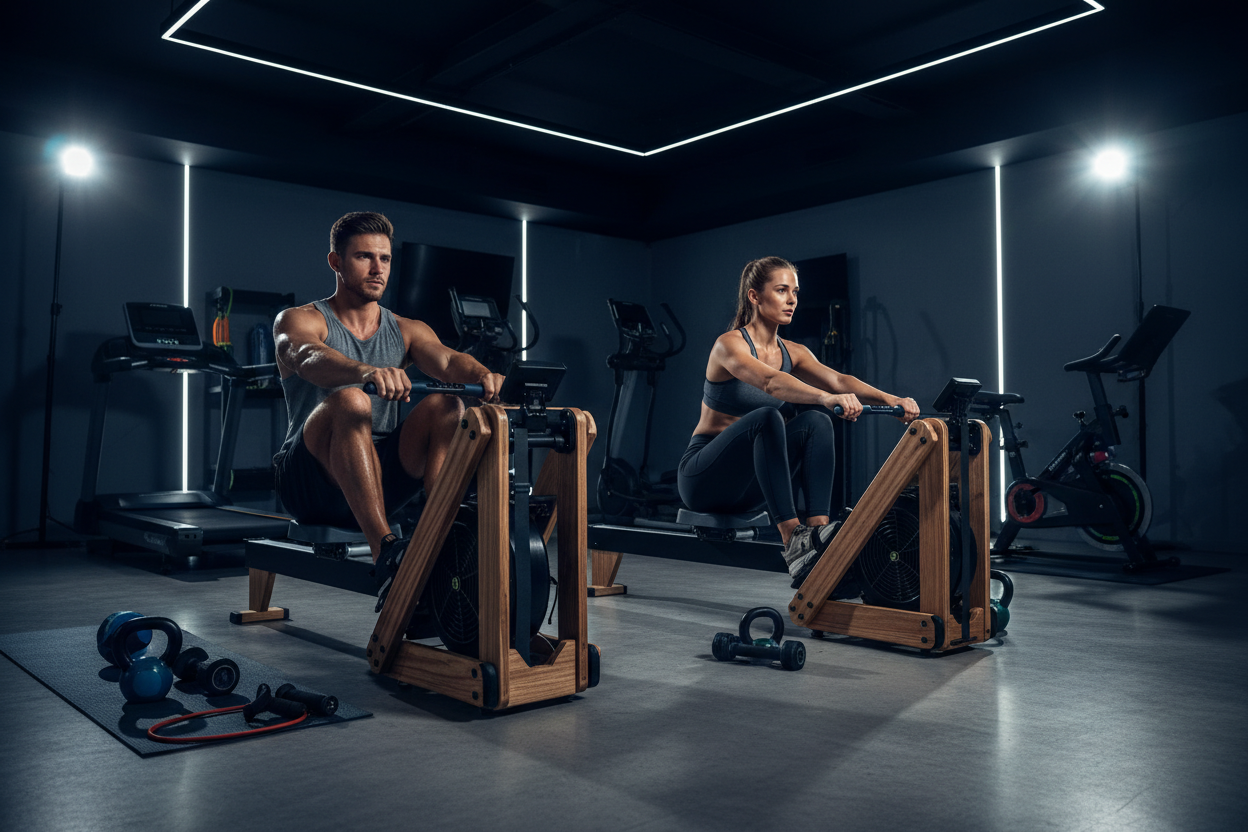
Technically, this isn't folding, but it solves the same problem. Many premium wooden models are designed to be lifted by the back rail and stored vertically on the front wheels. The water stays in the tank.
This offers superior stability because the rail is one solid piece of wood or aluminum. The footprint becomes roughly the size of a dining room chair. Unless you have a strict height restriction in your storage area, the vertical stand is usually the superior choice for durability.
Water Resistance Dynamics in Compact Frames
The primary reason you want a water rower is the variable resistance. The harder you pull, the harder the water fights back. It’s infinite resistance physics.
When manufacturers shrink these machines to make a water rowing machine foldable, they sometimes reduce the tank size to save weight. Be wary of "compact" tanks.
A smaller tank means less water volume, which can result in a "lighter" stroke feeling, even when filled to the max line. Ensure the model you choose retains a standard diameter tank (typically 19-22 inches) to maintain that authentic on-water feel.
The "Leak Anxiety" Is Real
This is the elephant in the room. If you are constantly folding and unfolding a machine filled with 3-5 gallons of water, is it going to leak?
On quality units, the tank is a sealed polycarbonate unit. However, the fill point (the bung) is the vulnerability. On a foldable unit, the fill point must be positioned so that when the machine is vertical, the water line remains below the stopper.
If you overfill the tank past the manufacturer's calibration line, gravity will win when you fold it up. The pressure of the water against the stopper will eventually cause a drip. Respect the fill line religiously.
My Training Log: Real Talk
I want to share something the product manuals never tell you about living with a folding water rower. It’s about the "slosh shift."
I tested a mid-range hinged model last year. The rowing action was fine, but the transition from workout to storage was always a little sketchy. When you lift the rail to fold it, the water in the tank doesn't just sit still; it crashes to the bottom (which becomes the back) of the tank.
This sudden shift in weight changes the center of gravity instantly. The first time I folded it, the weight transfer almost pulled the handle out of my hand and slammed the machine shut. You have to brace yourself and move slowly. Also, there is a very distinct, lingering chlorine-plastic smell that puffs out of the tank stopper when you first unbox and fill it. It takes about three days to dissipate, so don't plan on putting it in your bedroom immediately unless you want to sleep smelling like a public pool.
Conclusion
A water rower foldable is a fantastic solution for apartment dwellers or those with multi-use spaces. It allows you to access elite-level conditioning without sacrificing a permanent 7-foot strip of floor space.
Just remember: if you have the ceiling height, prioritize a solid-frame model that stores vertically. If you must have a hinged model for a closet, inspect the locking mechanism and never overfill the tank. Choose wisely, and your back (and floors) will thank you.
Frequently Asked Questions
Do foldable water rowers leak when stored upright?
They should not leak if the tank plug is secure and the water level is below the maximum fill line. However, overfilling the tank is the number one cause of leaks during storage, as the water presses against the stopper when the angle changes.
Is the resistance different on a foldable water rower compared to a fixed one?
Generally, no. The resistance is generated by the paddle moving through water, which works the same regardless of the frame's folding capability. However, some compact foldable models use smaller tanks, which can limit the maximum resistance ceiling for elite athletes.
What is the weight limit for a hinged water rowing machine?
Most high-quality foldable water rowers support between 265 lbs to 330 lbs (120-150 kg). Hinged models often have slightly lower weight capacities than solid-frame models due to the structural break in the rail.