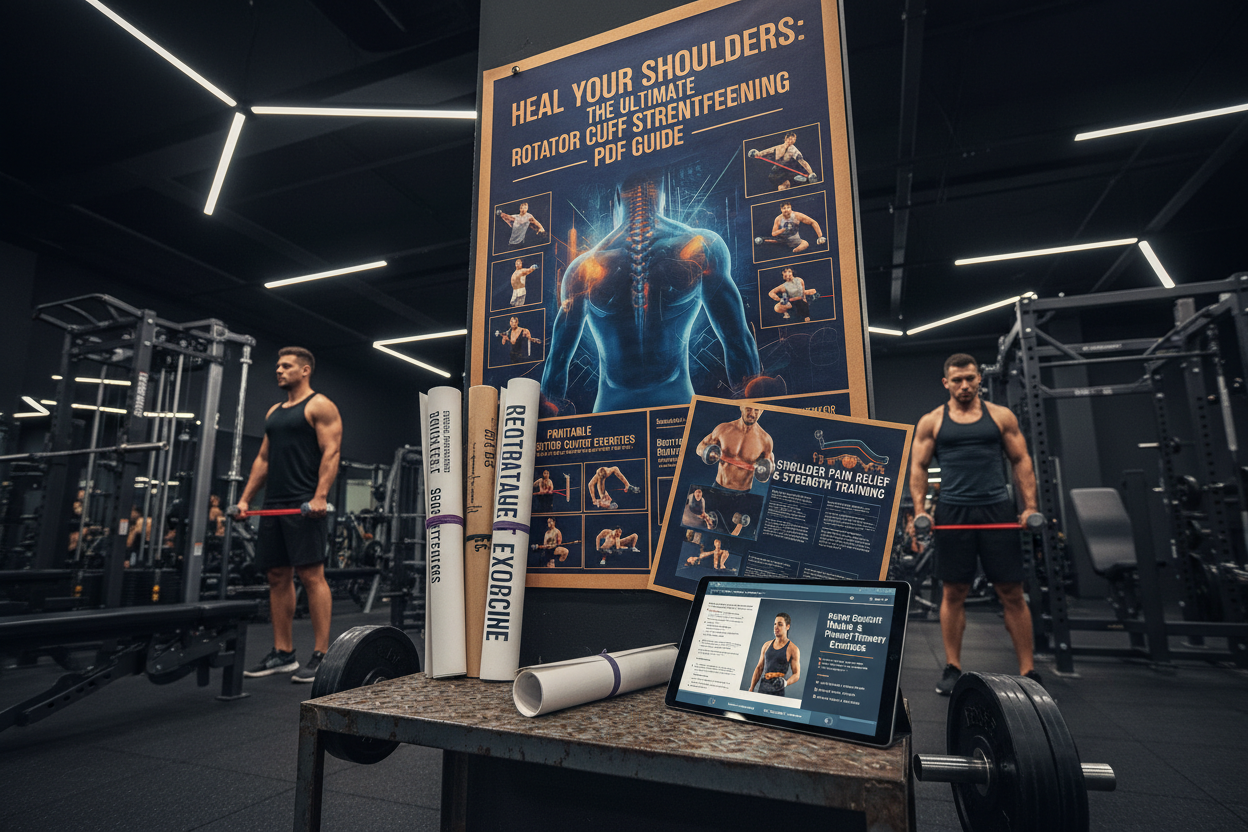
Heal Your Shoulders: The Ultimate Rotator Cuff Strengthening PDF Guide
That familiar click in your shoulder when you reach overhead isn't just noise; it’s a warning light on your body’s dashboard. Whether you are a pitcher, a powerlifter, or someone who spends hours hunched over a keyboard, ignoring the small stabilizer muscles is a recipe for chronic injury. You don't need complex machinery to fix this. You need a structured plan, ideally in a format you can take anywhere, like a printable rotator cuff strengthening exercises pdf.
Video tutorials are great, but fumbling with a phone while lying on a gym mat disrupts your flow. A printed guide allows you to focus entirely on the mind-muscle connection, which is the secret sauce to rehabbing these small, stubborn muscles. This guide breaks down exactly what needs to be on that sheet and how to execute the movements for bulletproof shoulders.
Key Takeaways: The Shoulder Health Checklist
- Consistency Beats Intensity: The rotator cuff responds better to high frequency and low load than heavy weights.
- Positioning is Paramount: Using a towel roll under the armpit during rotations prevents cheating by isolating the joint.
- Balance the Joint: You must train external rotation (back of shoulder) twice as much as internal rotation (front) to counteract modern posture.
- Warm-up vs. Rehab: These exercises serve as both a pre-lift activation and a post-injury rehabilitation protocol.
Why Your Current Routine is Failing Your Shoulders
Most gym-goers treat the shoulder like a simple hinge, blasting the large deltoid muscles with overhead presses while ignoring the cuff. The rotator cuff is a suction cup that keeps the arm bone centered in the socket. If the big muscles (delts/pecs) overpower the small stabilizers (rotator cuff), the joint migrates, leading to impingement.
A well-structured shoulder exercises rotator cuff pdf shouldn't just list movements; it needs to sequence them. You cannot strengthen a muscle that is locked in a spasm. This is why the order of operations—release, stretch, then strengthen—is non-negotiable.
The Core Routine: What’s Inside the Guide
1. The Setup: Scapular Setting
Before moving the arm, you must stabilize the base. Your printed guide should start with scapular retractions. Imagine squeezing a pencil between your shoulder blades without shrugging your ears toward your shoulders. This engages the foundation before you build the house.
2. The Bread and Butter: Side-Lying External Rotation
This is the gold standard. Lying on your side works against gravity in the most effective range of motion. The critical detail here is placing a rolled-up towel between your elbow and your ribcage. Without the towel, you will subconsciously use your deltoid. With the towel, you isolate the infraspinatus and teres minor. If you don't feel a deep burn in the back of the shoulder socket, you are using too much weight.
3. The Forgotten Movement: Prone Y’s and T’s
Lying face down (prone) and lifting your arms into 'Y' and 'T' shapes targets the lower trapezius and the cuff simultaneously. This combats the 'slumped forward' posture that causes most impingement issues. The focus here is not height, but length—reaching your hands as far away from your body as possible.
Mobility Matters: The Cool Down
Strength without mobility creates a stiff, breakable joint. Your routine must conclude with flexibility work. Specifically, an infraspinatus stretch pdf section is vital. This usually involves the 'Sleeper Stretch,' where you lie on the affected side and gently push the forearm down. This targets the posterior capsule, which gets incredibly tight in overhead athletes.
For general relief, incorporating shoulder pain stretches pdf protocols—like the doorway pec stretch and the cross-body stretch—ensures that the tightness in the chest doesn't pull the shoulder back out of alignment immediately after you've strengthened it.
My Training Log: Real Talk
I want to share a specific reality of rehabbing a shoulder because I’ve been there. I used to think I could just memorize the movements from a YouTube video. I was wrong.
I remember vividly lying on the floor of my garage gym, trying to do a side-lying external rotation. I was holding my phone in my left hand to watch the form, while working my right shoulder. It was a disaster. The screen kept dimming, and craning my neck to see the video actually tweaked my levator scapulae (the neck muscle).
That was the moment I switched to paper. I taped a single sheet to the wall at eye level. But here is the gritty detail most people won't tell you: doing these exercises correctly is humbling to the point of embarrassment. I was a guy who could bench press 225 lbs, yet I was physically shaking holding a 2-pound pink dumbbell during external rotations. The 'wobble' isn't weakness leaving the body; it's your nervous system finally figuring out how to fire a muscle that has been asleep for years. If you don't feel that humiliating shake, you probably aren't isolating the muscle correctly.
Conclusion
Shoulder health isn't built on one-rep maxes; it's built on boring, consistent, low-load work. By utilizing a physical reference guide, you remove the friction of technology and ensure your form is perfect every time. Download a reliable guide, tape it to your wall, and respect the small muscles. Your future self will thank you when you can reach overhead without wincing.
Frequently Asked Questions
How often should I perform these exercises?
Unlike heavy lifting, rotator cuff exercises can be performed frequently. For rehabilitation, daily practice is often recommended. for maintenance, aiming for 2-3 times per week, preferably as a warm-up before upper body training, is effective.
Should I feel pain during these movements?
No. Discomfort or a burning sensation in the muscle belly is fine (and expected), but sharp pain in the joint is a red flag. If you feel pinching, stop immediately, reduce the range of motion, or consult a physical therapist.
Do I need heavy weights for this routine?
Absolutely not. The rotator cuff muscles are small stabilizers. Using heavy weights forces the larger deltoid muscles to take over, defeating the purpose of the exercise. Resistance bands or light dumbbells (1-5 lbs) are usually sufficient.