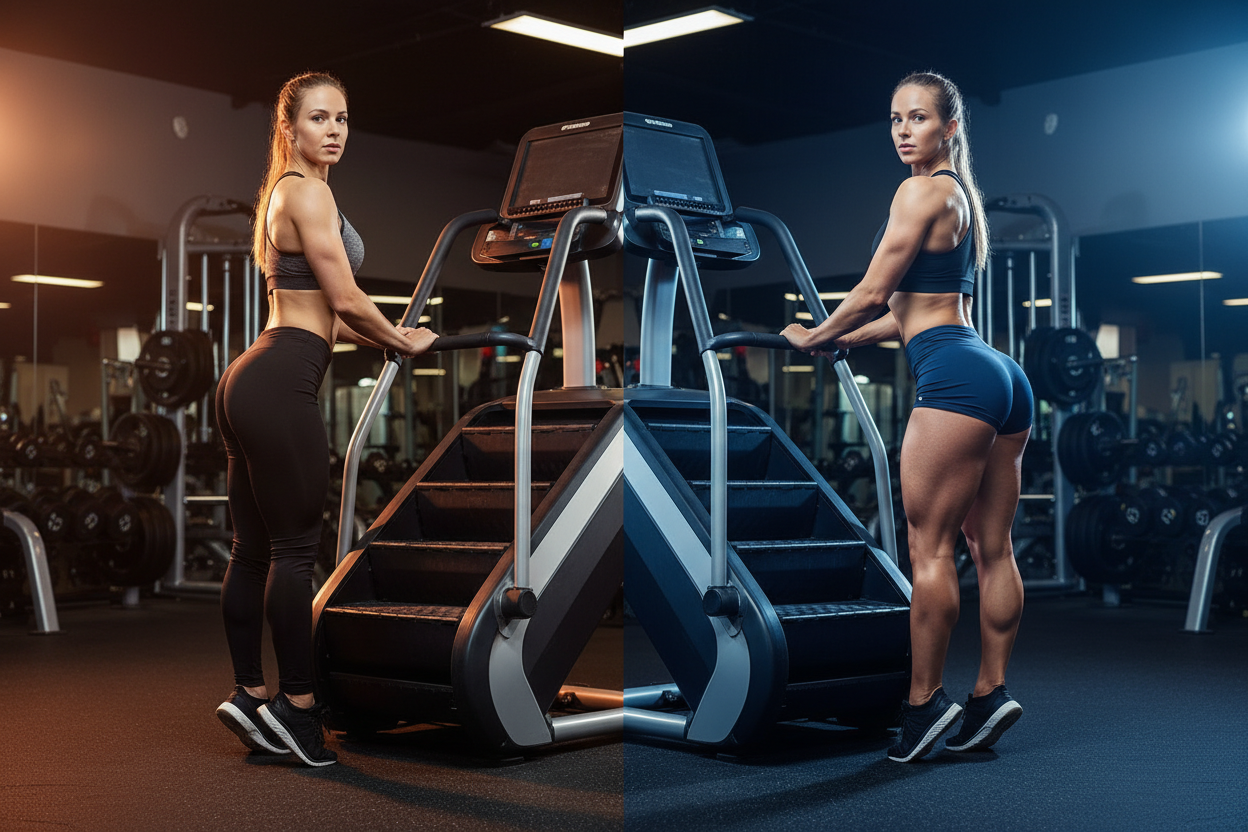
Stairmaster Legs Before and After: The Transformation Truth
You have seen them. The gym-goers drenched in sweat, trudging endlessly on the revolving stairs while clutching the handrails. You are likely wondering if that level of suffering actually translates to visible results. Specifically, you want to know what stairmaster legs before and after results actually look like.
It is the love-hate machine of the fitness world. While it is technically cardio, the resistance suggests it might be something more. Does it build muscle? Does it strip fat? And crucially, how does it fit into a heavy lifting schedule?
Let’s break down the physiology, the timing, and the realistic expectations for your lower body transformation.
Key Takeaways: The Stairmaster Protocol
- Hypertrophy vs. Endurance: The Stairmaster builds muscular endurance and tones the glutes and calves, but it requires high resistance to stimulate significant muscle growth comparable to lifting.
- The "After" Effect: Visible results usually manifest as leaner legs and higher, tighter glutes due to the hip extension movement pattern.
- Timing is Critical: Always prioritize weight training first. Doing the Stairmaster after leg day maximizes fat oxidation without compromising your heavy lifts.
- Not a Replacement: While effective, the Stairmaster cannot replace compound lifts like squats or deadlifts for raw mass building.
The Anatomy of the Transformation
When we talk about the "before and after," we need to manage expectations regarding muscle mass versus muscle definition.
The Stairmaster is unique because it forces you into constant hip extension (pushing the leg back) and knee extension (straightening the leg). This targets the glutes, hamstrings, quadriceps, and calves. However, because there is no eccentric (lowering) phase—you are only stepping up—you experience less muscle damage than you would with squats.
What to expect:
- Glute Density: The constant stepping mimics a lunge pattern, which is fantastic for the gluteus maximus.
- Calf Definition: You are on the balls of your feet for 20+ minutes. The vascularity and separation in the calves usually improve rapidly.
- Fat Loss: It burns a tremendous amount of calories, often revealing the muscle you have already built underneath.
Timing Strategy: Stairmaster Before or After Leg Workout?
This is the most common question I get from clients: should I do stairmaster before or after leg workout? The answer depends entirely on your energy systems.
Why You Should Do Stairmaster After Leg Day
If your goal is hypertrophy (muscle growth) or strength, you must do the stairmaster after leg day. Here is the science: heavy lifting requires glycogen (stored carbohydrates) for explosive energy. If you spend 20 minutes climbing stairs first, you deplete these stores.
When you get to the squat rack, your central nervous system is fatigued, and your stabilizer muscles are tired. This increases injury risk and decreases the weight you can push. Save the stairs for the end as a "finisher" to flush out lactate and burn extra calories.
When to Do It Before
The only time you should do the stairmaster on leg day prior to lifting is for a warm-up. We are talking 5 to 10 minutes at a low intensity. The goal here is simply to raise your core temperature and lubricate the knee joints, not to sweat profusely.
Can Stairmaster Replace Leg Day?
Short answer: No.
Many people ask, is stairmaster a good leg workout to the point where they can skip the weights? While it is a resistance-based cardio exercise, it lacks the progressive overload necessary for significant mass.
Squats and deadlifts apply mechanical tension that the Stairmaster cannot replicate. If you skip weights and only use the stairs, you will get a "runner's physique"—lean and toned—rather than the thick, muscular development associated with bodybuilding. Use the Stairmaster to reveal the legs you built with iron.
Common Mistakes That Kill Progress
Leaning on the Rails
If you are supporting your upper body weight on the console, you are cheating your legs. This reduces the activation of the glutes and hamstrings significantly. Stand tall. If you can't maintain the pace without leaning, slow down.
Doing Too Much Volume
Asking should I do stairmaster after leg day is valid, but asking "should I do 45 minutes after leg day" is dangerous. After a heavy leg session, your recovery capacity is taxed. Limit post-workout stairs to 15–20 minutes to avoid overtraining and cortisol spikes that eat away at muscle tissue.
My Training Log: Real Talk
I want to be transparent about my own experience with the stairmaster legs before and after journey. I used to think more was better. I would grind out 40 minutes before hitting squats, thinking I was "pre-exhausting" the muscle.
The reality? My squat numbers tanked. My knees felt like rusty hinges.
The biggest change happened when I moved the session to the end of the workout. But here is the specific detail nobody mentions: the "jelly wobble." Walking off the machine after a heavy leg day, specifically stepping onto the stationary gym floor, creates a momentary loss of proprioception. My legs felt inflated, heavy, and shaky.
Also, the sweat factor is different. Unlike a treadmill where the wind hits you, on the Stairmaster, you are moving vertically in a stationary pocket of air. The sweat drips directly onto the display or your shoes. I learned the hard way to wear moisture-wicking socks, otherwise, the friction from wet socks inside my lifting shoes caused blisters on the balls of my feet that sidelined me for days.
Once I stopped leaning on the handrails and focused on driving through my heels, the glute soreness the next day was distinct—deeper and more localized than what I felt from squats alone.
Conclusion
The Stairmaster is a tool, not a miracle worker. Used correctly, the "after" photo will show leaner, more defined legs with significant glute development. Used incorrectly, it will just make you tired and weak for your lifts.
Prioritize your heavy compounds, use the stairs as a high-intensity finisher, and keep your posture upright. That is the formula for the legs you want.
Frequently Asked Questions
Is Stairmaster good for leg day finishers?
Absolutely. It is one of the best finishers because it safely fatigues the legs without the risk of dropping a weight on yourself. It flushes blood into the muscles (the pump) and aids in nutrient delivery.
Should I do Stairmaster on rest days?
Yes, this is often better than doing it on leg day. Using the Stairmaster on a separate day allows you to go harder and longer (30–45 minutes) for maximum fat loss without impacting your lifting performance.
Does the Stairmaster build a bigger butt?
It helps shape and lift the butt, but it won't add massive size on its own. It builds the glutes through repetition, but for significant size increases, you need heavy resistance training like hip thrusts and squats.