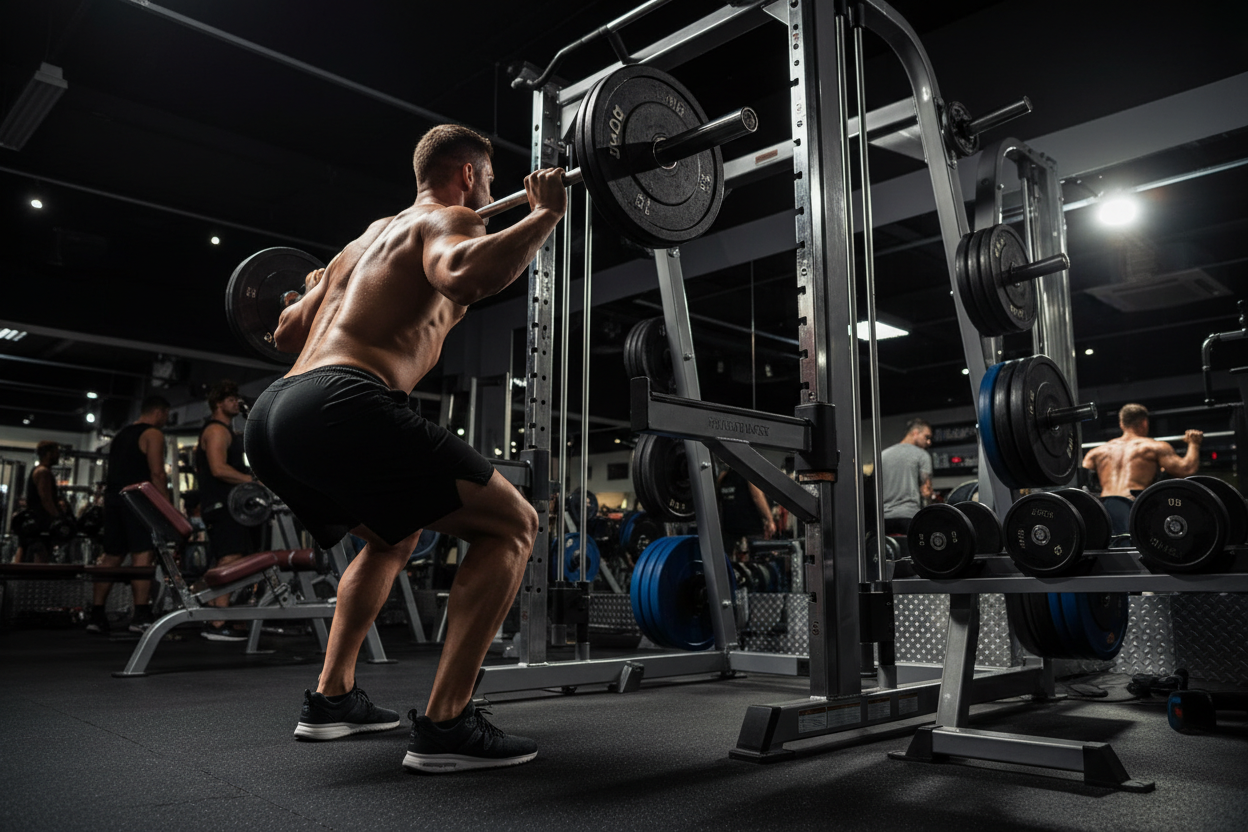
Smith Machine Weight Conversion: The Honest Truth About Your Lifts
You walk into a commercial gym, load up what you think is your working set for a bench press, and suddenly the math doesn't feel right. Either the weight feels suspiciously light, or you are getting crushed by a load you usually handle with ease. This is the confusion surrounding smith machine weight conversion.
The reality is that a plate on a Smith machine does not equal a plate on a barbell. Between counterbalances, friction, and the fixed plane of motion, your numbers are going to skew. If you are trying to track progressive overload or switch between gym chains, you need to know how to translate these numbers accurately.
Key Takeaways: The Conversion Cheat Sheet
- The Bar Weight Varies: Unlike a standard 45-lb (20kg) Olympic barbell, Smith machine bars can weigh anywhere from 15 lbs to 45 lbs depending on the manufacturer.
- Counterbalance Factor: Many machines use pulley systems to counterbalance the bar, effectively making the starting weight near-zero or significantly lighter than it looks.
- The Stability Gap: Because you don't need to stabilize the load, you can generally lift 10-15% more weight on a Smith machine than with free weights.
- Friction Drag: Older machines with un-oiled guide rails can add artificial resistance (drag) on the concentric (upward) phase and reduce load on the eccentric (downward) phase.
The Starting Point: How Much Does the Bar Actually Weigh?
This is the most common variable that throws off your smith machine conversion math. In the free weight area, a standard bar is almost always 45 lbs. In the machine section, it is the Wild West.
The Counterbalanced Bar
If you look at the top of the Smith machine frame and see cables running from the bar up to a weight stack hidden inside the columns, you are using a counterbalanced machine. Manufacturers do this so the bar stays in place when unclamped, making it safer for beginners.
On these machines, the bar usually offers 15 to 20 lbs of resistance. If you are calculating your total volume assuming a 45-lb bar, you are inflating your numbers by 25-30 lbs per rep.
The Non-Counterbalanced Bar
These are simpler setups often found in older gyms or bodybuilding-focused centers. There are no cables, just the bar sliding on rails. These bars are typically closer to standard weight, usually ranging from 30 to 45 lbs. However, the hook system and bearings often make them slightly lighter than a true Olympic bar.
The Stability Factor: Smith Machine to Barbell Conversion
Even if you know the exact weight of the bar, 200 lbs on a Smith machine is not the same as 200 lbs on a barbell. The guide rails eliminate the need for your stabilizer muscles to fire. You don't have to balance the weight; you just have to push it.
The General Conversion Rule:
- Smith to Free Weights: Expect your strength to drop by roughly 10% to 15%. If you bench 225 lbs on the Smith, your free weight max is likely closer to 190-200 lbs.
- Free Weights to Smith: You can typically add 10-15% to your load. This is why the Smith machine is excellent for overloading the prime movers (pecs, quads) without stability being the limiting factor.
The Angle of Attack
Not all Smith machines are vertical. Many commercial gyms (like Planet Fitness or LA Fitness) use angled machines, usually set at a 7 to 12-degree incline. This changes the physics of the lift.
When performing a smith machine to barbell conversion on an angled unit, the vector of force isn't purely vertical. If you are bench pressing, you are pushing slightly up and back. This mechanical advantage can make the weight feel lighter, further widening the gap between your machine numbers and your free weight reality.
My Training Log: Real Talk
I learned the hard way that you cannot take your Smith machine numbers to a powerlifting meet. A few years ago, I was training at a hotel gym for two weeks that only had a counterbalanced Smith machine. I was hitting "PRs" on my overhead press, feeling like absolute royalty. The movement felt smooth, almost like the bar was floating.
When I got back to my home gym, I loaded up a standard barbell with that same weight. I didn't just fail the rep; I barely got it off my clavicles. The specific detail I noticed wasn't just the weight—it was the wobble. On the Smith machine, I had zero lateral instability. On the free weight press, my wrists and shoulders were shaking trying to find the groove. I also missed the "gritty" friction of the Smith machine rails which, I realized later, actually helped me control the descent. Realizing I was 20 pounds weaker than I thought was a humbling check on my ego.
Conclusion
The Smith machine is a fantastic tool for hypertrophy and rehabilitation, but it is a liar when it comes to strength standards. To get an accurate smith machine weight conversion, assume the bar is lighter than you think and acknowledge that the stability rails are helping you lift heavier. Use the machine to build muscle, but don't trust the math until you verify it with a standard barbell.
Frequently Asked Questions
How do I know exactly how much the Smith machine bar weighs?
The most accurate method is the "scale test." Bring a portable luggage scale or use a bathroom scale if the gym allows. Place it under the bar and lower the bar onto it. If that isn't an option, look for a sticker from the manufacturer on the side of the frame; many modern machines list the "starting resistance" clearly.
Is a 225 lb squat on a Smith machine the same as a barbell squat?
No. A 225 lb squat on a Smith machine is generally easier because you do not have to stabilize the load or maintain a perfect center of gravity. Most lifters find their free weight squat is significantly lower than their Smith machine squat due to the involvement of the core and stabilizer muscles.
Does the Smith machine kill gains?
Absolutely not. While it isn't ideal for functional strength or powerlifting specificity, it is excellent for hypertrophy (muscle growth). The stability allows you to safely push muscles to failure without worrying about dropping a loaded barbell on yourself.